Gypsy music - Mesmerised by Magyar melodies
Forget the stereotypical images of Gypsy culture – it's about time we acknowledged the lasting contribution that the Roma have made to classical music, says Jessica Duchen
As the latest hot-air balloon of a wedding dress spread out across the screen, I couldn't quite join in the nation's gasps. My goodness, don't we love the mystique of Gypsy life?
The Channel 4 series My Big Fat Gypsy Wedding had everyone riveted, principally by the degree of flamboyance that it claimed to find within this most self-contained of communities. A flood of letters to newspapers and websites followed from the community itself, protesting that yet again they had been misunderstood and misrepresented. Beyond the small screen, the Roma and Travellers are still the victims of all manner of prejudice and discrimination. A moment in the original documentary, when a wedding venue refused to allow a family to book in because they were Travellers, did capture a hint of what they're up against.
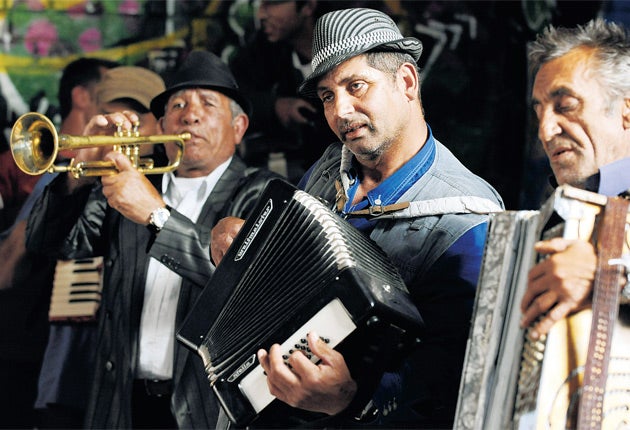
But the area in which the Roma have made a great impact on Western culture is, of course, music. From Haydn's chamber works to today's Romanian superstar band Taraf de Haidouks, the sounds of Gypsy music have spread to an astonishing degree, whether lurking just beneath the genteel surface of a string quartet or metaphorically blasting out the ceiling with the manic, full-on energy of a true Gypsy band in full flood. In that music there seems to lie a magnetic sense of emotional release. The illusion of freedom, the perceived ability to shake off the shackles both without and within, is what magnetises us.
Not that classical composers' response to Gypsy culture is precisely free from prejudice. My Big Fat Gypsy Wedding proved how a preoccupation with superficial perceptions can make us miss the deeper essence, and with it, its value. You can find this misrepresentation in music too. Where would opera be without Bizet's Carmen or the Gypsy scenes of Verdi's Il Trovatore? But while Carmen has a certain psychological acuity, Il Trovatore is a travesty, its lurid representations typical of the 19th-century's prejudiced fascination of horror.
Johannes Brahms's attitude to Gypsy culture was more positive, though not desperately enlightened: he lifted passages wholesale from café bands for his Hungarian Dances, failing to recognise that someone else might actually have composed the melodies, hence landing himself with accusations of plagiarism. Franz Liszt, this year's big bicentenary composer, set out in a new way to glorify the Gypsy music of his native Hungary. Thanks to his espousal, it was eventually Gypsy music that the world came to think of as typically Hungarian. It was partly a wish to distinguish the sounds of "real" Hungarian folk song that later inspired Bartók and Kodály to set off across the Transylvanian countryside to record its traditional music.
But all the way through, it's the big fat Gypsy fiddle that remains central to Hungarian Gypsy music and seems to hold the key to its heart. Liszt was famously inspired by hearing the violinist Niccolo Paganini in recital, but he also encountered a Gypsy violinist equally legendary in his field: János Bihari. The great Gypsy violin virtuosi have often been capable of playing classical soloists under the table, so to speak. Jascha Heifetz, perhaps the greatest violinist of the 20th century, is said to have claimed that the finest violinist he ever heard was Grigoras Dinicu, the Romanian Gypsy musician whose Hora Staccato and The Lark are still concert favourites today.
Yet Gypsy music is not all about virtuosity – nor even primarily about it. Improvisation is crucial, the ability to create spontaneous music, something that eludes many classical performers who often remain inhibited by their rigorous training. And just as important is the element of heart and soul that infuses the music and its performance. The sweetness of tone, the gentle swoops and sensual slides that we associate with the violinist Stéphane Grappelli's Gypsy jazz style, is vital; and there's a special flexibility in the rhythm, a particular sense of rubato (the give and take that balances out slowing down and speeding up). The razzle-dazzle of Gypsy virtuosity is in some ways the musical equivalent of those acres of white tulle in the wedding dresses shown so avidly on TV: the illusory tip of the iceberg.
Further into the 20th century, composers grew more eager to dig into the deeper essence of Gypsy style. George Enescu, the Romanian composer, violinist and pianist, created an entire sonata (his Violin Sonata No 3) based upon it. In Paris, Debussy was enchanted by a Gypsy band in a hotel restaurant and wrote a piece inspired by them: the elusive, slightly louche waltz, La Plus Que Lente, the challenges of which are not about brilliance, but lie in the subtlety of its rhythms. As for Ravel, an encounter with the Hungarian violinist Jelly d'Arányi, who played him Gypsy music she remembered from her childhood in Budapest, inspired him to write his Tzigane, in which he not only conjured up a trance-like mystery and ecstasy, but also responded in detail to the rhythmic quirks, the characteristic bowing and the exceptional eloquence of the style.
Today, of course, with recordings and easy travel, we have the real thing. The phenomenal violinist Roby Lakatos – a descendent of Janos Bihari – is probably the most celebrated of today's Gypsy performers and has joined up traditional songs with elements of modern jazz and also with classical orchestras. Meanwhile, Taraf de Haidouks tour all over the world and has appeared in a number of films. These are just the most famous examples of a rich, vigorous and still-evolving tradition.
It was partly a fascination with the impact of Gypsy violin music on classical that inspired my novel Hungarian Dances. And since the violinist Philippe Graffin made a CD to match it, a concert version of the book has somehow refused to go away. With the violinist and leader of the Northern Sinfonia, Bradley Creswick, and the pianist Margaret Fingerhut, we follow the story with music ranging from wild Dinicu numbers like The Lark to the sophistication of Debussy and Ravel. But it's Ernö von Dohnányi's Andante Rubato alla Zingaresca that I think holds the essence of the real thing and our response to it: that shivering, flexible, mesmeric magic and the intangible longing for a heart deeper and wilder than our own. White tulle is nowhere to be seen.
Hungarian Dances, starring Bradley Creswick (violin) and Margaret Fingerhut (piano), with readings by Jessica Duchen: Potton Hall, Suffolk (01728 648265) 18 March; Old Swinford Hospital, Stourbridge (01384 817316) 22 March
Join our commenting forum
Join thought-provoking conversations, follow other Independent readers and see their replies
Comments
Bookmark popover
Removed from bookmarks