Joyce DiDonato - A diva with joie de vivre
The irrepressible mezzo soprano Joyce DiDonato didn't let a broken leg upstage her at the Royal Opera House this summer. She talks to Jessica Duchen
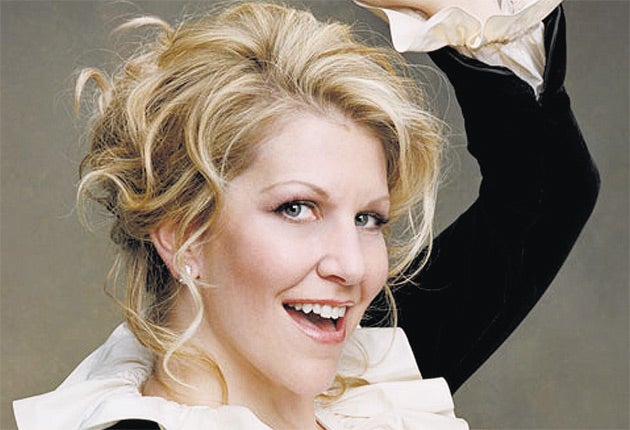
Joyce DiDonato greets me with a gigantic smile, although you might expect the rest of her to belie it: the American diva is confined to a wheelchair with her leg in a bright pink plaster cast. Her fall on stage during the first night of Rossini's Il Barbiere di Siviglia at the Royal Opera House in July has shot into the realms of operatic legend. She'd sung to the end of the show despite the pain, then made for hospital, where she learned that she had not only injured her leg, but broken it. One wheel sports a pink paper flower to match the plaster: a signal of how she turned disaster into triumph by integrating the wheelchair into her portrayal of the opera's wilful heroine, Rosina.
"All this pink is not necessarily my taste," she comments, "but I think it's definitely Rosina's!" The wheelchair, she adds, works quite well as a metaphor: Rosina feels trapped and is determined to break free of her confines. "After all, there's no point pretending I'm not in a wheelchair, and if we tried to ignore that, it would make the audience uncomfortable. It's better to have fun with it."
But how can you have fun when you've just broken your leg on stage? It's amazing what adrenalin and sheer willpower can do, DiDonato suggests. "I think the body is an unbelievable, miraculous thing. First, the adrenalin takes over and you don't feel the pain as acutely as you might in a less panicky situation.
"My mind just went into another compartment. Luckily, my body knows what it's doing in terms of singing, so I wasn't worrying about that, but I was concerned about the staging, wondering how I could get from point A to point B and what I could leave out. In the storm scene, I have to pull down the wiring and wreck the harpsichord, and it's vital for the later scenes that that happens, so I had to find a way. The good thing was that I wasn't nervous about my opening night at Covent Garden because I was nervous about this instead.
"People have told me that they don't know any other singer who would have kept going – but nobody thinks they can do something until they're actually in that situation. I would never have imagined that I could have sung on a broken bone, but when you're in that zone you do what you have to do. Besides," she adds, "I've never broken a bone before, so now I can cross that off my 'To Do' list!"
DiDonato, in her vocal prime at 40, is one of today's best-loved mezzos. Her ever-positive attitude and irrepressible joie de vivre feed straight into her performing, whether in the coloratura curlicues of Rossini and bel canto opera, the baroque extravaganzas of Handel, the high drama of Berlioz and Strauss, or the contemporary operas by Tod Machover, Michael Daugherty, Mark Adamo and others in which she has starred.
A few weeks ago, she brought the house down at the Proms in a Handel and Haydn anniversary programme with the Orchestra of the Age of Enlightenment. Next season, besides "getting back on my feet and into my yoga regime", as she says, she'll be back in London for two Wigmore Hall recitals (26 and 28 January). Elsewhere, she will be tackling Rossini's La Donna del Lago for the first time, "revisiting Rosina" and performing Cherubino in Mozart's Le Nozze di Figaro in Chicago – and she loves trouser roles like this one. "I enjoy wearing dresses – though heels perhaps not so much any more," she remarks, with a glance at her trussed-up leg. "But these trouser roles are extraordinary – what trousers! There's no greater joy than discovering the development of a character like Cherubino."
The entire operatic scene seems a long way from where DiDonato started out, in the American Midwest where she was determined to become an inner-city school music teacher. She was born Joyce Flaherty into an Irish-American family in Kansas – also the home of Dorothy in The Wizard of Oz: "That's me," DiDonato laughs, "somewhere over the rainbow!" She still lives there with her second husband, the Italian conductor Leonardo Vordoni, though professionally she has retained her first married surname.
Her first experiences of singing involved the church choir and high-school musicals. "I grew up in a reasonably musical family – my father was choir director at the local church," she recounts. "And I had a wonderful choir teacher at high school who inspired me to go into music education. I didn't love opera, I didn't understand what it was about, but I loved classical music and choral musicin particular, and funnily enough at university [Wichita State] they gave me extra scholarship money first to join the choir and then to join the opera. I thought: 'How hard can it be? Let's start singing!'"
Nevertheless, her decision to move away from teaching to sing professionally involved much reflection. "I did student teaching in some very poor inner-city schools in Wichita," she says, "and I was worried about how I could go into opera and enjoy myself so much when there's such a need for good teachers." She discussed the issue with her father. "He said: 'You know, there's more than one way to educate, touch and communicate with people.' That advice has always been the wind behind my back."
When she took on her first solo role, the Mother in Hänsel und Gretel, she knew she had found herself. "I was hooked! This profession incorporated everything I loved. You need the intellect to interpret a score, plus the musicality to do it, and there's also something spiritual involved that is not always easy to articulate, but is definitely present and requires you to access it. It was the most challenging, rewarding, astonishing thing I'd ever done." Since then, there's been no turning back.
Her forthcoming CD also involves much to challenge, reward and astonish. It explores the roles that Rossini modelled on one singer: his wife, Isabella Colbran. "She was not a Rosina or a Cenerentola: she was a very fiery Spanish diva," DiDonato says, "and he created nine of his biggest opera seria dramatic heroines for her. It was fascinating to try to enter the mind of a composer and see how he wrote for one person, not just a singer he liked, but the woman he loved and married."
When Colbran's voice began to deteriorate, Rossini altered his approach to show her abilities to best advantage. DiDonato says she's struck by the care and passion with which the composer thought through roles such as Armida, La Donna del Lago and Desdemona (in his Otello, which long predated Verdi's). As Colbran was slow to warm up, he wrote no big entrance arias for her; instead, he kept the best for last. "Armida has an incredible finale in which she experiences an intense inner conflict between vengeance and love, and she ends up vowing to destroy the world," says DiDonato. "It's the most extraordinary scene with tom-toms and percussion – as far from "usual" Rossini you can imagine. Too often we dismiss Rossini as a fluffy, light-hearted affair. This is totally different."
Another completely different activity is DiDonato's blog, Yankeediva, which has become a firm favourite of the blogosphere. "I was told I needed a website, but I didn't want a static biography just saying I did this or that role," she says. "I wanted something personal that would make it my own. I started by writing some quirky captions for photos; then it turned into a journal that I'd write every couple of weeks. I've always enjoyed writing, but it also scratches the educator itch in me.
"What I love most about performing is the fact that someone might write to me and say I've made them think about or feel something in a different way. Writing the blog is another means to open people's eyes to what I think about the processes involved in performing and music-making. It's a chance to communicate something that I can't communicate while I'm singing." Her eyes sparkle: "Not everybody wants to know that, of course. But they don't have to read it!"
And with that, she's ready to speed away down the corridor to her next appointment. There's no question that that wheelchair is in the fast lane, pink flower and all. Just don't ever wish her luck by telling her to "break a leg".
Joyce DiDonato's CD ' Rossini: Colbran, the Muse' will be out next month on Virgin Classics
Join our commenting forum
Join thought-provoking conversations, follow other Independent readers and see their replies
Comments
Bookmark popover
Removed from bookmarks