Kit Armstrong: Playing by numbers
Maths, topology, computer games, origami...oh yes, and music. Michael Church on the many talents of a piano prodigy who has come of age
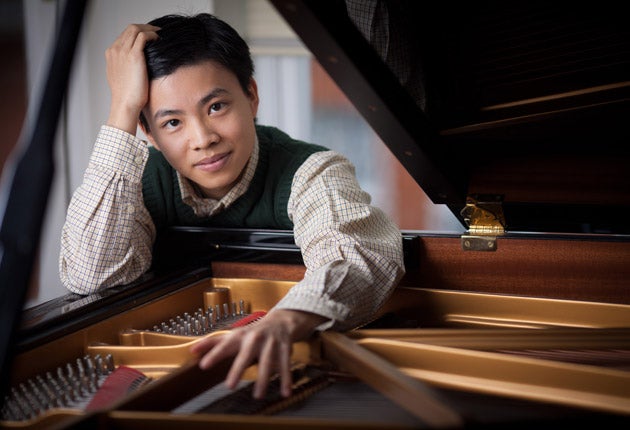
When 18-year-old Kit Armstrong makes his Royal Festival Hall debut tonight, a secret long in gestation will be revealed. If his past form is anything to go by, Armstrong's account of Beethoven's third piano concerto will exude a relaxed and expressive authority, and the critics will hail a budding new member of the pianistic pantheon.
But that's only one of this British-Taiwanese youth's precocious accomplishments. Even if he couldn't play a note, the intricate music he writes for piano and chamber ensemble would mark him out as a composer to watch. Meanwhile his research in algebraic geometry and topology has taken him way past PhD level. In a lighter vein – though he regards it as speculative mathematics, not mere fun – he creates the most elaborately complex origami: making a flying rhino from folded paper (without cuts and glue) would tax a Japanese master of that art. Armstrong does regard the computer games he creates as a hobby as frivolous, but he's as ferociously competitive an online gamer as he is on the tennis court. Yet to meet this diminutive, bright-eyed, forcefully humorous creature, you'd say 14 rather than 18, and quite possibly from another planet.
That wasn't what Alfred Brendel said when he first heard Kit play at 13: what the Olympian pianist heard was a born Bach player, and he's been devotedly coaching him ever since. That wasn't what Benjamin Kaplan, Kit's tutor at the Royal Academy, thought when he watched his 11-year-old pupil learn a formidable eight-page Debussy piece by heart in 45 minutes, without touching the piano. "I don't like bandying the word genius around," says Kaplan, "but this was much more than mere talent."
I first heard Kit play Beethoven at the Academy at a time when his hands could barely stretch an octave, and though just 13 his musical wisdom seemed fully formed. This boy with a wide smile and luminous gaze was living with his mother May, an economist, in a flat between the Academy and Imperial College in central London, where he was just completing his undergraduate maths course.
The talent that revealed itself before his first birthday, May explained, was mathematical. "If he was asleep and needed waking up, all I had to do was give him a maths problem. He was so smart that I decided to give him an electronic keyboard as a hobby, and he began composing at five."
Kit's own account was forensically precise: "I composed monophonic music, just one single line of notes, not even particularly melodious. And at one point, I realised I had to make it sound good. Then we got a piano, and I started to write melodies with harmonies. I began to figure out which chord would like to be followed by which other chord. I worked out my own primitive version of harmony, and theory, and voice leading."
At seven, he became the youngest maths student at Chapman University in California. At nine, he was a full-time undergraduate, with his musical creation keeping pace. Some of the pieces he composed at seven are Bachian, others are Bartokian; he transcribed Mozart symphonies for his own two-finger piano rendition, before being taught to play properly. But in our interview five years ago, even at 13, there was a seamless continuity between the often philosophical nature of his discourse, and the delight with which he brought out his origami chickens, and showed me his skill at juggling.
Last summer, I ran into him at the glitzy Verbier Festival in Switzerland, where he was heading a chamber group and giving a solo recital of works by Bach, Debussy, Beethoven, and himself. His Bach and Beethoven were majestic, and his own works had a playful translucence, but the Debussy pieces were shorn of magic. We talked about this, and he said he intended to show these works were "almost mathematically" constructed. "I played them in a thought-oriented way, instead of a sound-oriented way."
This led him to discuss the difference between thought and sound in music, and to express the hope that one day he might be able to use mathematics to throw light on music's mysteries. But for now, he said, he no longer tried to play "in a moderate way which nobody could criticise". And, in his American college-boy way, he likes to provoke. "The concert hall in Dortmund has asked me to create an origami rhino with wings, which is its symbol. I've just given them the plan to make it, if they can figure out how."
He was recently commissioned to write a piece for the Austrian pianist Till Fellner: "It's supposed to sound more difficult to play than it is, but I may make it the opposite." Gratuitous sadism? "That is the composer's possibility, and also his delight." The mischievous grin prompts me to ask which composers he does not like. Quick as a flash: "Much of Tchaikovsky is unpleasant to me." Why? "It's hopelessly overblown. And I have yet to appreciate Mahler. I have a problem in general with late Romantic music. I don't like swimming in music. I don't like being sucked in." This is exactly what many people require from music, but it contravenes all the rules in Kit Armstrong's pellucid world: this urge to control suggests some mellowing is needed.
He has a problem with music that crosses the boundary into noise, citing parts of Stravinsky's Rite of Spring as offenders here. Doesn't this exclude much of what modern composers are doing, and incidentally line him up with Middle England? He quotes the psychologist Steven Pinker's view that music is auditory cheesecake. Armstrong goes on to say: "Every chef knows that a cheesecake is a work of art to be enjoyed, rather than something which must be 'interesting'."
Last week, I caught him in London after a lesson with Brendel, preparing for tonight. What did they focus on? After a grave disquisition on music history from medieval to Baroque polyphony, he said a lot of time was spent on one chord in the slow movement, which needed a specific "shroud of colour". Then he demonstrated on his Steinway: a brief snatch, but beautiful.
An engaging film by Mark Kidel is soon to be released under the title Set The Piano Stool On Fire. It follows a year in the relationship between these two remarkable musicians, the elder regarding the younger with wonder. "He must keep his childlike quality," says Brendel at one point, and it's pretty clear Kit Armstrong will. He's an extraordinary amalgam, evoking protectiveness in everyone he meets, yet also being tough as nails ("idiot" is his preferred term of abuse). Exotic yet worldly, ultra-refined yet not rarefied, this very likeable young meteor will certainly need to be tough when his current support systems are no longer in place. But it will be a privilege to watch his trajectory through life.
Kit Armstrong performs tonight with the Philharmonia Orchestra, Royal Festival Hall, London SE1 (southbankcentre.co.uk)
Join our commenting forum
Join thought-provoking conversations, follow other Independent readers and see their replies
Comments
Bookmark popover
Removed from bookmarks