The divo leaves the stage
José Carreras has announced his retirement from opera. It marks the end of a glorious career as one of the greatest tenors of our age
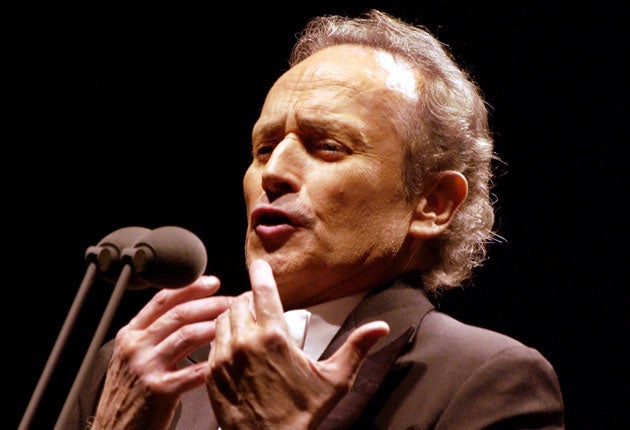
In a poll taken by Classic FM and Radio Times last year, José Carreras came a surprising eighth in the search to find the Nation's Favourite Male Singer of all time. The other two who made up the phenomenon known as the Three Tenors didn't fare that much better. Plácido Domingo came fifth and Luciano Pavarotti, who had died a year earlier, fourth. It was Russell Watson who came first.
What different results such a survey would have drawn back in the 1990s following those singers' eager participation in Italia 90. A benefit concert at Rome's Baths of Caracalla was watched by more than a billion viewers on the eve of the World Cup and enjoyed by many more on the best-selling classical album ever. The three quickly became the world's favourite male opera singers of all time. We are lucky to have had them around at the same time.
Now the 62-year-old Carreras has, not unexpectedly, announced his retirement from opera with its exacting and gruelling claims on a singer's whole life. Concerts are an altogether less stressful affair and, besides, apart from the attractive possibility of discreet amplification, it's easy enough to adapt recital repertoire to suit an inevitably diminishing range or less robust technique. Carreras was always the most sensitive, sweet-toned element of the Three Tenors. Picked out for the extraordinary sensuous beauty of his voice on his debut as Pinkerton in Madame Butterfly in New York in 1972, Carreras set off on a career which would circle the globe and dominate the recording studios, attracting the more discerning fans for his lyrical brilliance and beguiling combination of passion and taste.
With his obvious musical intelligence, the slightly older Domingo – now returning to the baritone register with which he began his career – had the authority, while Pavarotti thrilled with his almost animal vocal instinct and Italianiate swagger. When the Three Tenors got together Carreras was slightly the outsider. Not for nothing, in the TV series, did Seinfeld and his pals remember the names of Pavarotti and Domingo but keep forgetting the name Carreras, referring to him simply as "the other guy".
Two years before the Three Tenors debut, Carreras had drawn 150,000 people to an open-air concert in his native Barcelona. (In the same venue Michael Jackson had just attracted a mere 90,000.) But this event was special for the tenor. It marked the return of Carreras to the public platform following his recovery from a knife-edge encounter with acute lymphocytic leukaemia from which he was given a one in 10 chance of survival.
Until then, the young Catalonian – who included among his heroes Mario Lanza and Enrico Caruso – was gradually challenging the tenorial supremacy of Pavarotti and Domingo. During their 10-year collaboration Herbert von Karajan described Carreras as "my favourite tenor", while the soprano Montserrat Caballé – who had spotted the honeyed quality of his voice on his operatic debut in Barcelona when Carreras was just 18 and shared the platform with him on his London debut in 1971 – had become an invaluable artistic mentor.
Forced by illness to abandon temporarily the stage and concert platform, "the other guy" immediately assumed a centre-stage position in the hearts and minds of an international musical public. From Barcelona to a cancer centre in Seattle he was followed by 10,000 messages of support. "I felt that I couldn't disappoint all these people," he said, "so I played the tough one." And tough he certainly was, requesting only a partial anaesthetic during surgery to minimise any possible damage to his throat by tubes. Chemotherapy, radiation and the painful extraction of bone marrow from his hip followed. His hair falling out, his nails dropping off, he grew emaciated in an isolation chamber. During it all, in his head, he sang. And not only did he survive that awful year, he returned, greyer around the temples but in no less lustrous a voice, to a career that demands so much physically as well as emotionally. Still the born communicator, still dark-hued in sound, still retaining an innate dramatic ability – though often pale, with deep circles under his eyes – Carreras resumed his career with a gusto and gratitude to be alive at all.
Yet not even the tremendous ovations by rapturous audiences that greeted his return turned him into a divo. Where others like to bask in the adulation following a high-profile performance, Carreras, like Macavity, is never there. Sauve and slightly enigmatic, he comes across as sincere and thoughtful, considering his words carefully in interviews and never slagging off the competition. Intensely private, he has had a complex love life. He and his wife Mercedes, whom he married in 1971, divorced in 1992. But by then the woman for whom he had given up a 13-year relationship with Italian soprano Katia Ricciarelli had tired of waiting and had married someone else. Not until 2006, by which time she had borne her husband three children, was Carreras able to marry Jutta Jäger.
If his illness changed him it was to add a considerable dimension to his life outside music in the formation of the José Carreras International Leukaemia Foundation which invests in scientific research as well as matching organ donors with patients and offering practical support. Appropriately, since he also excelled in sport, he was musical director for the official celebrations for the 1992 Barcelona Olympics.
Supposing I had to pick just one recording from his vast discography by which to remember Carreras, it wouldn't be the lovely though soft-focused Neapolitan repertoire in which he has recently immersed himself. Neither would it be any of the many Verdi operas he has recorded, especially the earlier ones where age and too many heavy roles hadn't tarnished his exemplary tonal colour and eloquent urgency. And it certainly wouldn't be his ill-advised portrayal of Tony in West Side Story opposite Kiri Te Kanawa's Maria, for, sympathetic though he tries to be, Carreras struggles with the words and comes across as wooden.
It would be his 1976 recording of Puccini's Tosca with Caballé in the title role. As a radiant and ardent Cavaradossi, especially secure in the resonant middle range of his voice, Carreras is surely unmatched as the most subtly expressive tenor voice of our time. And that will be recognised when he accepts a Lifetime Achievement award at the Classical Brits on 14 May at the Royal Albert Hall.
Join our commenting forum
Join thought-provoking conversations, follow other Independent readers and see their replies
Comments
Bookmark popover
Removed from bookmarks