'World's bravest orchestra' defies the bombers
Next week, young Iraqi musicians make their international concert debut in Britain. Paul Bignell reports on the obstacles they faced
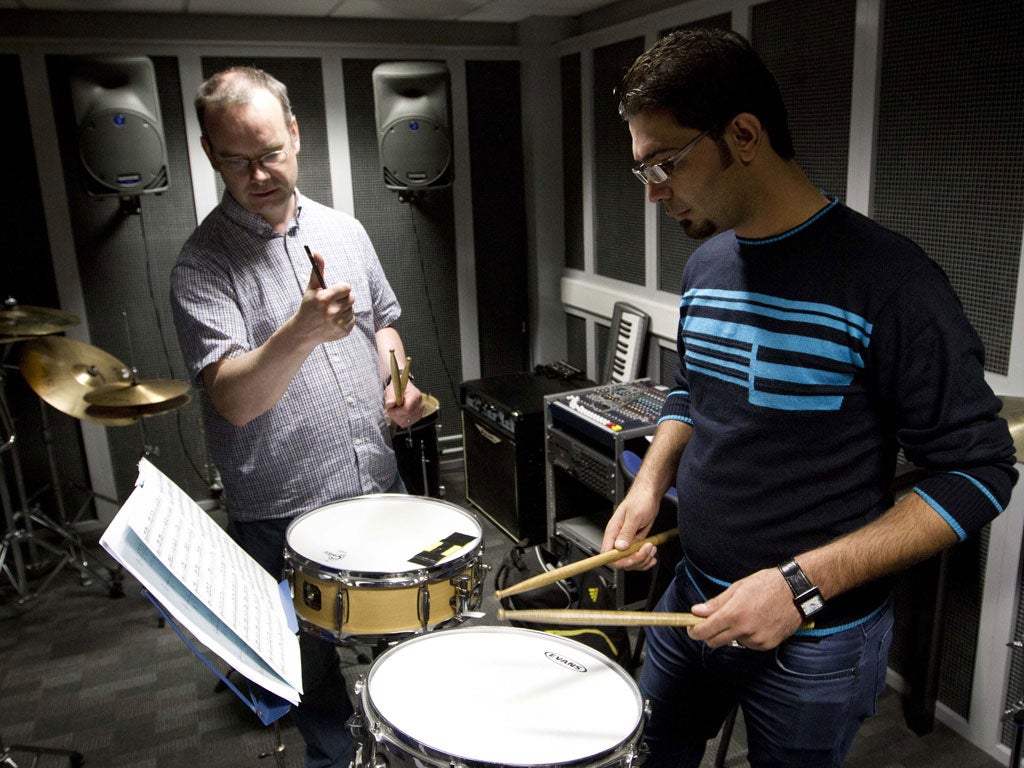
It has been dubbed the "bravest orchestra in the world". Members of Iraq's National Youth Orchestra have had to run the gauntlet of car bombs and other forms of violence to get to rehearsals – that is, if they weren't banned from playing outright. They have had to disguise their instruments to avoid being stopped by fundamentalists opposed to "Western" music. Even in the relative safety of their own homes they play quietly to avoid attracting attention.
But next week, after defying the odds, they will give their first performances outside Iraq. The 45-strong orchestra will accompany the world-renowned British cellist Julian Lloyd Webber at concerts in Edinburgh and Glasgow.
Iraq once had a rich classical music tradition: in 1948, it formed the first national orchestra in the Middle East and founded the region's first music school in Baghdad. However, it suffered during years of war and rule by Saddam Hussein's Ba'ath Party. Many of the finest musicians fled abroad. When violence again consumed the country after the US-led invasion of 2003, the fate of those who had remained was uncertain. They risked retribution from fundamentalists opposed to classical music and watched as concert venues were closed down.
Despite this, in 2008, a then 17-year-old Zuhal Sultan, a pianist from Baghdad, set about recruiting members for the country's first youth orchestra. "I thought it would be great for Iraq to have a youth orchestra that inspires Iraqis but also sets out a positive image about the country, which has been lacking over the past seven years. What else better than music and young people on one stage?" asks Ms Sultan.
The British Council in Iraq and a Scottish conductor, Paul MacAlindin, lent support and gradually the hope for a youth orchestra gained ground. Since the country remains a dangerous place to travel, potential members were auditioned over the internet and a phone-video service. There were more than 100 applications in the first year alone.
One of the biggest challenges facing the conductor was to get the musicians to play louder. "Our trumpeters have taught themselves to hold back"Mr MacAlindin says. "We're trying to decondition them so that they can play with openness, expression and joy, not fear."
Despite significant improvements in Iraq's security, rehearsals posed enormous difficulties. "The orchestra is safer in the Kurdish towns in the north of the country, so the first year we rehearsed in Sulaymaniyah, the second time it was Arbela," Mr MacAlindin explains. "We've never tried to get to Baghdad as it's still less safe than the north. It's always an aim to go there, we just don't know when."
The musicians, who are currently rehearsing in Edinburgh with several members of the Scottish Youth Orchestra, will also play in London. They will perform pieces by Sir Peter Maxwell Davies and Tchaikovsky.
'I had to practise very quietly because I was living in a dangerous neighbourhood'
Dua'a Azzawi, 19, from Baghdad, oboe player
"I started playing the oboe when I was nine but I had a teacher who left after almost two years, so then I had to teach myself. In 2006-07, the situation [in Iraq] was very bad. But fortunately an oboe is small. I can store it in a laptop bag, so it was easy to hide. But it's not easy to hide its sound. So sometimes I had to practise very quietly, because I was living in a very dangerous neighbourhood and I was scared that the neighbours might hear. When people asked me what the noise was, I would say it's just the TV."
Music for peace
Music and conflict have been intrinsically linked since the walls of Jericho fell as Joshua's army marched around the city blowing their trumpets in 1400BC. During the Second World War, the Allies adopted Beethoven's 5th Symphony before the Axis could get their hands on it. The rhythm of the famous first four notes corresponded to three dots and a dash in Morse code – to signify V for victory. But music has also been used to heal. In 2000, the Israeli-Argentinian conductor Daniel Barenboim performed Wagner in Israel even though the composer was banned there as a one-time Nazi favourite. Barenboim also founded the West-Eastern Divan Orchestra – with players from Egypt, Iran, Jordan, Israel and Palestine – to promote peace between Israelis and Palestinians.
Join our commenting forum
Join thought-provoking conversations, follow other Independent readers and see their replies
Comments
Bookmark popover
Removed from bookmarks