150 hours and counting: the world's longest film goes on
It began as 205 seconds of simplicity – and grew into a celluloid behemoth. Genevieve Roberts on the 'Cinematon'
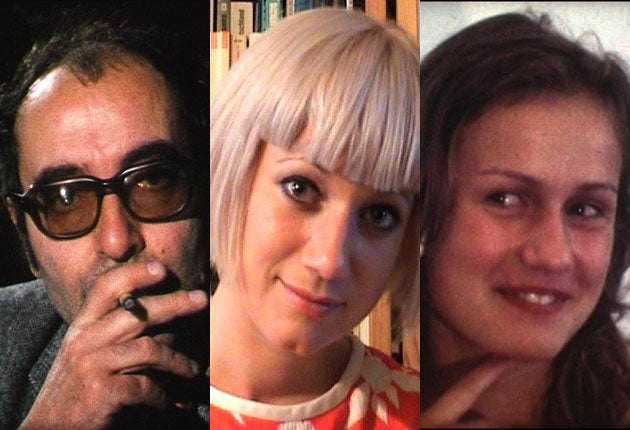
Three decades is a long time to spend making a film, but when your project runs to more than 150 hours, it is perhaps understandable that it takes a little while to put together. Indeed, Gerard Courant's Cinématon is the world's longest. And yet it may also be one of the simplest: this epic movie consists of nothing more than a succession of thousands of people – artists, philosophers, journalists, babies – on camera for three and a half minutes, doing exactly as they please.
When the project began in 1978, Courant was concerned that while artists or filmmakers were happy behind the camera, there were very few captured in front of the lens. So he embarked on a project to record artistic people he knew, filming each one for three minutes and 25 seconds. At first, his subjects were his friends. But over time, he moved on to the great and the good.
Cinématon, which will be shown in Avignon this month and in Paris in January, may well be the only art project to feature intimate encounters with filmmakers Ken Loach and Jean-Luc Godard, actors Roberto Benigni and Samuel Fuller, former Monty Python Terry Gilliam and French chess grandmaster Joël Lautier in the same place.
Courant, 57, has kept the same silent format, reminiscent of Andy Warhol's screen test idea, for the past 30 years. The rules are simple. "People can do exactly what they like in front of the camera," he says. "But it won't be refilmed and they have to accept it will be shown in public. It's like a photo identity." He says the film defies categorisation. "It's a documentary, but also fiction." The project has grown organically. "When the chance comes along, I take it," Courant says. "It's simpler that way."
Terry Gilliam's appearance, for instance, came about when Courant bumped into him at the film festival in Deauville in 1985. Gilliam chose to be filmed beside a 19th-century rococo house. "He started off to one side [of the camera], then came into the shot," Courant says. "He played with the frame, exiting and entering, and ate a 100F note, making it into a little ball. He never stopped playing with the square, and never lost sight of the limit of the frame. The three minutes 25 seconds of film with him is a true sketch."
On the same day, Courant filmed the American screenwriter and director Samuel Fuller, whose approach was rather different. "He lit his cigar and sat there smoking for three minutes, 25 seconds."
A year later, in 1986, he filmed the actor Roberto Benigni when he saw him at the Cannes film festival. "He amused himself, and had so much energy he was like electricity," Courant said. Benigni's miniature, like Gilliam's, had a financial flavour. "He took a 100F note and ripped it in two, offering half the note to me." Benigni was with his wife, the actress Nicoletta Braschi, who Courant filmed directly afterwards. "She was the absolute opposite," he says. "She stayed very calm and still, almost like a statue."
He filmed Ken Loach at the beginning of the 1990s, after he met him in a hotel in Paris. "He had been interviewed by journalists for most of the day, and was a little stressed," Courant says. "He chose to be filmed in a narrow road in St Germain. He was on the other side of the road to the camera, so he gets cut by cars driving past. The result is quite revealing of his personality."
His favourite Cinématon is that of a seven-month old baby. "It shows the whole spectrum of human emotions in less than four minutes," he says.

Watch Apple TV+ free for 7 day
New subscribers only. £9.99/mo. after free trial. Plan auto-renews until cancelled.
ADVERTISEMENT. If you sign up to this service we will earn commission. This revenue helps to fund journalism across The Independent.
Watch Apple TV+ free for 7 day
New subscribers only. £9.99/mo. after free trial. Plan auto-renews until cancelled.
ADVERTISEMENT. If you sign up to this service we will earn commission. This revenue helps to fund journalism across The Independent.
When Courant, who is the son of the writer and historian René Courant, started on the series, his initial objective was a mere century of contributions. But when he first showed the film to an audience it was an immediate success, and 100 portraits began to seem unduly limited in scale. "The audience felt like they'd participated and wanted to respond," he says. "Some cried or laughed. I've never changed the concept, so Cinématon clips from different eras can be shown alongside each other. But different people can find the same Cinématon exceptional, or boring. It's all relative."
Provoked by his audience's reaction, his ambition evolved to create 24 hours of film within six months, even that seemed like not enough, and he removed the limits altogether. Now Cinématon – or a segment of it – is shown at film festivals, as in Toronto, where it was shown for 130 continuous hours.
When Courant is asked to produce standalone feature-length films of Cinématon for screening for those lightweights who are unable to commit to a five-day stint in the auditorium, he will pick 25 people he has filmed, often according to theme. "There are unlimited combinations," he says. "The funniest, or the most famous people. People with beards, or people who choose to drink."
Cinématon could continue for the rest of Courant's life. But while he continues to write books, dedicate time to his enthusiasm for bicycles and the Tour de France and make other films, including L'Anniversaire de Bambou and Promenade dans les lieux de mon enfance dijonnaise, he is uncertain whether he will continue making Cinématon forever. "It's hard to say what I'll do tomorrow, in a year or in five years," he says. "Generally, the public think I'll continue working on this, but I don't know what I'll be doing in a few months."
Three minutes of fame: 'I pull some pretty bizarre faces'
Andy Warhol said that everyone could be famous for 15 minutes. In my case, three minutes and 25 seconds is fine.
Much as I'm glad to rub metaphorical shoulders with Ken Loach and Terry Gilliam, the roll call of previous film subjects in Courant's Cinématon is fairly daunting.
So, as I sit down facing the camera, I'm not expecting to find the experience especially enjoyable. Courant asks what I'm planning to do. I tell him I'm going to write my diary, and the filming begins. Having a camera close to my face is pretty distracting actually; rather than flirting with the lens I suspect I'm pulling some pretty bizarre expressions. I've been told that my face reveals exactly what I'm thinking and I'm not sure whether I want my stream of thoughts revealed on camera. But it's way too late for that.
After about two minutes, I start wondering how much longer the lens will be on me. It's strange being hyper-aware of the passing of time. But a few scribbles later, I see Courant smiling at me as the camera stops whirring.
"How did you find it?" he asks. I say that I feel like I've cheated a bit. I had a prop – my pen and diary. Had there been nothing between me and the camera, it would have felt more intense.
Afterwards, I ask him what other people did. When I hear his answer, I feel relief that I didn't know before the camera turned on me – I would have felt desperately intimidated.
And reassuringly, I'm still pretty anonymous. There are 150 hours of film: it would take a very dedicated fan to watch the whole epic.
Join our commenting forum
Join thought-provoking conversations, follow other Independent readers and see their replies
Comments
Bookmark popover
Removed from bookmarks