Benicio Del Toro - A Latino rebel becomes our man in Havana
Benicio Del Toro has form when it comes to Cuba, having played Che Guevara. Now the brooding actor has chosen the country as the setting for his directing debut. Kaleem Aftab goes on set
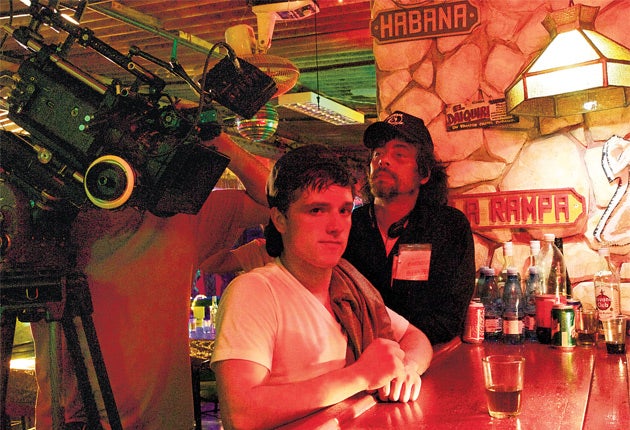
Benicio Del Toro is agitated. The Usual Suspects star is pacing to and fro outside the picturesque Bar Silvia in central Havana, where he is directing his first film. It's not often that the dashing star looks out of his comfort zone, but right now he's trying to shoot a scene for 7 Days in Havana in which the actor Josh Hutcherson (The Kids Are All Right) chats with locals at the famous hang-out. In the apartment above the bar a dog barks incessantly. As Del Toro looks into the monitor, watching a gorgeous couple waltz past, he worries that the scene is going to look "like a video".
In fact it looks like an advert for post-socialist Cuba, a romantic idyll with classic cars on the streets, beautiful architecture as far as the eye can see and Americans shooting the breeze in welcoming bars that look as if they were designed to be on the pages of fashion magazines.
On set Del Toro, 44, exudes an aura. Much taller than he seems on screen, and having put on a few pounds and grown a grizzly beard, he cuts an imposing figure. The actor may have won a Best Actor prize at Cannes for his portrayal of Che Guevara in Steven Soderbergh's diptych Che but it's the Cuban leader, Fidel Castro, that he most resembles today.
"I care about my looks as much as the next guy," he tells me the next day, seated in a Havana seafront hotel in front of a painting of a bull. Today he's wearing a baseball cap and denim shirt.
"I look at myself in the mirror, but not that much. I realise I'm not getting any younger. I like a good shirt and I like a good pair of shoes. I don't think about that." Catching himself in a lie he changes tack. "But I do, I do, I do I, do. I still wear cologne, and I want to pick up a girl and be the man."
His looks and a certain glint in his eye have often seen Del Toro cast as the stereotypical Latin lover. He has claimed that he doesn't need to get married and, famously, allegedly, enjoyed a tryst with Scarlett Johansson in a lift at the Chateau Marmont after the 2004 Oscars (a rumour recently satirised in Sofia Coppola's Somewhere in which Del Toro makes a brief cameo loitering in – where else? – the hotel's elevator). And just this month his publicist announced that Del Toro had impregnated Rod Stewart's daughter Kimberly. The statement came with an amusing adjunct that the pair are not in a relationship that seemed to say, "don't worry girls".
He's in Cuba to shoot 7 Days in Havana, a story told in seven chapters by seven different directors. On a list which reads like a who's who of international arthouse cinema, Del Toro rubs shoulders with Laurent Cantet, Gasper Noé, Elia Suleiman, Pablo Trapero, Julio Medem and Juan Carlos Tabio. Rather than creating a portmanteau project like Paris Je T'aime, in which directors are given a free rein, the Havana project has been given an overall structure by the Cuban novelist Leonardo Padura in the hope that it gives a picture of the country in 2011. It's also being financed by the rum company Havana Club. In today's Cuba, branding is slowly taking hold.
Del Toro always stays at the famous Nacional Hotel on his frequent visits to the capital. "It's a special place," he says. "I was born in Puerto Rico and it's very similar to Cuba in the way that people speak, in the way it looks, and the food. The revolution does not change people. Cuba is my own flesh and blood."
All the same, Del Toro had to apply for a special permit to film so as not to break the terms of the American embargo on Cuba. It only allows him to make a documentary in the country and, as such, his segment, called "Yuma", is a strange mixture of docudrama and reality. The idea is to have a young actor interact with Cubans in as real a way as possible, and include some recreations of real incidents.

Watch Apple TV+ free for 7 day
New subscribers only. £9.99/mo. after free trial. Plan auto-renews until cancelled.
ADVERTISEMENT. If you sign up to this service we will earn commission. This revenue helps to fund journalism across The Independent.
Watch Apple TV+ free for 7 day
New subscribers only. £9.99/mo. after free trial. Plan auto-renews until cancelled.
ADVERTISEMENT. If you sign up to this service we will earn commission. This revenue helps to fund journalism across The Independent.
"A documentary is run-and-gun. Let's put people in a situation and see what happens. So this is a documentary with some re-enactments," he states. On the limitations, he states, "I'm not for the embargo. I'm here, obviously. We came here with a permit and everything is legal. Of course I'm not the only one against the embargo, [there] is Italy, Spain, England. Most countries in the world."
Yet he does not see his act of shooting on the Caribbean island as overtly political: "It has nothing to do with politics. For me cinema is not political. You can say that the Che movies are political but in fact they are not political movies. It's a historical snapshot of a country of a man. I'm not into politics, but I do believe wrong is wrong and right is right, and I have my ideas about what that is."
Having acted for more than two decades, and worked with some of the world's greatest directors, Del Toro felt he'd been exposed to enough film-making to have a crack himself.
"Well, you get tired of anything you do for 20 years," he says of acting. "It's good for the brain to try and make it a bit more complicated. At times I was overwhelmed with all the things that come into play as a director. Almost the same feeling you have when you're in a wave and it tosses you upside-down and you don't know which way is up. That is a freaky feeling to have."
In a typically explicit aside, the actor adds: "To try and solve those problems, I think that is one of the great moments in life, it's like eating a great steak, or it's like having sex."
As an actor, Del Toro has something of a reputation for being difficult on set, and admits that sitting behind the camera has enabled him to see the error of his ways. "I'm not the same guy as when I first started acting. I drove directors crazy doing stuff. Silly things like insisting that I would light my cigarette behind my ear. As a young actor I would fight every battle like it was a war. As you evolve as an actor you realise that not every battle has to be won, but you still have to win the war. When I was younger I had moments of panic as an actor."
On screen, though, he hides it well, with a seemingly effortless cool. Citing Anthony Quinn, Andy Garcia and Antonio Banderas as paving the way for him in Hollywood, his eyes light up as he recalls arriving in LA as a young actor. "I was just a Latin-Americano. I had knowledge of English but with no connections in Hollywood and in LA to carve yourself into acting, the odds are really stacked against you."
That he broke through is testament to the qualities he brings to a role. Intense, dark and brooding, he only need lift his bushy eyebrows to show disquiet or infatuation.
He quickly moved on from Big Top Pee-Wee and Licence to Kill to challenging independent dramas such as The Indian Runner and Swimming with Sharks. But it was his turn as the wisecracking Fred Fenster in The Usual Suspects that turned him into a global superstar. He then piled on the pounds to play Dr Gonzo in Terry Gilliam's adaptation of Fear and Loathing in Las Vegas, and soon after received a Best Supporting Actor award for his turn in Traffic, playing a Mexican border-cop trying to stay honest amid the drug wars. He would receive another nomination in 2003 for his turn in 21 Grams as a reformed drug-addict who has found God. At this point, his career seemed to stall. A lean period saw him appear in Sin City and Suzanne Bier's Things We Lost in the Fire, before he spent the best part of a year working with Soderbergh on the Che biopics.
He insists that he is going to wait to see how his directorial effort pans out before deciding whether he will go behind the camera again. Meanwhile, he has signed on to star with Daniel Day Lewis in Martin Scorsese's adaptation of Silence, due to shoot next year, and is slated to star in a biopic about mob hitman Richard Kuklinski. A rom-com with Cameron Diaz is also in the works.
As the press release about his impending fatherhood showed, whether he is acting or directing, there's one thing he insists will never change: "I don't like to apologise too much. I don't apologise. I don't apologise. That's fear."
'7 Days in Havana' is out later this year
Join our commenting forum
Join thought-provoking conversations, follow other Independent readers and see their replies
Comments
Bookmark popover
Removed from bookmarks