Carry On going strong: Farces of nature
The Carry On films are 50 – and still they're planning more. Geoffrey Macnab celebrates a British institution
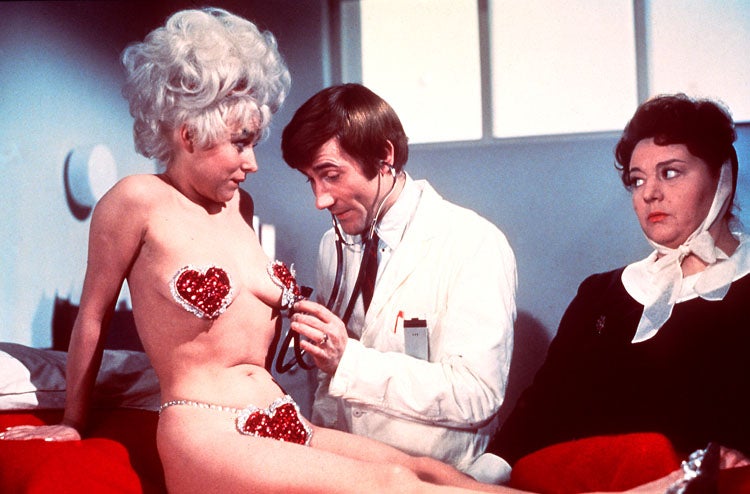
The setting is a British film studio, 40 or so years ago. Two producers meet on the backlot and have the same conversation they always do: Hugh Stewart, the producer of many Norman Wisdom films, asks Peter Rogers, the producer of the Carry On series, what he is working on now. "Same story, different title," Rogers always replies.
Stewart told me this anecdote when I was researching my book, J Arthur Rank and the British Film Industry. It sums up perfectly why the Carry On series (which celebrates its 50th anniversary this year) is both so cherished and so reviled. It would be unfair to accuse the Carry On team of remaking the same film 30-odd times and of continually recycling the same jokes in a slightly different context – hospital one year, the French Revolution another, up the Khyber one moment, down Cleopatra's cleavage the next. Nonetheless, familiarity helped ingrain the series in British public consciousness. The reason you remembered the gags was that they were so reminiscent of one another. There was something reassuring about Sid James's leering, Charles Hawtrey's rubbery nincompoopishness and Kenneth Williams' oohs, ahhs and facial gymnastics. There was always a bit of healthy voyeurism for the men (Barbara Windsor's bra becoming unstrapped, or maybe a striptease at the caravan site), but the matronly Hattie Jacques was normally on hand to give a symbolic scolding.
Over the last decade or so, the Carry Ons have achieved a respectability that once would have been unthinkable. "The Carry Ons are a brisk, beaming, no-nonsense coachload of cliché and innuendo," enthused the university lecturer Andy Medhurst in Sight and Sound at the time of the release of Carry On Columbus (1992). "They are films that display a dread of significance, a refusal of nuance, an indifference to complexity that is almost shocking – and at the same time deeply wonderful." Another Carry On fan, Robert Ross, recently wrote his university dissertation on "Male Sexuality in the Carry Ons," something that left Norman Hudis, the writer of the first six Carry On films, "silent and awed".
Ask Hudis today how he regards male sexuality in the comedy series he helped originate and he recounts an anecdote about the US writer and film-maker Garson Kanin discussing character motivation with a New York police officer. "Kanin said to the cop that it was very difficult to get any kind of a slide rule about character. The cop said: 'It's very simple, Garson – in my experience, all men are pricks and all women are crazy.'" That, Hudis suggests, is the philosophy of Carry On in a nutshell.
Fans hold a mind-boggling depth of knowledge about the series. They know how many Carry On films Terry Scott appeared in, and can give the name of Bernard Bresslaw's jealous wrestler in Carry On Loving (Gripper Burke) without blinking; they can tell you who played Busti in Carry On Up the Khyber, or Citizen Bidet in Carry On Don't Lose Your Head, and just which buildings at Pinewood Studios housed the lavatory-making factory in Carry On At Your Convenience.
Just as popular lore has it that no one in London is ever more than a few feet from a rat, no would-be spectator today need ever be more than a few minutes from a Carry On film. They are repeated often on British TV (especially on bank holidays), have been given away with newspapers and many are available to be downloaded. And just as there are regular attempts to remake Hammer horror movies, there are frequent stabs at revivifying the Carry On franchise. At the 2006 Cannes film festival, it was a case of "here we go again" (in Peter Rogers' words) as details were announced of Carry On London – the 32nd film in the franchise. An array of former EastEnders actors and ex-Playboy models were expected to star in the film, which was about a limousine company to the stars. There were even rumours that Burt Reynolds was to play Hollywood movie magnate IP Freely.
Two years on, the film has yet to begin production. The project's lengthy gestation – Carry On London was first mooted as early as 2003 – suggests that financiers and stars alike have qualms about reviving a franchise whose heyday was roughly four decades ago. The original investors backed out after changes to UK film tax legislation; more recently, the subprime mortgage crisis has apparently deprived the producers of other potential backers. However, Brian Baker of Carry On Films Limited, who holds the rights, is adamant that Carry On 32 will be made. Baker says he has found new investment through Bulgarian-based financiers. The title is no longer Carry On London, Baker says, and casting details are yet to be confirmed, but he promises it will return to "the double entendre, sexual innuendo and slapstick which is typical British sense of humour. What we are trying to do is to bring [Carry On] into the 21st century."
Norman Hudis, now 85, is bemused by the longevity of the series he ushered into existence in 1958 with his screenplay for Carry On Sergeant. No one had especially high expectations for the film, Hudis says, which was shot quickly on a small budget with the hope of capitalising on the popularity of a recent TV sitcom.
"My father and some of my uncles were all tremendous music hall fans," Hudis says. "They regaled me with stories of Florrie Forde and Harry Champion – names which today may be virtually forgotten."

Watch Apple TV+ free for 7 day
New subscribers only. £9.99/mo. after free trial. Plan auto-renews until cancelled.
ADVERTISEMENT. If you sign up to this service we will earn commission. This revenue helps to fund journalism across The Independent.
Watch Apple TV+ free for 7 day
New subscribers only. £9.99/mo. after free trial. Plan auto-renews until cancelled.
ADVERTISEMENT. If you sign up to this service we will earn commission. This revenue helps to fund journalism across The Independent.
Hudis was a former publicist who made his name as a writer with The Tommy Steele Story. "He always struck me as a no-nonsense character, and I would not have imagined in those days that he was particularly endowed with a sense of humour," says Peter Rogers (who put Hudis under contract). "Norman could write anything."
Nobody involved – Rogers, the director Gerald Thomas, Hudis – had any idea they were launching a full-blown franchise when they embarked on Carry On Sergeant. "None of us had any idea that there would be even a second film, let alone this extraordinary stream of movies that followed," Hudis recalls.
The critical response was lukewarm. The Monthly Film Bulletin called it "a conventional farce, in which all the characters come from stock" and pointed out its debt to seaside postcard humour. The reviewer conceded that Hawtrey's "weedy incompetence" and Williams' "condescending intellectualism" yielded a few laughs, but dismissed the rest as "either overdone or half-baked".
However, when Carry On Sergeant became an unlikely success – hitting No 3 in the UK box-office charts for 1958, behind Dunkirk and Bridge On the River Kwai – the producers decided to make another. "It seemed a pity not to continue," Rogers remarked. A former publicist and journalist, Rogers began his film career as part of J Arthur Rank's religious film unit. He had seen some of Rank's films pelted by audiences, and so had a strong idea of what the public didn't like. Carry On was as far removed from Rank's Sunday Thought for the Week as it is possible to imagine.
Hudis knew that the Carry On phenomenon was taking hold when he began noticing references to it elsewhere in British culture. After a nurses' strike was averted, a newspaper carried the headline "Carry On Nurse". Even Noel Coward included a reference to Carry On in something he wrote.
Carry On script conferences were brisk in the extreme. "[Rogers] was not terse to the point of being dismissive, but had very clear ideas of how he wanted a script to go," says Hudis, who turned out his screenplays at a relentless pace – he calculates that he took only a week and a half to finish Carry On Nurse. He stuck to a formula: naughtiness rather than vulgarity; music hall-type humour; changes rung only on familiar themes.
After Carry On Cruising, his sixth in the series, Hudis decamped to Hollywood, where he wrote for such TV series as Danger Man, Hawaii Five-O and The Man From U.N.C.L.E. He is full of praise for his successor, Talbot Rothwell, who wrote over 20 Carry On films. "He took the series into more esoteric areas, playing with things like Cleopatra and so forth, whereas with mine, I was very lucky to have easy targets to snipe at – the army, hospitals, schools and so forth."
Arguably, though, what really distinguished the Carry On series was less the writing or directing than the actors. Without Sid and Babs, without Kenneth, Hattie and Joan, the formula didn't really work. It was their absence that sunk Carry On Columbus despite the presence of such familiar faces as Jim Dale and Bernard Cribbins.
The challenge for Brian Baker in reviving the franchise is unearthing talent as distinctive as Williams ("such a fireworks, such a Catherine wheel of talent", in Hudis's words), Joan Sims ("such a bubbly girl – she had had a lot of disappointment in her life, but on screen she emitted this sense of warmth and fun"), Hawtrey ("an enormously gratifying eccentric") and Kenneth Connor ("so down to earth").
Brian Baker says the new Carry On film is looking to attract audiences "from the ages of 13 up to about 40". Filmgoers of that age are unlikely to remember the Carry On films, but Baker is confident there is still an audience for salty, seaside humour. "We're not going to copy Sid James and Kenneth Williams, but develop new artists equally as funny in their own right," he says.
One prediction can safely be made: if Carry On 32 is a success, 33 will be just around the corner – and will copy its predecessor shamelessly. After all, as Rogers' "same story, different title" adage attests, there is no need to change a winning formula.
Norman Hudis's autobiography 'No Laughing Matter' (Apex Publishing) is published this month, as is a new edition of the official 'Carry On Quiz Book', compiled by Chris Cowlin and Paul Burton
Join our commenting forum
Join thought-provoking conversations, follow other Independent readers and see their replies
Comments
Bookmark popover
Removed from bookmarks