Cloud Atlas: Time to say goodbye to your characters
Watching your novel go from the page to the big screen is exhilarating as long as you trust the directors, as David Mitchell finds out on the film set of his book Cloud Atlas
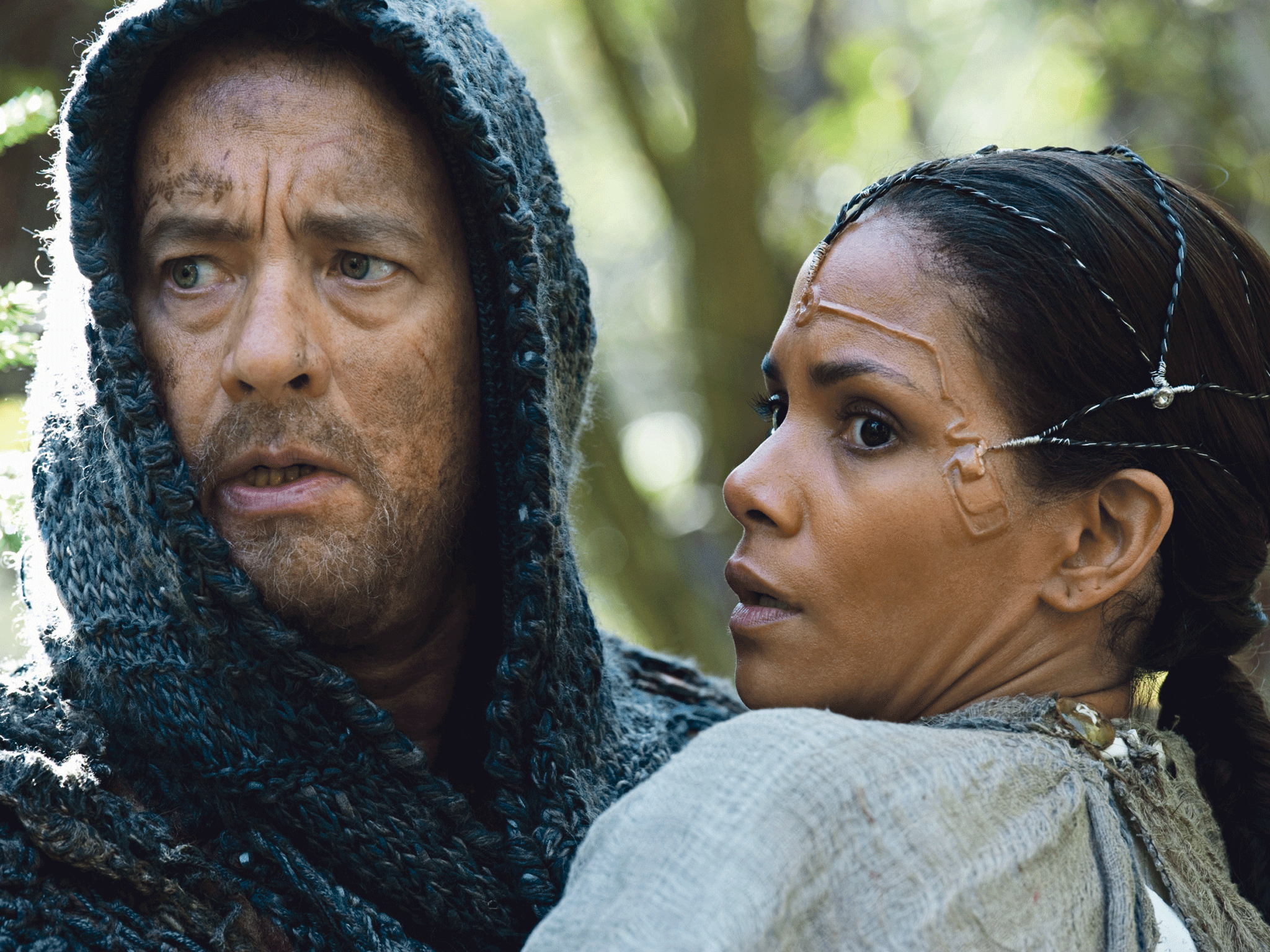
'So how does it feel?' is the reasonable question you hear a lot when your book completes the long ascent from production purgatory to movieplex. First off, there's a primal kick to be had from seeing and hearing your word made flesh. Before your very eyes, actors are speaking dialogue you wrote in your back bedroom years ago, and all those nonexistent people are now real. They find flashes of humour or menace that you never spotted, and pretty soon all memory is gone of how you imagined the character looked before the actor muscled in.
For a playwright or screenwriter this ontological wow is a normal day at the office, but my memory of the first cast read-through of the Cloud Atlas script will stay with me forever. With three or four actors unable to attend, the film's three directors – Tom Tykwer and Lana and Andy Wachowski, who also wrote the screenplay – were divvying up the spare roles, and it seemed rude not to volunteer. I hadn't been in a group-reading situation since my high-school English class, but instead of my 17-year-old classmates sitting around the table slogging through A Passage to India, here were the likes of Mr Hanks, Ms Berry, Mr Grant and Mr Broadbent delivering lines that sounded uncannily familiar. That whole experience felt rather like a dream of finding Gandhi playing Connect 4 with your plumber in the cupboard under the stairs — it wasn't so much the individual elements of the scene that were surreal, but their juxtaposition.
Yet the fact soon sinks in that you've morphed from being your novel's monotheistic Creator to the guy who happened to write the original novel. How this makes you feel depends, I guess, on how you feel about the adaptation itself. Hand on heart, I've never experienced much anxiety in this quarter. I'd met the three directors in 2008, when their manner and vision reassured me that Cloud Atlas was in capable hands. Their plan to foreground the novel's "transmigrating souls" motif by having actors perform multiple roles (each role being a sort of way-station on that soul's karmic journey) struck me as ingenious. Some changes to plot and character were inevitable, so the book's six worlds could be coaxed into a film-shaped container: the love interest between the (now) middle-aged Zachry and Meronym on post-apocalyptic Hawaii, for example, or Cavendish's epilogue, which appears in the film but not the book.
Moreover the novel's Russian-doll structure has become more of a mosaic structure – you can't ask a viewer to begin a film for the sixth time after 100 minutes and not expect popcorn to fly. I could see that wherever the Cloud Atlas screenplay differs from Cloud Atlas the movie, it did so for sound narrative reasons that left me much more impressed than piqued. (At the read-through I was sitting next to Lana Wachowski and when a line earned a particularly strong response I'd whisper, 'Was that one of yours or one of mine?' The tally was about 50/50, I think.) Anyway, film adaptations of novels are sometimes prone to failure, not because they are too faithless but too faithful: why spend all that effort producing an audiobook with pictures?
Production! My week on set in Berlin in December 2011 gave me access to a world I'd heard a lot about, but never visited. Look – there's a clone recycling unit where there wasn't one an hour ago; mind out, fibreglass mountain outcrop coming through; what, are all hi-tech sliding doors in SF movies made of painted plywood? Nosiness about other peoples' jobs is a writerly habit I try to cultivate, and I filled a Moleskine with notes from informal interviews with a range of professionals I rarely, if ever, encounter in my solitary-ish novelist's life: language coaches, script editors, costume- and set-designers, CGI animators, entertainment lawyers, caterers, extras, a futuristic vehicle designer, stuntmen, and the accountants who monitor the financial Niagara that is any film in full production.
I acquired a heightened respect for actors, too: there was nothing computer-generated about the water drenching the ever-gracious Halle Berry up to her neck (for the second take that afternoon); and David Gyasi, who plays a 19th-century Moriori islander in the film, helped me decide what sort of accent I had had in mind when writing the character by riffing from a pitch-perfect Maori accent to Caribbean and then to African with the ease of a man changing hats. Thanks to my cameo appearance, I also learnt how many hours are spent in the trailer for every minute on screen. Little wonder some actors become voracious readers. Directors during a shoot are often compared to generals during a war, but I'm not sure if the metaphor does full justice to the job. Directors are not only strategists; they need to be dramaturges and editors, morale-handlers and arse-kickers; cameramen and soundmen, diplomats and economists and (ideally) artists of the highest calibre.
They also need a ton of physical and mental stamina – during production, every 16- or 17-hour day sees the director getting bombarded with hundreds of questions. Tagging along after the Wachowskis and Tykwer for a few days encouraged me to look for similarities and differences between my own addiction to writing novels and the relatively vast operation of filmmaking. Perhaps where text slides towards ambiguity, film inclines to specificity. (Creative writing students are often taught to "Show Don't Tell", but in truth words can only tell; that's why they aren't images.)
Perhaps a novel contains as many versions of itself as it has readers, whereas a film's final cut vaporises every other way it might have been made, at least until a remake or director's cut. Yet while a written scene can only bear so much detail, every last aspect of a filmed scene – light, acoustics, the objects peopling it – can, and should, be considered. And while a writer has only clumsy means of saying exactly how a given line is to be heard in the reader's head (italics and adverbs), a director gets to fine-tune the delivery of that line and preserve it for all time. Film-making is as extraordinary a world behind the scenes as it can be on-screen, and whatever happens to the film commercially, I'll always be grateful to Cloud Atlas and its three directors for my temporary visa.
'Cloud Atlas' is released in cinemas nationwide on 22 February; the book, by David Mitchell, is published by Sceptre, £7.99
Join our commenting forum
Join thought-provoking conversations, follow other Independent readers and see their replies
Comments
Bookmark popover
Removed from bookmarks