Explosive material: Can Angels & Demons make particle physics sexy?
The latest Dan Brown film adaptation stars Tom Hanks, Ewan McGregor – and a lethal substance, antimatter
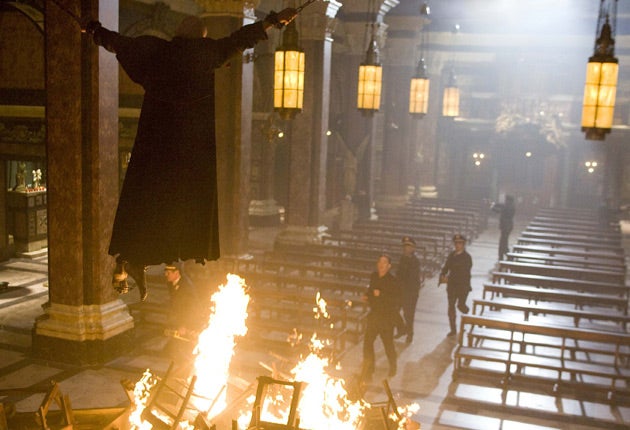
In the beginning there was both matter and antimatter. Matter is the stuff we, and everything around us, is made of, from the biggest galaxy to the smallest speck of dandruff. Antimatter is its weird doppelganger - identical to matter in all respects, except that everything within its atoms is the opposite way round. Negative becomes positive, and left is right.
Now consider this: matter and antimatter can never coexist. Put them together and you get total annihilation. When matter meets antimatter, there is an instantaneous release of explosive energy in the forms of a piercing pulse of light. Antimatter, as blockbuster novelist Dan Brown has discovered, is the perfect ingredient for the Armageddon device - a weapon thousands of times more potent than the most destructive nuclear bomb.
Brown's novel, Angels & Demons, puts antimatter centre stage as the mysterious element of the bomb that is going to destroy the Vatican. Next week a film version – the sequel to The Da Vinci Code – hits cinemas. And director Ron Howard has done his homework. Early on in the planning of the film he contacted and visited the European Organisation for Nuclear Research (Cern) near Geneva. Cern knows a thing or two about antimatter, having made more of it than anywhere in the world - and possibly more than anywhere in the present-day Universe.
The Cern's underground laboratories feature in the film as the place where antimatter is created, which happens to be true in real life. But what is clearly fiction is the idea that scientists can make enough of it to make a bomb and, even more importantly, store it and carry it around from one place to another in some kind of portable device.
As Cern is quick to point out, if all the antimatter it has ever created over the years could be assembled and combined with matter, the total amount of energy released would be just about enough to power a light bulb for a few minutes. The Oxford physicist Frank Close calculates in his new book on antimatter that with existing technology it would take hundreds of millions of years and cost $1,000trn to make just one gram of antimatter.
Then there is the problem of what to do with it once it has been created. Antimatter is exceedingly difficult to store because it reacts explosively with ordinary matter. Huge electromagnetic forces have to be applied to trap the tiniest amounts of antimatter in one place - forces that require hundreds of tons of heavy equipment. Some have suggested that antimatter could turn out to be an unlimited source of clean energy for the future, but as Close says, this is unlikely. "Regrettably, antimatter is not a panacea for 'saving the planet'. Thankfully, neither it is 'the most deadly weapon'," he writes.
So what is antimatter? It would look and feel just like ordinary matter, except you wouldn't be able to touch it without exploding. Its atoms are in reverse to everything we know about atoms, not just negative and positive, but right and left, up and down. "Like the mould that remains when the cast is removed , matter and antimatter are the yin and yang of reality," explains Close.
Theoretical physicists believe that within the first fraction of a second after the Big Bang, when all matter was created, antimatter was made is almost equal amounts. But try as we might, there is no evidence of this antimatter existing naturally anywhere in the visible Universe. Some scientists believe this is because all antimatter, along with virtually all matter, was destroyed in what Close describes as the Great Annihilation within the first fractions of second after the Big Bang.
It was only because there was a slightly higher proportion of matter to antimatter - something like a one in 10 billion particles - that there was any ordinary matter left to form what we know to exist today. In the meantime, the only antimatter we have observed is the stuff that is either created transiently in particle physics laboratories such as Cern, or in the random collisions of Cosmic rays in space.

Watch Apple TV+ free for 7 day
New subscribers only. £9.99/mo. after free trial. Plan auto-renews until cancelled.
ADVERTISEMENT. If you sign up to this service we will earn commission. This revenue helps to fund journalism across The Independent.
Watch Apple TV+ free for 7 day
New subscribers only. £9.99/mo. after free trial. Plan auto-renews until cancelled.
ADVERTISEMENT. If you sign up to this service we will earn commission. This revenue helps to fund journalism across The Independent.
Paul Dirac, the brilliant if eccentric British physicist, first postulated the existence of antimatter in 1928, although he did not call it by this name. His calculations suggested a particle with an opposite charge to an electron. Other scientists subsequently discovered this "positron" in 1932, the first antimatter particle.
Since then scientists have discovered a range of anti-particles, and in 1995 researchers at Cern produced the first anti-hydrogens by combining anti-protons with positrons. It was the first time any laboratory had created anti-atoms artificially. The news of antimatter quickly spread around the world, and evidently seeded the fertile imagination of Dan Brown.
The antimatter story took a surreal turn when on 24 March 2004 Kenneth Edwards, director of "revolutionary munitions" at a US Air Force base in Florida, gave a scientific talk on the military potential of positrons. A speck of antimatter weighing no more than 50 millionths of a gram and too small to be seen could, for instance, release the explosive power equivalent to the Oklahoma City bomb, which killed 168 people and injured 500 more when it destroyed a federal building.
Fevered speculation in the media suggested that the US military were engaged in secret research to develop an antimatter weapon. But it subsequently turned out that Edwards was only outlining the theoretical potential and there was no serious military programme - or none at least that made scientific sense.
Cern, meanwhile, has embraced publicity surrounding the film, seeing an opportunity to explain the principles of particle physics. In addition to giving Howard personal tuition in antimatter, the lab has allowed its premises to be filmed. Howard has returned the favour by making a more scientifically accurate DVD extra to be released with the film.
"There was nothing we could have done to stop the film being made and we accept that it is a work of fiction," says James Gillies, a Cern spokesman. "They take a few liberties, but we can forgive them for that."
* Antimatter, by Frank Close, is published by OUP Oxford, (£9.99)
Join our commenting forum
Join thought-provoking conversations, follow other Independent readers and see their replies
Comments
Bookmark popover
Removed from bookmarks