Martin Scorsese: You talkin’ to me?
A fascinating new book captures Martin Scorsese in conversation – and reveals an addiction to film that stretches back to the director’s early childhood
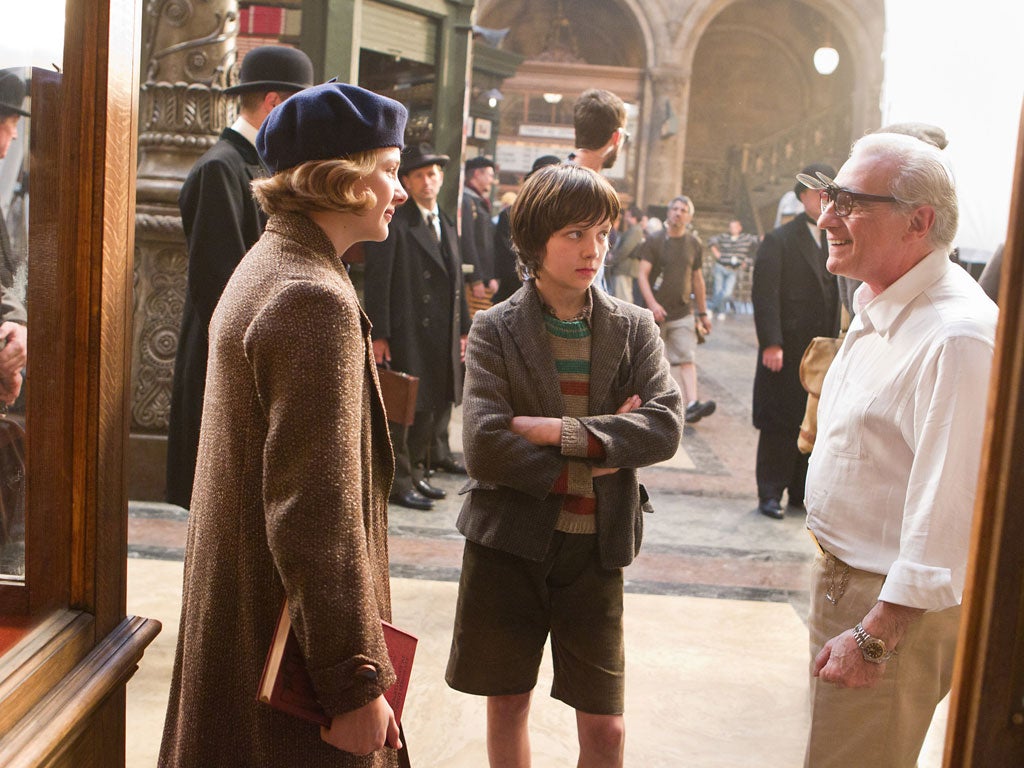
An audience with Scorsese isn't like a typical junket interview with a big-name American director. That is made very clear in Michael Henry Wilson's new book, Scorsese on Scorsese. This features a series of discussions that Wilson has had with Scorsese about his films, from 1974 right up to the present day. Their encounters are confessional, therapeutic, invariably littered with references to other movies and often highly technical. Wilson (who co-wrote Scorsese's masterful documentary A Personal Journey with Martin Scorsese Through American Movies and is now working with him on his new doc about British cinema) is reverential towards his subject, but also very probing. The metaphors used here are often about illness, addiction and transcendence: a strange mix of the biblical and the psychoanalytical. "Film is a disease... as with heroin, the antidote to film is more film," Scorsese once observed, quoting his fellow director Frank Capra. He is clearly contaminated with this disease. Wilson is fascinated by his symptoms.
The book is very lavishly illustrated with family photos and images of Scorsese and his young buck friends from Little Italy in New York, where he grew up uncertain as to whether he was going to be a gangster or a priest. There are stills, storyboards and images of heavily annotated pages of his screenplays. One full-page illustration underlines the obsessive cinephilia that characterised Scorsese, even as a child. It is an intricately drawn and calligraphed set of images for The Eternal City, an imaginary widescreen epic that Scorsese dreamed of making as an 11-year-old. "A fictitious story of Royalty in Ancient Rome" is how he characterises it. The storyboard images are very carefully drawn and coloured in. It is striking that he has given himself a bigger credit as producer-director than any of the stars (who include Marlon Brando, Richard Burton, Virginia Mayo and Alec Guinness.)
What leaps out from every interview over a 35-year span is Scorsese's driven quality: that obsessiveness that almost killed him as a young film-maker.
"Do you know what Fellini said to me... when I was at death's door and had to go into the hospital?" he confides to Wilson in an interview from the late 1970s. "Carry on, my friend! Be crazy! Kill yourself! Work till it kills you!"
Although he reined himself in and got over his morbidly romantic idea that he should drive himself to death through his work, the Scorsese talking in the latter part of the book about Boardwalk Empire is still the same febrile presence who Wilson and his colleague Michel Ciment first met in Paris in 1974, when they came to interview him about Boxcar Bertha and Mean Streets for Positif. At the time, he was in bed, struck down by an asthma attack. "With etched features reminiscent of an El Greco painting, he is an extraordinarily sensitive livewire," they wrote of the then young and largely unknown director. "He laughs often, like a child, in an effort to conceal his underlying anxiety. How can we fail to be won over and inspired by his consuming passion?"
Scorsese doesn't "do" small talk or gossip, but plenty of familiar names pass through these pages and some of the anecdotes can't help but have a comic feel.
Scorsese on Robert De Niro in Taxi Driver
Bobby really understood the character. He was Travis. A piece of scenery could collapse behind him and he would react the way Travis would. He had become Travis. I had complete confidence in him. That went back to our collaboration on Mean Streets. We feel many things the same way. We understand each other perfectly. We don't need words to work together. The communication between us is like a form of sign language. His contribution to Taxi Driver was crucial. I think he succeeded in moving audiences, in eliciting their empathy. Thanks to him, we are able to identify with this character that might have been a monster.
How did he prepare for the role?
For example, he drove a cab for two weeks. He had just won an Oscar [Best Supporting Actor] for The Godfather Part II. One evening, an actor got into his cab and recognized him. The guy, who couldn't believe his eyes, exclaimed, "Do you have to drive a cab? Are times as bad as that? Hasn't the Oscar helped you?" One night, I got into Bobby's cab myself; I sat up front, next to him. We drove up and down 8th Avenue, a bad neighborhood. The impression I had was that anything could happen. You have no control over what could happen. Your life doesn't belong to you anymore. That was exactly what the character had to feel. Believe me, anyone who drives a cab in New York at night will be like Travis sooner or later.
Scorsese on his initial doubts about making Raging Bull
[Paul] Schrader told me, "You pulled Mean Streets from your guts. Do it again, but this time limit yourself to two or three characters. You won't be able to handle four." After that I went through a serious crisis. I no longer wanted to make the film; I didn't want to make any film at all. Physically, I was in terrible shape. I spent four days in the hospital hovering between life and death. I was lucky, I survived and the crisis passed. My suicidal period was over. Bobby came to see me. We talked heart to heart. Wanting to kill yourself with work, dreaming of a tragic death – there comes a point when you have to stop talking nonsense, even if you can't help it. We were talking about ourselves, but suddenly I really understood the character. When Bobby asked me point-blank, "Do you want us to make this film?" I answered yes. It had become clear. Jake had experienced before me what I had just gone through. In our different ways, we had both been through it: the Catholic heritage, the sense of guilt, and the hope for redemption. Above all, it's about learning to accept oneself. That's what I understood the moment when, without really knowing what I was saying, I answered yes. When I got out of the hospital, we left for Saint Martin, an island in the Caribbean where there was no cinema or television, to get away from it all. Now we were on the same wavelength; we were speaking the same language. We wrote a hundred-page script in ten days. On the last page I added a quotation from St. John's Gospel, the exchange between Nicodemus and Christ. Jesus tells the high priest that one must be "born from on high", born from the Holy Spirit, to enter the Kingdom of God. I wasn't planning to use it in that form, but I was determined to give everyone reading the script a clear understanding of what it meant to me.

Watch Apple TV+ free for 7 day
New subscribers only. £9.99/mo. after free trial. Plan auto-renews until cancelled.
ADVERTISEMENT. If you sign up to this service we will earn commission. This revenue helps to fund journalism across The Independent.
Watch Apple TV+ free for 7 day
New subscribers only. £9.99/mo. after free trial. Plan auto-renews until cancelled.
ADVERTISEMENT. If you sign up to this service we will earn commission. This revenue helps to fund journalism across The Independent.
Scorsese on the influence of George Stevens's footage of the concentration camps on Shutter Island
Imagine being a soldier and discovering what he did in those camps: the guilt emanating from the worst century in recorded history! You know, he never made another comedy after World War II. We studied his footage, which is unimaginable, beyond disturbing, but we couldn't incorporate it. We had to re-create it because the flashbacks take place in the mind of Teddy or Andrew. It had to be stylized, blanketed with ice and snow. We used the same color process, Kodachrome, but digitally. All the dreams were shot in Kodachrome. That's why the wallpaper in our interiors has such garish colors.
Extracts taken from 'Scorsese on Scorsese' by Michael Henry Wilson (Phaidon). Order for £40 (rrp £45, free p&p) from the Independent Bookshop: 08430 600030
Join our commenting forum
Join thought-provoking conversations, follow other Independent readers and see their replies
Comments