Robert McKee - A day with Mr Movie
His screenwriting seminars are legendary, but Christina Patterson finds that this 'guru of gurus' gives advice that goes way beyond how to write a hit film
He's the "guru of gurus". He's a "master of the form and a servant of the craft". He's "legendary", according to the Washington Post, and "brilliant", according to Newsday, and "empowering", according to Movieline. He is, in fact, Hollywood's "most wanted screenwriting teacher", and has been for 30 years. "Everything I know about story structure," says Paul Haggis, the Oscar-winning writer and director of Crash and Million Dollar Baby, "I learned from Robert McKee."
Some creative writing teachers can name a handful of successes. With Robert McKee, the list goes on and on. There's Akiva Goldsman (A Beautiful Mind) and Ed Saxon (The Silence of the Lambs) and John Lasseter (Wall-E) and Andrew Stanton (Finding Nemo) and Jane Campion (The Piano) and Peter Jackson (The Lord of the Rings). And then there are the writers for TV. The writers, that is, for The Sopranos, and Sex and the City, and Ugly Betty, and Six Feet Under and Boardwalk Empire and Game of Thrones. These are just some of the 55,000 people, who include Joan Rivers, John Cleese, Russell Brand and David Bowie, who have done a "Story Seminar" with Robert McKee.
The seminar used to take three days, and now takes four. It covers, if his book Story is anything to go by, the elements of story, like structure, setting, genre and character, and the "principles of story design", like crisis, and climax and resolution. If this makes it sound like a formula, it isn't. "Anxious, inexperienced writers obey rules," says McKee in his introduction to the book. "Rebellious, unschooled writers break rules. Artists master the form."
Four days (and £545 plus VAT) isn't much to invest if you're planning your career as an Oscar-winning writer and director, but it's quite a lot if you're a journalist who's heard a lot about the guy and just wants to see what he's like. Luckily for me, and about 100 writers, or budding writers, at the Barbican the other day, Robert McKee also sometimes gives talks. This one was part of the London Screenwriters' Festival's monthly "London Breakfast Club". There was coffee. There were croissants. There were a lot of hopes and dreams.
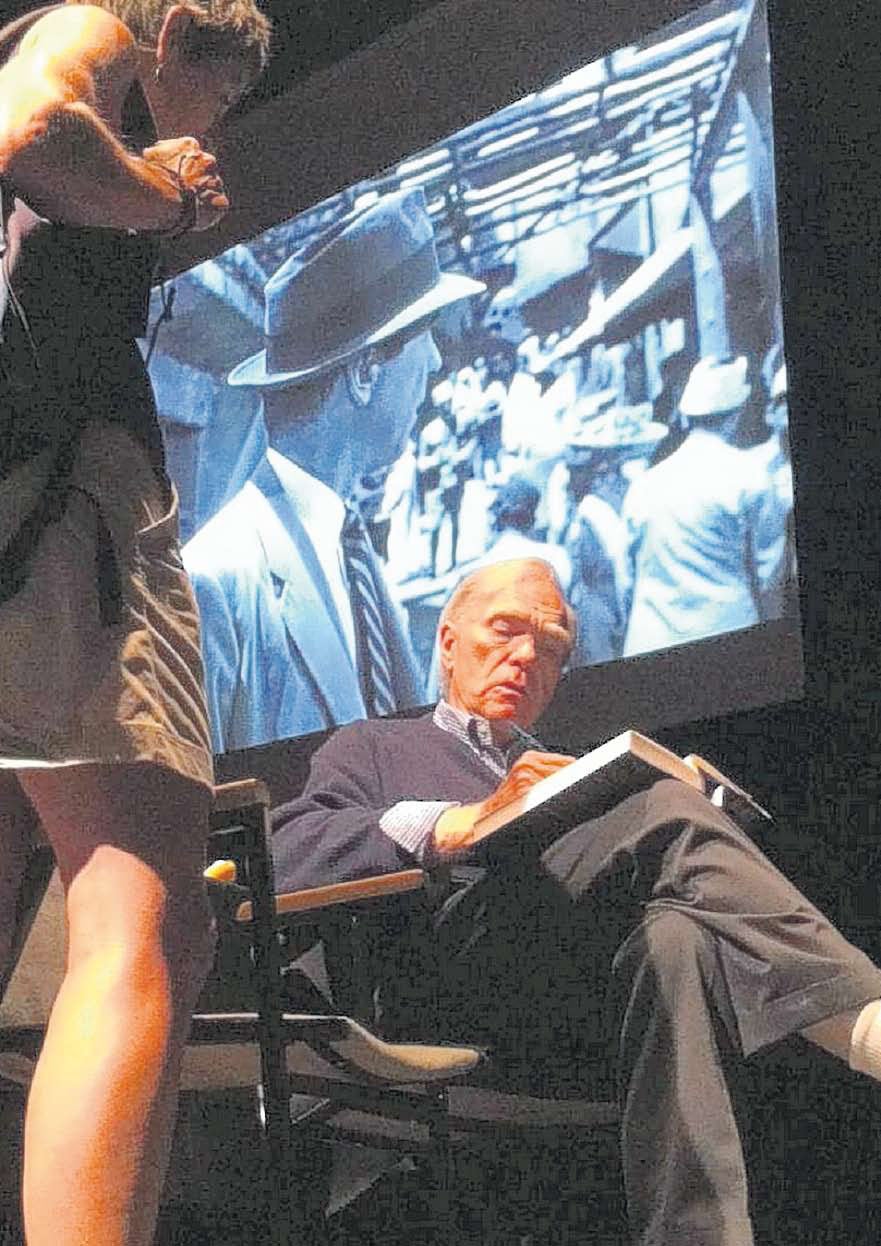
Robert McKee, it was clear from the big photo projected on the stage, and also from the figure who walked up to the lectern, has very bushy eyebrows. For a moment, I couldn't think of anything else. But when he started speaking, I forgot about his eyebrows, and the second croissant I'd meant to grab but hadn't, and thought only about the words. "Story began," he said, "the moment Mother Nature and human nature went their separate ways. The first human thought was something like 'I am', and the second thought was 'some day, I shall not be'. As we became aware of the passage of time, and the brevity of it, and the end of it, we quickly became aware that just living does not teach you how to live."
There is, as Dr Johnson knew, nothing like death to concentrate the mind, but I hadn't expected a talk on screenwriting to start with death. From death, it went on to survival, and how the human mind can "rationalise any evil act". There is, said McKee, "no structural difference between cutting someone up in traffic and cutting off their head". All of us, he said, are struggling to answer Aristotle's question about how a human being should "live their life". Living, he said, "is chaotic and painful", so human beings began to create stories. Culture, he said, "is our great nest".
Any of us who read or write know that stories are what we create to make order out of chaos, but I'm not sure I've ever heard the idea presented with such urgency, or power. The challenge, said McKee, was to "create an emotional truth of what it is to be a human being". There is, he said, a "notion" he finds "repulsive" that stories, or films, are "just entertainment". Entertainment, he said, was "going into the ritual of story so that time vanishes". When a society has weak storytelling, he said, "life rots". We need storytelling to "shine a bright light into the corners of society and express the truth of what it is to be a human being".
I wish I could tell you everything he said. I wrote down nearly every word. This, it turned out, was about as far from 'how to get on in Hollywood' as you could get. This, it turned out, was about how to ditch the careerism, and the cynicism, and the formulas, and write with integrity, and truth. "Are you," he said, "in love with yourself in the art, or with the art in yourself?"
It was, I told him when we met for a cup of coffee afterwards, like a religious experience. McKee laughed. "It is kind of like my religion," he said. "I think these people need to be reminded of why they do what they do". I had thought, I told him, that it might get boring saying the same things all the time, but I could now see how it wouldn't. McKee nodded. He keeps changing things, he said, and developing new resources, like an online "enterprise" called Storylogue, which gives new lessons on a different aspect of writing every week. "I do not teach people how to do anything," he said. "I simply teach what is."

Watch Apple TV+ free for 7 day
New subscribers only. £9.99/mo. after free trial. Plan auto-renews until cancelled.
ADVERTISEMENT. If you sign up to this service we will earn commission. This revenue helps to fund journalism across The Independent.
Watch Apple TV+ free for 7 day
New subscribers only. £9.99/mo. after free trial. Plan auto-renews until cancelled.
ADVERTISEMENT. If you sign up to this service we will earn commission. This revenue helps to fund journalism across The Independent.
And did he think, I asked, trying to put it as tactfully as I could, that he'd had as much satisfaction teaching people how to write stories as he'd have had if he'd produced the film equivalent of War and Peace? McKee didn't hesitate. "Yes. There is an understandable point of view about what I do, that I'd rather be a writer, and nobody believes that I'd rather not. I was a successful writer. I made a living. I bought a home in Santa Monica and put a swimming pool in it with the money I made. I saw enough of my work on screen to realise that my talent was clear, but modest, and I would never be Ingmar Bergman. I just came to realise that this was the natural thing to do."
There seemed, I told him, to be quite a strong moral component to what he does. It seemed, in fact, to be like a vocation. Was it? "Yes. The only meaningful thing," he said, "is that human beings suffer and anything a human being can do to alleviate the suffering of others is meaningful. Art," he said, speaking for all true artists, and for everyone who benefits from art, which is pretty much all of us, "softens the sharp edges of life, and helps us get through our lives."
Robert McKee's next Story seminar is taking place in London this weekend. mckeestory.com Details of the London Screenwriters' Festival's London Breakfast club can be found at: londonbreakfastclub.com
Join our commenting forum
Join thought-provoking conversations, follow other Independent readers and see their replies
Comments
Bookmark popover
Removed from bookmarks