Simon Oakes: 'It's a welcome return. We've managed to fire people's imaginations'
'The Woman in Black' is turning into a triumph for the resurgent Hammer Films. The studio's boss, Simon Oakes, talks to Nick Clark
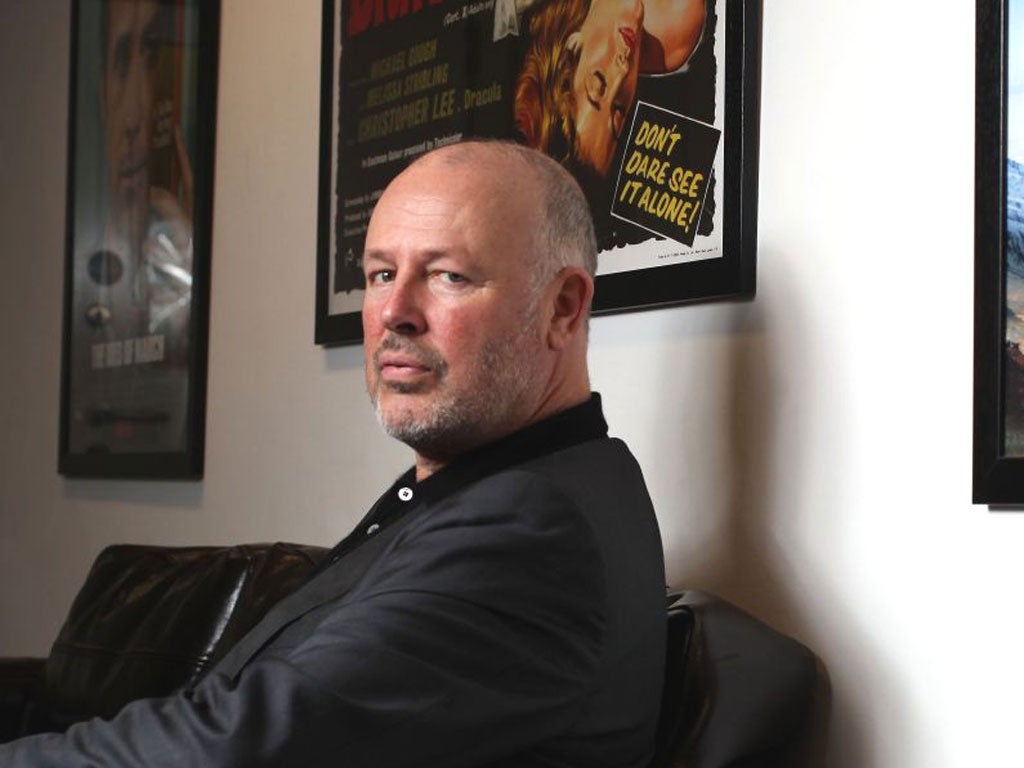
Five years ago, Simon Oakes came up with an unlikely plan – to bring Hammer Films back from the dead. Hammer, which during its golden age in the '50s and '60s produced a string of horror films, had been languishing in the doldrums for 30 years after falling out of fashion.
"Hammer was a part of my youth," Oakes, a former cable television producer, explained. "It was part of our cultural infrastructure." It was this fondness for the films, coupled with a canny eye for the market, that led Oakes and his colleague Mark Schipper to approach Exclusive Media Group's co-chairman and CEO Nigel Sinclair and co-chairman Guy East, and convince investors to back the project.
Three films followed but it has been the fourth, The Woman in Black, starring Daniel Radcliffe, which has propelled Hammer back into the mainstream. The film of the Susan Hill story – a long-time hit on the West End stage – has earned $45m around the world since it opened 10 days ago, topping the box office in the UK and enjoying one of the most successful openings in the US ever to coincide with Super Bowl weekend.
"We never in our heart of hearts thought we'd have that phenomenal opening," Oakes said. "It just caught fire. I hope this means Hammer is back. We now have to follow that up; you don't want to be a one-hit wonder. There is something in the gothic horror theme that really speaks to the heart of Hammer. It's traditional in the sense that it's a welcome return. It's somehow pricked people's imagination."
The film is rated 12A, a far cry from the X certificate given to earlier Hammer movies like Dracula, in 1958. Some questioned the rating but Oakes said there had not been problems from teenagers scared by the movie. "The kids are as tough as old boots; the only people who've had a problem are adults." One woman even passed out at the premiere, although Oakes is adamant she was not a plant in the audience. "Perhaps getting older we're just more neurotic," he said.
Earlier projects for Oakes and his team included the Irish occult horror Wake Wood, the stalker movie The Resident, starring Hilary Swank, and Let Me In, a remake of the Swedish vampire movie Let the Right One In. They were all the result of a re-thinking of what Hammer was about. "Hammer was very much of its time," Oakes said. "We asked ourselves the question: if Hammer had carried on from the late 1970s, where would it be today? How would it have progressed?"
There are some genres within horror that Hammer is not prepared to tackle, for fear of straying from its roots. Oakes said there were no plans to make slasher films or anything from the "torture porn" genre, which saw the rise of the Saw and Hostel franchises. "I just don't think Hammer should make that sort of film. Horror as a genre has almost been usurped by body count movies."
While the production group is now an arm of the US company Exclusive Media, Oakes stressed the importance of Hammer's roots. "The Britishness is very important," he said. "For Hammer, that is part of its selling point and we will have quite a focus on making movies in the UK."
Hammer's rich history stretches back almost 80 years to William Hinds, a comedian whose stage name was Will Hammer. His film production company, Hammer Productions, did not specialise in horror until 1955, following the success of The Quatermass Xperiment. The breakout came with The Curse of Frankenstein (1957) starring Peter Cushing and Christopher Lee, followed by Dracula (1958) which broke box office records around the world.

Watch Apple TV+ free for 7 day
New subscribers only. £9.99/mo. after free trial. Plan auto-renews until cancelled.
ADVERTISEMENT. If you sign up to this service we will earn commission. This revenue helps to fund journalism across The Independent.
Watch Apple TV+ free for 7 day
New subscribers only. £9.99/mo. after free trial. Plan auto-renews until cancelled.
ADVERTISEMENT. If you sign up to this service we will earn commission. This revenue helps to fund journalism across The Independent.
Wheeler Winston Dixon, a professor of film studies at the University of Nebraska, said: "Hammer broke into prominence by being a cutting-edge studio. After Universal had pretty much given up on horror, Hammer reinvented it. Hammer gave horror a new approach. There was more sex, violence and realism. It took horror back to its British roots. They didn't have money, but they had great ideas."
The success of Dracula convinced Universal to sign over the rights to its movie monsters. The remakes that followed included The Invisible Man, The Phantom of the Opera and The Mummy. The studio was recognised with the Queen's Award to Industry for its contribution to the British economy. But gothic horror films fell out of fashion the 1970s, audiences dwindled and the last movie was shot in 1979. The director Richard Donner tried to salvage Hammer before a consortium led by Charles Saatchi bought up the rights but failed to get any projects off the ground; it looked like Hammer had been the victim of a stake through the heart.
But Oakes realised in 2007 that Hammer was still "part of the vernacular. From David Mellor calling Chelsea's defence a Hammer House of Horrors to a New York party where the women were described as Hammer heroines... I started getting more interested".
It helped that its champions included the Hollywood directors Martin Scorsese, Tim Burton and John Carpenter. "I wasn't so much of a fanboy that I wouldn't take on the rebooting of Hammer," Oakes said. If you're too much of a fan you wouldn't want to touch it. We had to convince the fans we cared about it and weren't being opportunistic."
All of the new Hammer projects had remained true to the original company's DNA, he said. A crucial part was to avoid "camping up" the films. "If you look at the original work it was deadly serious. Peter Cushing is one of our greatest actors and never really got the recognition he deserved."
The production team is currently looking into Hammer's extensive back catalogue for remake material, with Scream of Fear (1961) among the possible projects. And then there are the big two. "It would be remiss of us if we weren't to look at an approach to Dracula and Frankenstein," Oakes said, adding that the company was working on "a modern-day version of Dracula. It's very much in its early stages".
Twilight fans should not expect to be swooning over the undead lead actor. "There should be a Hammer house approach to doing it. It should be very different, not a teeny approach," he said.
Horror experts said the strengths of Hammer included recurring casts and crews. While the Hammer of 2012 is looking for more projects for its Woman in Black star Radcliffe and director James Watkins, Oakes said the modern film industry made that approach almost impossible. "Hammer was like a repertory company in the 1960s; it's tough to recreate that."
While many went to see The Woman in Black to find out what Harry Potter did next, it is the job of Oakes and his team, including Tobin Armbrust and Ben Holden, to draw the audience in with the Hammer name alone. Coming attractions include a poltergeist movie set in the 1970s called The Quiet Ones and Gaslight, where Jack the Ripper is called upon to help solve a series of murders. Hammer has also bought the rights to Cherie Priest's zombie steampunk novel Boneshaker, set in 1880s Seattle.
Oakes believes it is a good time to be making movies in Britain, with support from the Government and US studios still making films in the country. The strength of the UK, Oakes said, "is that we have to be different. We can't be like the US with the studio system. We should embrace everybody from Working Title to the Mike Leighs and Ken Loaches. They are a breeding ground for young actors."
Beyond its new releases, the production company is tending to its legacy with the restoration of 30 classic Hammer films for high-definition release. Last year Oakes launched Hammer Books with Random House, and the Hammer Theatre of Horror is in development for London's West End.
Simon Oakes: the CV
Born: St Helen's, Lancashire. Now lives in London, where Hammer films is based.
Education: Studied at Stoneyhurst College, in his home county of Lancashire, before studying Law at Bristol University.
Career: Background includes 12 years working with Liberty Global, Europe's largest cable company, after an impressive early start as the founder and managing director of Crossbow Productions. Resurrected Hammer in 2007. Five years on, he has found commercial success with old-school thrillers Let Me In and The Woman in Black.
Hammer time: the studio that would not die
1934 Hammer Films is founded in London and named after its owner, William Hinds, a comedian whose stage name was Will Hammer.
1937 Studio overstretches itself and goes bankrupt. Only its Exclusive Pictures distributing arm survived.
1946 James Carreras has idea of producing so-called "quota-quickies" to fill gaps in cinema schedules, required by law to show at least of 20 per cent British films.
1951 Studio signs deal with US producer Robert Lippert, establishing it in the American market. Hammer starts producing horror films for which it would become famous.
1955 Seen as the birth of Hammer Horror, starting with The Quatermass Xperiment, above.
1959-early 60s Company courted by US studios as titles include The Curse of the Werewolf and The Kiss of the Vampire.
Late 60s Cash injection sees new surge of horror. Hammer wins Queen's Award for Industry after a three-year stint raises more than £5m in revenue.
Early 70s Arrival of colour television hits British cinema. Hammer is forced to make money from projects like sit-coms.
1980s It concentrates on horror for television but goes into hibernation until 2007, when producer John De Mol buys the Hammer Films rights.
2007-onwards Revival sees a return to horror films, culminating in The Woman in Black, starring Daniel Radcliffe.
Join our commenting forum
Join thought-provoking conversations, follow other Independent readers and see their replies
Comments
Bookmark popover
Removed from bookmarks