Tom Cruise and the world of 'E-meter'-wielding Scientologists
When Ian Halperin went undercover to investigate the lives of struggling actors in Hollywood, he soon found himself in a world of 'E-meter'-wielding Scientologists...
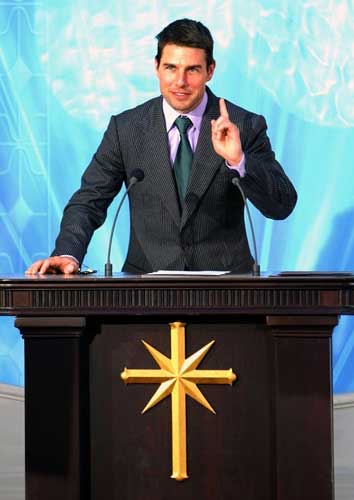
I'd arrived in Hollywood in search of something. But unlike most new arrivals, what I was looking for wasn't celluloid celebrity, but content for my next book – an investigation into the plight of aspiring actors. Most actors struggle for years before landing their first role – and fewer than one per cent end up making a living from the profession. Yet still they come in their droves. I wanted to find out why, what keeps them going and how they make a living in the meantime.
I spent weeks interviewing aspiring actors, hearing one horror story after another about how difficult it is to get cast until I hit on the idea of going undercover and experiencing the life of a Hollywood wannabe for myself.
To this end, I created a suitable persona: a hungry, young, gay actor. My alter-ego was gay because homosexuality in Tinseltown's superficially straight world of lead male roles created an additional challenge to explore, one faced by many of the wannabes I was to encounter. But also, I thought, it seemed appropriate in my role as a wannabe screen star, to flex my own acting skills (I'm straight).
The last thing I had been expecting on my journey was a crash course in Scientology. Although I knew the religion was big in Hollywood, I hadn't fully appreciated what a symbiotic relationship it had with acting. Yet, walking down the street one afternoon, I saw a poster advertising a free acting seminar on how to achieve Hollywood success: "How to Get an Agent. How to Get Work", it shouted. In the name of research, I had to follow up – and was surprised to discover the seminar was being hosted by the Church of Scientology.
On the day, there were six of us in attendance – all actors in various stages of unemployment and all of us pretty bored as the instructor explained the benefits of using Scientology to further our acting careers. Bored, that is, until the woman mentioned several well-known members of the Church whose success – she seemed to be suggesting – might not be unconnected to their membership of the Church. Tom Cruise, John Travolta, Jenna Elfman and Kirstie Alley were among the names she mentioned, explaining how supportive these actors were of the Church and how we might enjoy success if we followed the same path. If it was that easy, I thought, why wouldn't every actor in Hollywood just sign up for Scientology to help them get auditions?
The flip-side, I later heard people claim, is that Hollywood is said to be terrified about the rise of Scientology. "Cruise and Travolta have never won an Oscar," a veteran Hollywood reporter told me. "Can you imagine the speech one of them might make to a billion viewers if they did win?" Could the Church really have that much power?
The instructor passed out information on the history of the Church and its founder, the former science-fiction writer L Ron Hubbard, and at the end, we got to ask questions. Everyone seemed keen on joining except one woman, who asked if there was any chance this process would be used to brainwash us. The instructor said it was important not to lose sight of the importance of attaining spirituality in LA, and that Scientology was the best way to do that. I asked whether there were any fees to sign up – but she was noncommittal at that point.
Like most other religions, I figured, raising funds is a motivator – and by signing up young, unemployed actors the hope is surely that one of their careers will take off and they'll have the next Cruise or Travolta on their hands, which could translate into mega-bucks: both stars donate millions each year to Scientology. Actors are perfect targets for Scientology recruiters, I thought to myself. In a profession dominated by uncertainty, they are vulnerable to someone offering certainty and hope.
A couple of days later I went back to the Church and told a Scientology instructor I was gay. A former Scientologist I'd interviewed had told me that the Church was homophobic and tried to "de-programme" its gay members of their homosexuality. He'd looked to the Church to turn him straight in the 1970s, he told me, but became bitter when the treatment he'd heard about failed to materialise. [Homophobia in Scientology was denied by John Travolta in an interview with The Times last year: "Scientology is not homophobic in any way," he said, "anyone's accepted."]

Watch Apple TV+ free for 7 day
New subscribers only. £9.99/mo. after free trial. Plan auto-renews until cancelled.
ADVERTISEMENT. If you sign up to this service we will earn commission. This revenue helps to fund journalism across The Independent.
Watch Apple TV+ free for 7 day
New subscribers only. £9.99/mo. after free trial. Plan auto-renews until cancelled.
ADVERTISEMENT. If you sign up to this service we will earn commission. This revenue helps to fund journalism across The Independent.
Still, I wondered whether the Church would try to de-programme me and asked if they could help with my "problem" – that my sexuality was affecting my confidence, and therefore my ability as an actor. "Is there any way to get over that?" I asked. "Possibly," the instructor said, and suggested a series of courses called auditing. Would I like to give it a try? After putting me through a series of personality-test questions, I was hooked up to an "E-meter". I had come across this bizarre-sounding device during my research and was somewhat apprehensive. The E-meter was introduced by Hubbard in the 1950s and is used to measure electrical changes in the skin while subjects discuss intimate moments from their past – a simplified lie-detector, as I understood it.
Some have suggested that the personal questions given to "preclears" – new members not yet "clear" of their issues – could provide embarrassing and incriminating information which they later fear the Church could use against them if they try to leave or reveal its secrets – even though the Church's official line on the E-meter is that it is "a religious artefact and can be used only by Scientology ministers or ministers-in-training".
My biggest concern was being hooked up to this device and possibly revealing my true intentions towards Scientology. "Think about something, anything in your life, and focus on it," said the instructor. My mother had died just a few weeks earlier so it was the obvious thing to focus on. The needle jumped to the right, about an inch. The handler could barely contain her excitement; I told her I was focusing on how my homosexuality was screwing up my acting career.
My results come back in the form of a computerised graph: apparently I have a few issues . "You are under severe emotional turmoil but you do have potential," she said tantalisingly. "Scientology can definitely help you with that. It will turn your life around."
I attended several more Scientology seminars. At points, I started buying into a lot of it. Especially the parts about spirituality and self-growth. Many of the people I met at the Church were nice. But I stopped going because I suspected I would have to spend thousands of dollars to complete the auditing sessions, so I decided to call it quits.
After months of blagging my way through auditions and interviewing countless people trying to make it, I sensed a genuine desperation among hopeful young actors to succeed in the movie business. Scientology is just one of many measures some use to try to jump-start their careers. Others I met had resorted to prostitution, sleeping with producers and providing drugs to agents and managers, while many happily paid exorbitant sign-up fees to unscrupulous agents and publicists or doled out for expensive headshots.
"It's all an illusion," a teenage actor named Nikita told me. "When you come here you have high hopes. By the time you leave you're broke, depressed and have to start your life right over from scratch."
I felt even worse for the actors I followed when I set out to audition for a lark and ironically landed a couple of minor roles, including one in the blockbuster of that year, The Aviator. It didn't seem quite fair. But then, in Hollywood, things rarely are.
'Hollywood Undercover', by Ian Halperin, is published by Mainstream at £7.99
Join our commenting forum
Join thought-provoking conversations, follow other Independent readers and see their replies
Comments
Bookmark popover
Removed from bookmarks