Brideshead Rewritten: storm over plot change in new movie
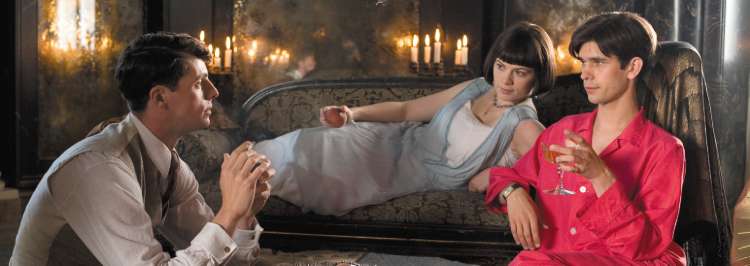
Hollywood scriptwriters have risked the fury of the British reading public by tampering with the plot of one of the 20th century's best-loved British novels.
The film version of Evelyn Waugh's Brideshead Revisited will hit the big screen in America in July, and in Britain in October, but already critics are circling.
With stars such as Emma Thompson and Michael Gambon, excellent acting can be expected. And the settings are apparently breathtaking. The script too, according to early reports is taut. But what have they done to the story? Something that will drive Waugh aficionados wild with rage.
For in comes a scene set in Venice, where Charles Ryder begins a love affair with the aristocratic Julia Flyte, under the nose of her brother, Sebastian, whose descent into alcoholism starts here. The film implies that this is a love triangle – a homoerotic friendship between young men that is displaced when one of them begins a heterosexual love affair, bringing emotional destruction to the other.
But those who have read Waugh's 1945 novel will know that it did not happen like that. Charles and Sebastian went to Venice together, but Julia was not there at all.
Ryder's affair with Julia began later. The siblings never needed to compete for his affection, and the impression given in the novel is that he never meant as much to any member of the rich, troubled, self-absorbed, and profoundly religious Flyte family as they did to him.
In the film, the love affair between Julia and Ryder is central to the story, while in the book it is but a sub plot.
In the book, Ryder is first summoned to the Flyte home when Sebastian needs company, and is under the impression that Julia holds him in contempt for being so readily available. She drifts into an affair with him much later because it is convenient, and because she is mourning for her stillborn baby and escaping from a loveless marriage.
However, the film's producer, Robert Bernstein, has said that he took care to obtain the agreement of the Waugh family before making the alterations. He has also defended the decision to focus on Charles Ryder's relations with Julia as the theme of love across a religious and aristocratic divide has contemporary relevance.

Watch Apple TV+ free for 7 day
New subscribers only. £9.99/mo. after free trial. Plan auto-renews until cancelled.
ADVERTISEMENT. If you sign up to this service we will earn commission. This revenue helps to fund journalism across The Independent.
Watch Apple TV+ free for 7 day
New subscribers only. £9.99/mo. after free trial. Plan auto-renews until cancelled.
ADVERTISEMENT. If you sign up to this service we will earn commission. This revenue helps to fund journalism across The Independent.
"We absolutely needed the approval of the family before we went ahead and wrote scenes that placed Julia, Sebastian and Charles in Venice. We were making a two-hour film, not an 11-part television drama," Bernstein said. "It is important for us to be able to get to the heart of what was, essentially, a triangle."
The screenplay was written by Andrew Davies, who has adapted a series of novels for television ranging from House of Cards to Bleak House, and Jeremy Brock, who wrote the screenplay for The Last King of Scotland.
The cast is headed by Hayley Atwell, as Julia, Matthew Goode as Ryder, and Ben Whishaw as Sebastian. One of the film's locations, Castle Howard, in Yorkshire, may look familiar, because it was also used for the 11-part television adaptation in 1981.
The troubled route from page to screen
*Gone With the Wind
In the novel, published in 1936, Rhett Butler plainly said to Scarlett O'Hara "Frankly, my dear, I don't give a damn", with all the emphasis on "damn". But that was a bit strong for film audiences, so in the 1939 film, Rhett Butler said "Frankly, my dear, I don't give a damn" – as if he might be minded to lend one.
Adaptation
Made in 2002 by Charlie Kaufman, it is probably the most memorable failed attempt to turn a book into a film. Kaufman wanted to adapt Susan Orlean's novel The Orchid Thief. The trouble was that nothing much happened in the book, and Kaufman was afraid of offending Orlean with an inferior adaptation. So he made a film about himself trying to make a film about her book. Nothing much happened in the film either.
*The Color Purple
The 1982 novel by Alice Walker was filmed by Steven Spielberg, who simplified the storyline, conflated characters, and gave the whole narrative a chronology that was easy to follow. Walker's first reaction was that the film was "terrible... it looks slick, sanitised, and apolitical ... like a cartoon". Later, she mellowed and confessed there was much to like in it.
*Notes on a Scandal
Richard Eyre's 2006 adaptation of Zoe Heller's novel got rave reviews, not least because of Judi Dench's performance as Barbara, the manipulative teacher. But Patrick Marber, who wrote the screenplay, was accused of softening the ending. The novel concluded with the main character, Sheba, trapped in Barbara's home, her future uncertain. The film ended with Sheba escaping.
Join our commenting forum
Join thought-provoking conversations, follow other Independent readers and see their replies
Comments
Bookmark popover
Removed from bookmarks