Chavez hits Venice with an entourage to shame the stars
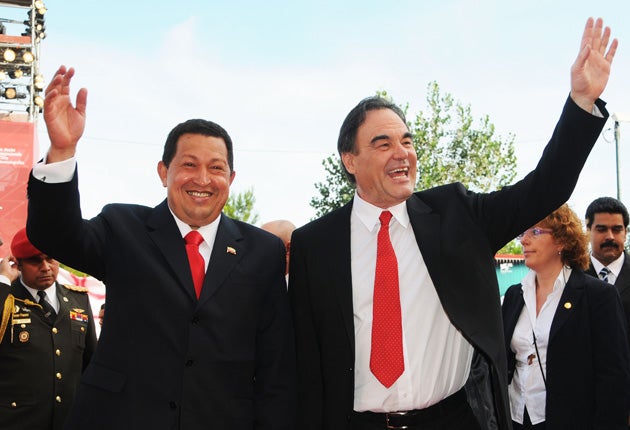
The first sign that something unusual was happening at the Venice Film Festival was when the usual group of dark-suited security men were replaced by a bank of armed police blocking both sides of the street at the entrance to the Sala Grande. Accreditations were being thoroughly checked and every bag, no matter how big or small, was given the airport treatment.
Even A-listers like Tom Cruise, Will Smith and Angelina Jolie don't attract this level of security and George Clooney wasn't due to arrive for another day.
No, this fanfare was all in aid of Hugo Chávez, the president of Venezuela and star of Oliver Stone's new documentary, South of the Border, who flew into Italy for the premiere of the film about his life, in which he is portrayed as being at the forefront of a left-wing consensus sweeping across South America.
In Venice, two protesters carrying anti-Chavez placards were refused entry while a team sporting a huge "Bienvenude Presidente" banner were waved inside the theatre to join the mushrooming crowd.
Tilda Swinton walked by, followed by screenwriter Tariq Ali, before Stone and Mr Chavez emerged from their car. The president, surrounded by an army of bodyguards, seemed to revel in the adulation and separated from his protection to throw a flower to a pretty girl in the crowd.
Mr Chavez spent 30 minutes on the red carpet signing autographs and posing for photos before being ushered into the auditorium where he was given a standing ovation. As is the norm at film festivals, the biggest star was given the final introduction and Mr Chavez rose from his chair and waved to the crowd, who started singing his name.
The film gives a potted history of Venezuela, painting the president as a general who tried to do something about a country in chaos, first through a failed coup attempt and then, following his release from prison, through the ballot box. Once elected, he is depicted as a democrat, a man of his word, who is willing to fight against American imperialism as well as making good on his promise to help the poor.
His success inspired the election of several similar politicians across the continent – Evo Morales (Bolivia), Cristina Kirchner and Nestor Kirchner (Argentina), Fernando Lugo (Paraquay) and Rafael Correa (Ecuador) – the film proclaims. All these leaders, plus Raúl Castro of Cuba, are interviewed by Stone, in a portrait that depicts Mr Chavez as a modern-day Simó*Bolivar, leading South America out of the clutches of the domineering power, with Spain being replaced by the United States.
Speaking at the festival earlier in the day, Stone attacked the Western media's depiction of Mr Chavez. He said: "I originally proposed to do a documentary on Chavez showing the ridiculous level of stupidity and broad statements in the constant media attacks on him. We show that in the film, but I realised that such a documentary was too small for this man. Chavez is a big phenomenon and much more than the attacks in South America."

Watch Apple TV+ free for 7 day
New subscribers only. £9.99/mo. after free trial. Plan auto-renews until cancelled.
ADVERTISEMENT. If you sign up to this service we will earn commission. This revenue helps to fund journalism across The Independent.
Watch Apple TV+ free for 7 day
New subscribers only. £9.99/mo. after free trial. Plan auto-renews until cancelled.
ADVERTISEMENT. If you sign up to this service we will earn commission. This revenue helps to fund journalism across The Independent.
Stone, who has previously made a controversial documentary on Fidel Castro as well as portraying George W Bush in W, said his attempts to make a documentary on Iranian president Mahmoud Ahmadinejad are being thwarted by scheduling conflicts.
Join our commenting forum
Join thought-provoking conversations, follow other Independent readers and see their replies
Comments