A Separation, Asghar Farhadi, 112 mins (PG)
Iran seems such an alien society that it's a relief to see how Tehran's middle-classes suffer the same hum-drum tragedies that befall us all
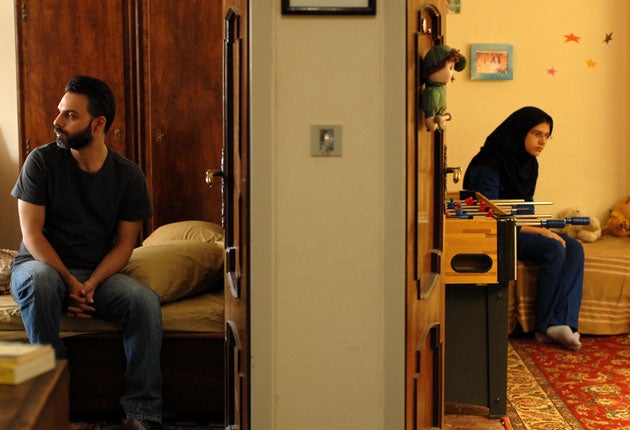
The titles that win the Berlin Film Festival's top prize the Golden Bear are, by and large, pitilessly short on glamour. To be honest, they're not always that distinguished either. This year's winner, however, was very good indeed – but as spare and unembellished as kitchen-sink realism comes. Asghar Farhadi's A Separation is not one of those Iranian films that make up in dramatic intensity (like the works of censured director Jafar Panahi) or formal innovation (Abbas Kiarostami) what they lack in production frills. Rather, A Separation is a low-key, interior-bound drama that you could easily plaster with that damning label "TV movie" – except that TV these days rarely makes or transmits realist drama this intelligent, certainly not in Britain.
Ashgar Farhadi is a new name to me, but this is his fifth film, and it's a very accomplished one. A Separation offers a revealing picture of a society that most of us think of as radically different from our own – and yet, it becomes clear from the film that Iran is remarkably familiar when it comes down to certain painful universals. In Iran too, couples choose to split up; in Iran too, people suffer from Alzheimer's; in Iran too, there's class conflict arising from the gulf between privilege and deprivation. Farhadi's film tells us plenty about social relations in contemporary Tehran – but you may be struck by how much it tells us about ourselves too.
A Separation begins with a middle-class Tehran couple deciding to go their separate ways. We first see Simin (Leila Hatami) and her husband Nader (Peyman Moadi) explaining their situation to a divorce judge. They're separating because she wants to move abroad with their 11-year-old daughter Termeh, while Nader wants to stay put because his elderly father has Alzheimer's. Simin accuses Nader of using his father as an excuse: "Does he even realise you're his son?" she says, with what seems like striking harshness. But we shouldn't judge these characters yet, tempting as it is. In fact, if we never see the judge in this sequence, it's because we are literally placed in his position, with the couple talking directly to camera, ie to us; and we remain in the judging position throughout this very delicate case.
When Simin moves out, a young woman named Razieh (Sareh Bayat) is hired as carer to Nader's father, but it quickly emerges that she's inexperienced and out of her depth. When the old man wets himself, Razieh is unsure what to do, not least on religious grounds – she has to phone an imam to check that it wouldn't be a sin to change his pants.
Then Nader comes home to find that his father has fallen out of bed while left alone; Nader is also convinced that Razieh has taken some of his money. Angry words are exchanged, then – crucially, off-screen – Razieh takes a tumble down the stairs. We learn that Razieh, who was pregnant, has had a miscarriage, and that Nader is blamed – which means that, under Iranian law, he stands to be charged with murder.
Nader soon comes to blows with Razieh's husband Hodjat (Shahab Hosseini), who is furious and desperate, with creditors at his heels. The two couples find themselves in court – or, rather, in the office of a judge who calmly writes documents while everyone shouts at him in turn. The Iranian legal system looks at once bizarrely informal and yet forbiddingly inflexible.
Writer-director Farhadi has contrived a legal drama of absorbing complexity, with the restless camera – working within the ordinary spaces of flats and institutional corridors – reflecting a perpetual shifting of the moral viewpoint. It becomes increasingly clear that it's not easy to apportion praise or blame, although everyone here – bourgeois or working-class, secular or pious – is forever trying to identify others as the cause of their own woes. Characters gain our sympathy, lose it, then win it back – Nader, for example, seems self-absorbed and petulant, the type who cavils over tipping a petrol pump attendant; but he's also a caring son and father.
The acting is terrific across the board, with the cast maintaining varying degrees of harassed distress, as all the characters hustle to keep their own lives in order; Shahab Hosseini especially stands out as the unemployed, beleaguered Hodjat, always on the brink of exploding with inarticulate despair. In fact, while all around lose their grip – and their moral compass – the drama's calm, serious centre is 11-year-old Termeh, played by the director's own daughter Sarina Farhadi. She's the one who ends up asking the pressing questions; and it's in her hands that the story ends, with a conclusion that's a daring and poignant demonstration of the power of an open ending.
Next Week:
Jonathan Romney watches The Tree of Life, the comeback by elusive Hollywood legend Terrence Malick
Film Choice
Kristen Wiig makes female trouble in Judd Apatow's comic kingdom in the priceless, boisterous Bridesmaids, the antidote to nuptial romcom soppiness...French maestro Alain Resnais gets a retrospective at London's BFI Southbank, with a legendary centrepiece in the shape of time- and mind-bending classic Last Year in Marienbad.

Watch Apple TV+ free for 7 day
New subscribers only. £9.99/mo. after free trial. Plan auto-renews until cancelled.
ADVERTISEMENT. If you sign up to this service we will earn commission. This revenue helps to fund journalism across The Independent.
Watch Apple TV+ free for 7 day
New subscribers only. £9.99/mo. after free trial. Plan auto-renews until cancelled.
ADVERTISEMENT. If you sign up to this service we will earn commission. This revenue helps to fund journalism across The Independent.
Join our commenting forum
Join thought-provoking conversations, follow other Independent readers and see their replies
Comments
Bookmark popover
Removed from bookmarks