First Night: The Road, Venice Film Festival

4.00

Bleak but moving tale of the apocalypse
News in pictures
News in pictures
On Facebook
Arts & Ents blogs

Beth Jeans Houghton interview: “I hate London”

Falling from the limelight is often damaging to any artist and devastating at the start of a career....

Turbo Records going into overdrive for 2012

Last year I interviewed Tiga, owner of Canadian label Turbo Records, about his ZZT project - which h...

Review of Being Human: ‘Being Human 1955’

Following on from an episode tinged with tragedy, this week lifted the mood with something lighter.

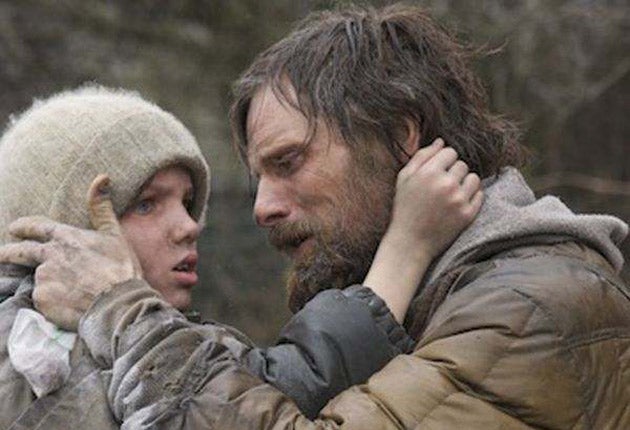
The Road, the very long-gestating adaptation of Cormac McCarthy's novel, was originally due to be released almost a year ago. Its long delay led many to speculate that the film was in trouble. It was very hard to see how a novel as stark and pared-down as McCarthy's fable about a father and son roaming a post-apocalyptic landscape could be made the stuff of cinematic drama.

In the event, John Hillcoat has made a film of power and sensitivity that works remarkably well on the big screen. It plays like a Dystopian version of Huck Finn. "Tattered gods slouching in their rags across the waste," was how McCarthy described the father and son on their grim odyssey south across America toward the coast.

The film captures well the strange mix of heroism and seeming futility that characterises the journey. What is most impressive is the restraint the filmmakers bring to their material. The look of the film is muted and grey other than in the flashbacks to the pre-apocalyptic moments that the man (Viggo Mortensen) enjoyed with his wife (Charlize Theron) before the world ground to a halt.

The music by Nick Cave and Warren Ellis is likewise understated. We don't hear Cave wailing out murder ballads. Instead, the score is used in ominous but understated fashion to accentuate the feeling of loss and foreboding that runs throughout the film.

The Road must have been a plum job for the production designers. They clearly relished helping create the barren landscapes, eerily empty cities and dust-covered houses that fill the film. In other hands, The Road might have played like a slightly artier version of the many post-apocalyptic zombie or horror movies that have been made in recent years. There are plenty of macabre elements here – skulls on sticks, blood-drenched ground, cannibalism, naked humans kept locked away in basements by grim-looking backwoodsmen.

However, Hillcoat eschews morbidity for its own sake. His focus is more on the relationship between the man and the boy. The father comes closer and closer to losing his moral compass and becoming like "the bad guys" It's his son (Kodi Smit-McPhee) who both gives him the reason for persevering with the journey and pulls him back from his own will to violence.

At points, the film is so earnest that it risks becoming inadvertently comic. Hairy, mud-encrusted men wandering across bleak landscapes eating precious tins of fruit can't help take on an absurd aspect. However, the craftsmanship here generally keeps the risk of self-parody at bay.

There is a moving cameo from (an unrecognisable) Robert Duvall as a dying old man the two travellers briefly take pity on and a slightly eccentric late appearance from Guy Pearce as another survivor.

The Road is short on dialogue and very bleak in subject matter but nonetheless makes absorbing and affecting viewing.

Independent Comment
blog comments powered by Disqus

Day In a Page

Picture preview: Lucian Freud drawings

Lucian Freud drawings

Picture preview
Silent revolution at the Baftas as the French take top awards

Silent revolution at the Baftas

The Artist wins in seven categories, with Meryl Streep the other big success story
Whitney Houston: The diva who had – and lost – it all

The diva who had – and lost – it all

Nick Hasted charts the highs and lows of Whitney Houston's life
How Picasso won over (some of) the British

How Picasso won over (some of) the British

Winston Churchill and Evelyn Waugh hated his work, but Picasso provided inspiration for a whole generation of UK artists
Topshop: A Decade Of Design

Topshop: A Decade Of Design

When London Fashion Week starts on Friday, Topshop will celebrate 10 years backing its brightest young stars
John Prescott: 'My wife thought I'd just retire, but I'm not a slippers man'

'My wife thought I'd just retire, but I'm not a slippers man'

At 73, John Prescott isn't mellowing. In fact he's taking a shot at becoming a police commissioner
Jim Gamble: We are losing the race to protect our young

Jim Gamble: We are losing the race to protect our young

Technology and the children who use it won't wait for slow-moving child-protection services and police to catch up
Sarah Sands: A friend is not the one you turn to, but the person who turns to you

Sarah Sands on friendship

A friend is not the one you turn to, but the person who turns to you
Andy Burnham: 'It's a genie out of the bottle moment'

Andy Burnham interview

'It's a genie out of the bottle moment'
Leveson: What we've learnt so far

Leveson: What we've learnt so far

Ingenious hacks, shifty editors and attacks of Sudden Memory Loss Syndrome – Matthew Bell assesses the state of play at the Royal Courts of Justice
Modern lovers: The 'sexual body warriors' and pioneers transforming 21st-century relationships

Modern lovers: The 'sexual body warriors'

Sarah Morrison meets the people redefining love in the 21st century.
'I was angry, so angry': How heartbreak, betrayal and Su Pollard helped Estelle find pop success

Estelle: 'I was angry, so angry'

The singer talks about heartache, betrayal and bouncing back.
Choc tactics: Bill Granger's Valentine's recipes for chocoholics

Bill Granger's Valentine's recipes for chocoholics

Should it be white, milk or plain? Can you make a melt-in-the-mouth pudding without using any?
Male, pale & stale: Could more women on the board help Mothercare – and other ailing firms?

Male, pale & stale

Could more women on the board help Mothercare – and other ailing firms?
Upstairs, downstairs, 2012-style

Upstairs, downstairs, 2012-style

There are now more domestic workers in Britain than in Edwardian times