I Am Love (15)
An Italian affair to remember
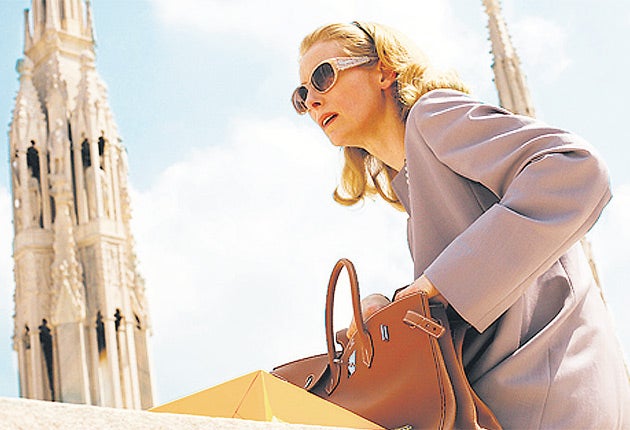
Avoluptuous unease defines the mood of Luca Guadagnino's I Am Love, the story of a super-rich Milanese family thrown into turmoil. From its opening shots – a city panorama, beautiful beneath December snow – the film seems at once serene and ominous, heightened by a brittle John Adams score that always seems to be scurrying ahead of the action. The camera conducts us inside an opulent mansion house, where a birthday dinner for 20 or so is being prepared in honour of Eduardo, ageing patriarch of the Recchi family. Amid the bustle of liveried waiters and kitchen staff, his daughter-in-law and head of the household, Emma (Tilda Swinton), is making sure that everything is just so: even the dining-room table appears to quiver beneath her command.
Guadagnino's rapt, almost fetishistic attention to surface luxury at first feels slightly odd, as if he's composing an ad for some high-end gourmet magazine. Yes, we get the picture, thanks – we're just the people pressing our noses against the window. Only as the story unfolds does its overture of formal perfection make a point: there's only so much even this money-honeyed lot can shape to their will. The first sign of the glaze beginning to crack comes when Emma's artist daughter, Elisabetta, presents her grandfather with what he assumes to be one of her paintings. He unwraps it to find, lo! an arty photograph instead – and looks distinctly underwhelmed by it, too. This little wrinkle of awkwardness foreshadows a large one: when the old man makes his announcement as to who will inherit the family textile business, he somewhat Learishly nominates his son Tancredi, as expected, and his grandson, Edo (Flavio Parenti), as joint owners.
By the end of the evening another time-bomb has been set. Edo has been beaten in a race earlier in the day, and the victor, a handsome young chef named Antonio (Edoardo Gabbriellini), has modestly called at the house to deliver a cake he has made as a consolation present. Emma, on her way to bed, is introduced to the stranger, an encounter that looks innocent enough until she collides with him again some months later, by which time Edo and Antonio are preparing to set up a restaurant together. The film, elliptical in its movement, indicates what lies ahead by shadowing Emma's story with that of Elisabetta's, who has recently come out as a lesbian and dumped her boyfriend. As if taking permission from her daughter's boldness (and copying her new cropped haircut to boot) Emma finds herself chafing at the constrained life she has made for herself. It is only halfway through the film, for instance, that we learn Emma is actually Russian by birth, and changed her name when she married Tancredi: "When I moved to Milan, I stopped being Russian," she says. This revelation spills out in the aftermath of a passionate rendez-vous with the chef at his rural hideout in Sanremo.
The director Guadagnino pieces this together in a dreamy, impressionistic way reminiscent of Visconti, particularly in his mixing of long shots and extreme close-ups. Yorick Le Saux's prowling camerawork in the scenes where Emma spies on Antonio evokes the half-sickened, half-yearning mood of Dirk Bogarde's Von Aschenbach stalking Tadzio through the streets in Death in Venice. The difference is that Von Aschenbach is already dying; for Emma, surprised by passion, a new lease of life is being offered. The affair unfortunately elicits a soft-headed, overheated extravagance from Guadagnino, evidenced in his close-ups of the couple's bodies entwined with flowers. It's like an idiot adman's vision of D H Lawrence, and a misjudgement on the director's part.
Yet there are compelling reasons to keep faith with the film, not the least of them Tilda Swinton's performance. She does banked-down hysteria better than almost anyone, whether as the blackmailed mother of The Deep End (2001), the hopeless kidnapper of Julia (2007), or the murderous schemer of Michael Clayton (2007), for which she won a deserved Oscar. She is not an immediately sympathetic character here, partly because we cannot see what could be wrong with her gilded life, apart from a stiff-necked patrician husband whom we barely get to know. But Swinton understands about making a person live and breathe on screen, rather in the way Pauline Kael once described Jack Nicholson: where other actors convey thought or emotion with a gesture, "Nicholson does it with his whole body, as if he were electrically prodded." That is Swinton's gift, too, and it is shrewd casting that makes her a convincing mother both to the fair-haired Elisabetta and the dark, rangy Edo. Swinton's is one of four memorable female faces here: Alba Rohrwacher as Elisabetta and Diane Fleri as Eva, Edo's fiancee, were familiar from Daniele Lucchetti's 2006 My Brother is an Only Child, while the tiger-eyed Marisa Berenson (another echo of Death in Venice) is superb as the faintly terrifying Recchi matriarch. I loved the way she just plucks an exquisite small painting (Morandi?) off her wall to give as a wedding present to her grandson.
Seen in the wrong mood, I Am Love may appear nothing more than a trivial and melodramatic squib about rich urbanites messing up. But the rich have their private agonies, just like the rest of us, and it's sometimes more relaxing to watch people combust in lovely surroundings, dressed in Jil Sander and Fendi. It might make you want to go to Milan, even if you can't run to a secluded baronial mansion with hushed lighting, immaculate furniture and museum-standard artworks. Think of it as the cinematic equivalent of window-shopping.
Join our commenting forum
Join thought-provoking conversations, follow other Independent readers and see their replies
Comments
Bookmark popover
Removed from bookmarks