Katyn, Andrzej Wajda, 118 mins, (15)
Soldiers who won’t fade away. Starring Andrzej Chyra, Maya Ostaszewska, Danuta Stenka
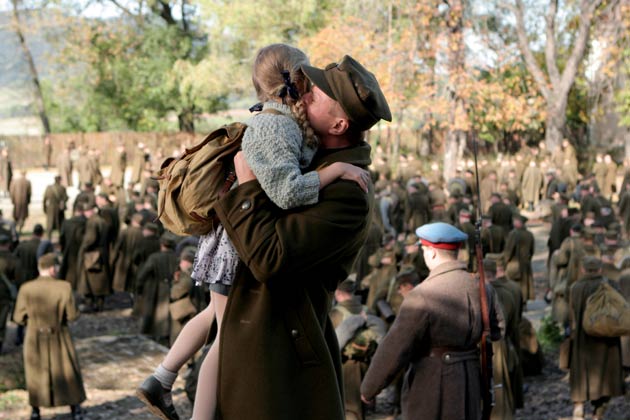
It is arguable that no European country in the 20th century had more injury and infamy heaped upon it than Poland. Andrzej Wajda’s magnificent and harrowing Katyn makes the point in its very first minutes. The time is September 1939, the scene a bridge somewhere in the Polish countryside: two lines of straggling refugees meet in the middle, one convoy fleeing the Nazis who invaded on the first day of the month, the other hurrying from the East, where the Soviets are also making inroads. This is the result of Hitler and Stalin having forged their short-lived pact and divided Poland into two occupied territories. The look on those civilian faces is one of terror mixed with confusion: caught between the Scylla and Charybdis of violent expansionist powers, where can they run to?
Wajda’s film, based on Andrsej Mularczyk’s novel Post Mortem, focuses upon an historical episode that has come to symbolise, for so many, the agony of Poland. The Soviets, after their invasion, took prisoner nearly 18,000 Polish officers, many of them reservists who had been prominent in civilian and intellectual life, doctors, engineers and the like. As such, they represented the possibility of a nation that could shape its own destiny – and therefore were a threat to Stalin’s totalitarian scheme. In the spring of 1940, the Soviet secret police, on his orders, murdered almost 15,000 officer PoWs kept in various NKVD camps. Their bodies were dumped in mass graves, a large number of them in Katyn forest.
This massacre haunts Wajda’s Katyn, as the title indicates, yet it is not seen in dramatic terms until the very end of the film. Instead, Wajda concentrates upon a handful of women – two wives, a mother, a pair of sisters – who suffer through the war wondering what happened to their loved ones, prey to different rumours that have accrued around the disappearance of so many thousands of officers. Bertrand Tavernier investigated a similar theme in his great 1989 film LaVie et Rien d’Autre,about the widows of French soldiers frustrated in mourning men who have literally been “lost”. Wajda, however, is addressing not just the pity of war but an actual war crime, and one whose afterlife became a waking nightmare of recrimination and falsehood. Both Nazis and Soviets used Katyn as a tool of propaganda. First, the Germans dug up the corpses in the forest and condemned the Bolshevik terror; later, when the war turned, the liberating Red Army laid blame for the atrocity on the Nazis – who had, after all, quite a record for this sort of thing by now.
Anna (Maja Ostaszewska), of the small group of characters, comes through the strongest in the first half. She has watched her captain husband, Andrzej (Artur Zmijewski), deported by train to god-knows-where, and her enquiries as to his whereabouts are charmlessly batted away. Andrzej, meanwhile, languishes in a detention camp, keeping a diary that forms part of the film's narration. His lieutenant and friend, Jerzy (Andrzej Chyra), wears the sort of unillusioned expression that sees right through the Soviets' purposes: "Buttons... that's all that will be left of us." The second half, set in the war's aftermath when Poland is under Soviet rule, examines the way history is falsified to such an extent that dissent from the official line can be a punishable offence. Agnieszka (Magdalena Cielecka) is so determined to memorialise her vanished brother – another victim at Katyn – that she sells her hair to a wigmaker in order to pay for a headstone. But the memorial, with its accurate date, is a denial of the Soviet-written history, and Agnieszka's refusal to compromise leads to her arrest by the secret police. What horrible farce is this, Wajda seems to ask, where you cannot mourn your own brother without being made an enemy of the state?
Katyn feels like a film that Wajda had to make. Having turned 83 in March, the director (Ashes and Diamonds is his best-known work here) has lived with his own anguish about the event for almost 70 years. He has said that Katyn, the history, is about two things, the crime and the lie: his dilemma was deciding which one the film should address. If the crime, it was about his father, one of the officers murdered in the forest; if the lie, it was about his mother, whom he watched wither and fade once she realised her husband was not coming home. In the end, of course, it is about both. The poignancy of it is the lie, which the Poles had to live with until as late as 1990, when the USSR finally admitted that the massacre was ordered by Stalin and carried out by the NKVD. In this regard Wajda's film might come to represent for Poland the national poem of loss that The Lives of Others represents for the former GDR. The crime, on the other hand, is poignant and gruelling, the more so for the matter-of-fact way in which it is filmed, a cattle line of slaughter (a bullet to the back of the head) inflicted upon men whose only "offence" was to be Polish. And, as long as the Soviets ruled, the truth of it would never come out. One bitterly disillusioned woman here says, "Poland will never be free". The existence of this film counteracts that pessimism, though it would be hard to call it life-affirming. It is too riven with grief and horror for that, too aware of what Poland has suffered for it to be anything but a deeply sombre memorial.
Join our commenting forum
Join thought-provoking conversations, follow other Independent readers and see their replies
Comments
Bookmark popover
Removed from bookmarks