Arthur Miller's Broken Glass reveals his private sorrows
The play contains allusions to his secret Down's syndrome child and marriage to Marilyn Monroe
Arthur Miller and David Thacker formed one of the most fruitful writer-director partnerships imaginable. From 1985 to 1993, while he ran the Young Vic, Thacker directed seven Miller plays, including the British premiere of The Last Yankee, and produced another three. With Miller's stock at a low ebb in America, Thacker did more than anyone, as The Guardian noted in 1994, to keep him "in the forefront of the English-speaking theatre". In August of that year, the firm of Miller/Thacker reached its creative peak with Broken Glass, turning Broadway failure into award-winning National Theatre success, and as the play has its first major London revival, now is a good moment to trace their collaboration.
Miller had grown to admire Thacker's "almost spiritual connection" with actors in Young Vic rehearsals, and the "youthful energy" of a man 35 years his junior. After the success of The Last Yankee early in 1993, he sent Thacker an early draft of "Gellburg", set in Brooklyn in November 1938, and centred around Phillip and Sylvia Gellburg. The impotent, repressed husband runs the mortgage department – and is the only Jew – at a real- estate company; his wife is confined to bed by hysterical paralysis, seemingly brought on by reading about Nazi attacks on Jews' homes, businesses and synagogues on Kristallnacht.
Though Miller had already dramatised numerous strained marriages and explored the Holocaust in Incident at Vichy (1964) and anti-Semitism in 1940s America in his brilliant novel, Focus (1945), his own Jewish identity had never registered so strongly in his stage writing.
They planned for Thacker to direct a regional tour, then bring the play to the West End, but balked at the producing consortium's insistence on casting star names, and instead approached Richard Eyre, who as NT director had produced its 1990 revivals of The Crucible and After the Fall. He offered them the Lyttelton. Then a veteran Broadway figure intervened. Robert Whitehead, producer of several Miller world premieres, insisted: "It's got to open in New York, because if it crashes at the National it's dead forever." Miller countered: "It's the other way round. I've got complete confidence in them. We should open in London." Whitehead would not back Broken Glass except as a world premiere and Miller yielded.
Working on the script at Miller's Connecticut home, Thacker told him: "Your great plays have got wonderful metaphorical titles – Death of a Salesman, All My Sons – and "Gellburg" does not adequately encapsulate what this play is about." Miller quickly came up with Broken Glass, explaining that this signified Kristallnacht, a groom smashing a glass goblet under his heal in a Jewish marriage ceremony and the breaking of the hymen (Dr Harry Hyman tries to cure Sylvia).
As Phillip, Thacker chose Henry Goodman, a Jew for whom this part was, the director feels, "like his Hamlet". After her performances in his earlier Miller revivals, he wanted his wife, Margot Leicester, as Sylvia, but felt "too vulnerable" to promote her to Eyre; she was hired only when other actresses had rejected the role.
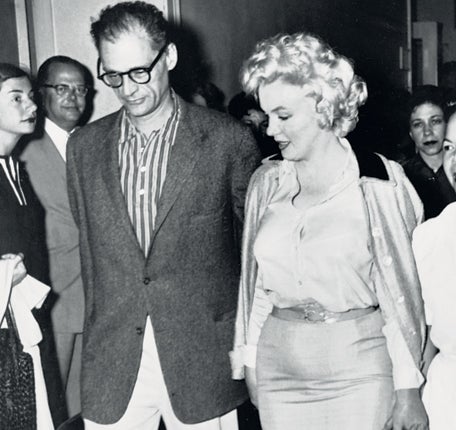
Ken Stott would play Hyman, whom Miller based on one of the many physicians he had watched treating Marilyn Monroe. "Arthur said he was one of the few doctors who would be completely honest with Marilyn," Thacker recalls. "He'd take out her pills and say, 'You see these, they're killing you!' " This elderly man "thought psychoanalytically" with Monroe; on stage, the middle-aged Hyman psychoanalyses Sylvia.
With the NT production set for August 1994, Broken Glass began a pre-Broadway try-out in New Haven, Connecticut, in March, with John Tillinger directing Amy Irving and Ron Rifkin
as the Gellburgs and Ron Silver as Hyman. It was disastrous. The press night was postponed and other performances cancelled. Silver quit. An anxious Whitehead rang Thacker asking for help, and his major suggestion (skip to the next paragraph to avoid reading how Broken Glass ends), was that the climax, when Sylvia regains the use of her legs as Phillip suffers an apparently fatal heart attack, should lose its "fairly crass" medical business and feel more symbolic.
Miller toned down the finale's melodrama, but when Broken Glass moved to the Booth Theatre in April, the New York Times dismissed its predictable "last-minute reckonings" and "baldly utilitarian" supporting characters, such as Hyman's wife, Margaret, and Sylvia's chatterbox sister, Harriet. By July it had closed.
It had lasted just long enough for Thacker to catch it, two weeks into his own rehearsals in London. He flew out thinking it would be very helpful "to see the play done well with American actors", and sat beside Miller in the Booth, only to find Broken Glass "cheap, played for laughs", too fast, devoid of emotional depth. He called it a "completely terrible" production, and Miller agreed.
That weekend, at Miller's house, Thacker suggested inserting a new, penultimate scene "pulling together the narratives" for Sylvia, Margaret and Harriet. Miller added a brief exchange at Sylvia's bedside, in which Margaret marvels at the contrasting personalities of newborn babies – her lines inspired by Thacker and Miller's conversation, while driving through Connecticut, about children – especially Thacker's daughter, Elizabeth, and the son from Miller's marriage to Inge Morath, Daniel, who was born with Down's syndrome and whose existence Miller kept secret, completely omitting him from his memoirs, Timebends. The full story only emerged in 2007, two years after the playwright's death. "We talked about Daniel very briefly," Thacker says, "and I alluded to Elizabeth being in hospital when she was about two and it was becoming clear that she had special needs. But mainly we were talking about different children, and the difference between us all... He wouldn't have written about babies in hospitals had we not been talking about that."
When the playwright joined the London rehearsals, Leicester watched him "get tenser and tenser" as the press night neared. "You felt like saying 'You're Arthur Miller! Why are you getting in a state because of a bunch of critics?'" Those reviewers deemed Broken Glass both "corroded with phoney sentiment" (Rhoda Koenig on these pages) and "one of the great creations of the American theatre" (John Peter in The Sunday Times); the acting was widely lauded. Miller, given a standing ovation on opening night, loved Thacker's "lyrical" staging, which helped Broken Glass win the Olivier Award for Play of the Year.
After 68 performances at the Lyttelton, Leicester and Goodman continued as the Gellburgs for a West End season, a tour, a BBC radio dramatisation and, finally, a 1996 television film directed and co-written by Thacker, which was how Iqbal Khan, currently rehearsing the Tricycle revival with Antony Sher and Lucy Cohu as the Gellburgs, first encountered Broken Glass. He recalls the screen version's "disturbing tone... haunted with fear of the Other, fear of inadequacy, fear of encroaching Fascism."
As Khan readies his first professional Miller production, Thacker is planning his 14th. Now artistic director of the Octagon, Bolton, he will direct The Price there next March, still determined to connect with the man of whom he once said: "I wouldn't exchange anything else I've ever done in the theatre for the experience of working with him."
'Broken Glass', Tricycle, London NW6 (020 7328 1000) previews from 30 September and opens on 6 October
For further reading:
'Arthur Miller' by Christopher Bigsby (Phoenix, £14.99). Order for £13.49 from the Independent Bookshop: 08430 600 030
Join our commenting forum
Join thought-provoking conversations, follow other Independent readers and see their replies
Comments
Bookmark popover
Removed from bookmarks