Galina Konovalova: 'I admired every single thing I did'
As the formidable actress, 97, treads the West End boards in 'Uncle Vanya', she tells Holly Williams of her late and sudden rise to fame
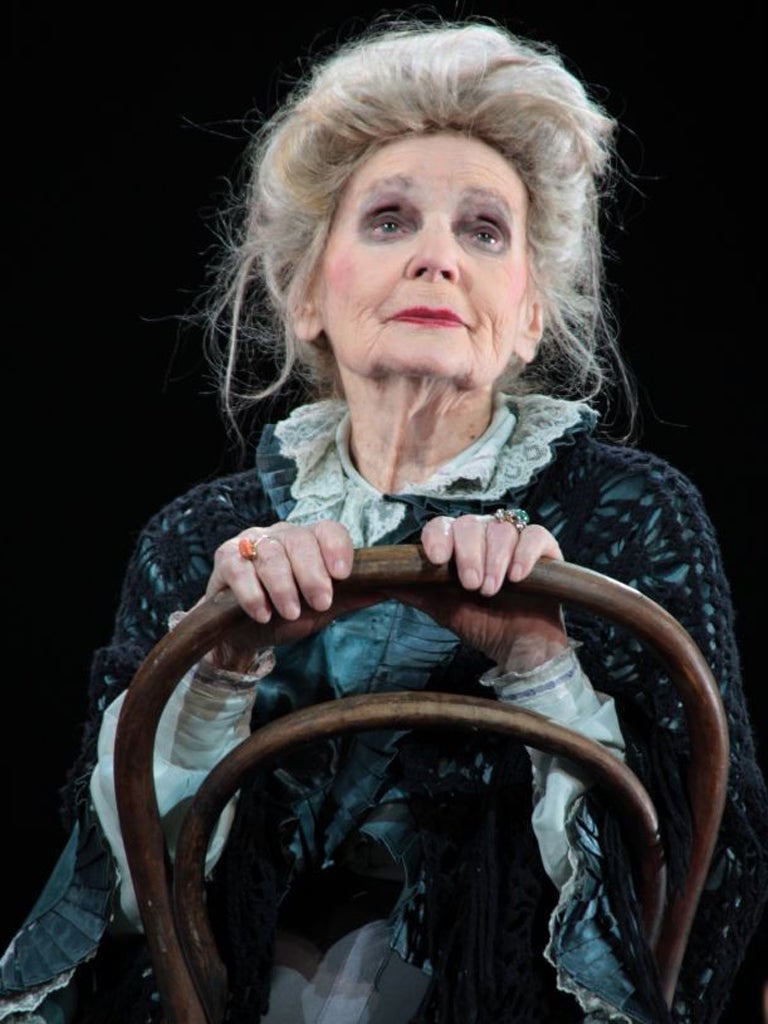
There are not many professions in which you expect to be working at 95. There are even fewer where you might suddenly become famous at 95. But that's what has happened to Russian actress Galina Lvovna Konovalova. Meryl Streep, Helen Mirren, et al – eat your heart out… Konovalova proves there's no age limit on star quality.
Konovalova has given her whole life to one theatre: she entered the B V Schukin Theater School in Moscow at 17, then joined its parent company, the Vakhtangov Theatre, in 1938, and has been there ever since. Admittedly, this is less unusual in Russian theatre, where company line-ups commonly remain unchanged, but it's still pretty rare to get your big break after 70 years.
In 2007, the Vakhtangov Theatre got an injection of new life with the arrival of Lithuanian director Rimas Tuminas. He cast Konovalova as the nurse, Marina, in his unconventional production of Anton Chekhov's Uncle Vanya in 2009; a hit show, it's still played in rep, and is about to enjoy a short run in the West End. While Konovalova has long been a matriarchal figure behind the scenes, on stage she'd always been a bit-part player.
But Tuminas saw something in her; soon, audiences and critics did too. "The most unexpected [performances], however, were not really the main parts," noted Roman Dolzhansky in the Russian newspaper Kommersant, "elderly nanny Marina... performed by Galina Konovalova became cheerful, young, powdered and flirty, with a clear voice Ω a kind of ironic old mermaid". Konovalova, now 97, has had several acclaimed roles since, including a life-imitating-art role as an ageing actress in The Haven.
"Before Rimas came, I had an entirely different life," she says, when I meet her and a translator backstage at the Vakhtangov Theatre, a grand venue on Arbat Street in the historical heart of Moscow. "He saw the character in me and gave me work and of course I'm grateful." But, like a good loyal company member, she explains it's about "giving all your soul" to whatever role you're playing. "I have lived all my life in this theatre, spent my youth and all my days here, and my feeling of success does not depend on this success – it depends on everything I have done here. They were maybe tiny, small parts, but I admired every single thing I did."
She certainly has a thoroughgoing work ethic. Konovalova concludes our interview barely 10 minutes before the curtain goes up on Uncle Vanya. When I timidly ask if she ever gets a bit tired by the three-hour play, she dismisses the idea with a wave, prompting an angry jangling of silver bangles: "I feel perfectly well on stage – I am much healthier on stage than in real life. I suddenly forget about every single ache." She doesn't understand the concept of retiring, it seems; her husband, Vladimir Osenev, also a celebrated actor with the same company, performed until his death in 1977.
Konovalova has lived through times of astonishing change within Russia. Born in 1915, she was an infant during the 1917 revolution that toppled the Tsar. In the Second World War, after a bomb partially destroyed the theatre, killing several actors, the company evacuated to the Siberian city of Omsk for two years. "I still consider it the best period of my entire life," she says. "We were always hungry, we were always cold, but despite all these things we performed there our best performances." Such was their hunger, at a lavish New Year party for the Regional Party Committee in 1942, the actors spent most of the time trying to hide fruit and cheese and even decanters of wine under their clothes.
Then there were the years of Communist censorship; thanks to Central Committee's 1946 cultural decrees, the company were effectively forced to stage on-message, if artistically weak, plays: "It was a 'recommendation' from above; a strong recommendation!" Their tactic was to intersperse these with classics to which there could be no objection, but still spoke to the political circumstances. For the fiercely proud Konovalova, the Vakhtangov theatre "managed to remain, during all those years, a highly intellectual part of society". It gained greater freedom during the post-Stalin "thaw" of the mid-Fifties, although censorship remained until the demise of state agency Glavlit in 1991.
A formidable looking woman, Konovalova is fond of banging the table to make a point Ω and it gets a good rap on the subject of the post-glasnost commercialisation, and dumbing down, of Russian theatre. Thick make-up in no way softens her direct gaze, but there's a wicked glint of humour. Tuminas spied it too: "I first noticed … her very independent spirit. She's a unique person Ω and she has an amazing sense of humour," he tells me after the show. He has her toying with strings of pearls and hooting with laughter in Uncle Vanya; she may be one of the oldest actresses you'll see on stage, but she's also one of the most flamboyant.
This Uncle Vanya may be performed in Russian – there will be English subtitles in the West End – by a long-running Russian company, but it caused a sensation in Moscow in rejecting Chekhovian tropes; as the programme notes threaten, "there are no cosy armchairs, no table laid for lunch with a lacy tablecloth and hot samovar". Set in a large grey frame, it is resolutely non-naturalistic: actors move in choreographed, filmic slow motion, or create vivid visual montages; some are cartoonish and grotesque, while others have a languid, sexual power. We may associate Chekhov with tragedy, but this production, although violent and bleak, is also funny – as it should be, given Chekhov considered his plays to be comedies as much as tragedies. Though if you thought Benedict Andrews's recent modern-day Three Sisters at the Young Vic was a desecration, then Tuminas's Uncle Vanya is also probably not for you.
Might this grande dame feel her national treasure has been violated? Not a bit. Konovalova subscribes to the idea that Tuminas is getting back to the heart of Chekhov's text. "It's not that he found something new and strange," she says. "He just chose the most important details; they're very vivid."
In this, Tuminas's directorial style is arguably in keeping with the Russian director who gives the theatre its name, Yevgeny Vakhtangov. Vakhtangov founded the third studio of the Moscow Arts Theatre in 1920, and it became the Vakhtangov Theatre after his death, aged just 39. "Russian theatre," says Tuminas, "would be completely different nowadays if it had not been for the early death of Vakhtangov."
He was one of seminal theatre practitioner Konstantin Stanislavski's star pupils and went on to reformulate his teacher's theories to develop his own "system" – if it can be called such, since he died before codifying much of his practice – which has been called "fantastic realism". This style combines a Stanislavski-esque exploration of psychological motivation to find a character's "truth" with an ostentatious theatricality, set off by colourful, brilliant sets and costumes.
When I ask Tuminas about Vakhtangov's style, the prickly director dismisses it: "The system – it does not exist, it was invented by theorists. There is a method: it is the method of working." But Konovalova suggests that "the group of students who continued [Vakhtangov's] theatre had this basis, and respected his way of working." She should know – in the 1930s, she studied under Vakhtangov's original acolytes.
System or no, Konovalova has been loyal to the Vakhtangov Theatre, and that long service has been unexpectedly rewarded. At the end of Uncle Vanya, Konovalova takes a bow, to a standing ovation. And she doesn't look a bit tired.
'Uncle Vanya' , Noël Coward, London, tomorrow until Sat
Join our commenting forum
Join thought-provoking conversations, follow other Independent readers and see their replies
Comments
Bookmark popover
Removed from bookmarks