India on stage and in-yer-face
Forget Bollywood dance routines and call-centre cliches, a week of new plays at the Royal Court Theatre is bringing the true drama of modern life in India to Britain
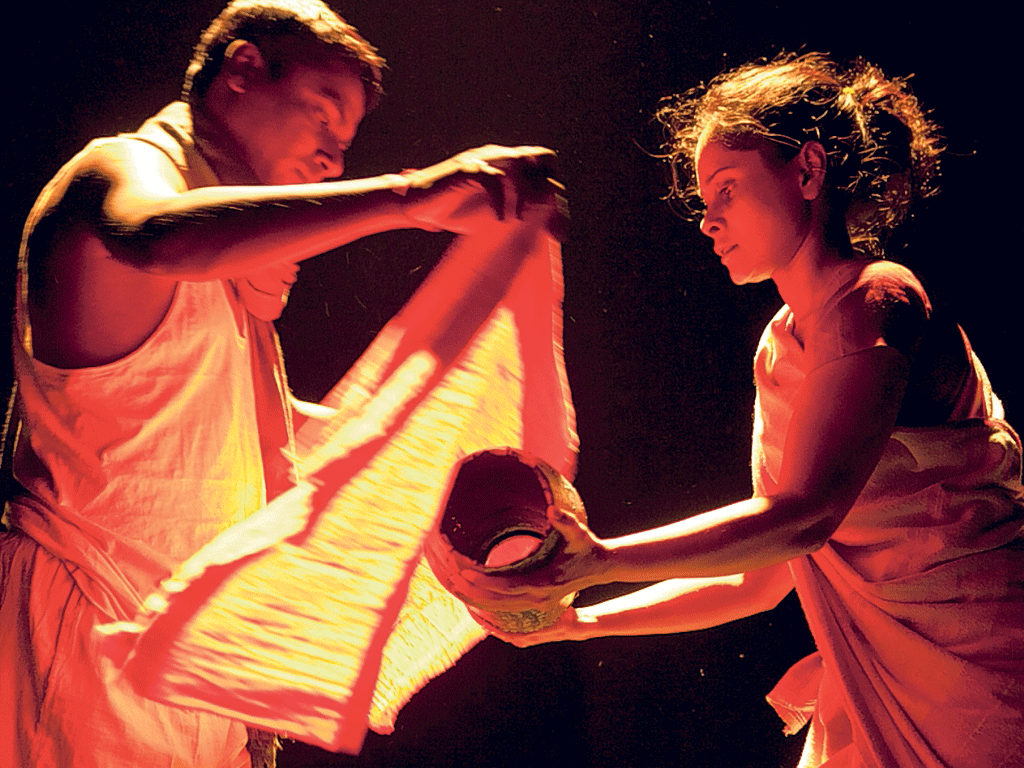
In 2007, I went to the Royal Court to see Free Outgoing, a play by Anupama Chandrasekhar, from Chennai. It was directed by the then rising star, Indhu Rubasingham, who has recently replaced Nicolas Kent as artistic director of London's Tricycle theatre.
The central role of a distraught mother was played flawlessly by Lolita Chakrabarti, whose own first play, Red Velvet, is getting rave reviews at the Tricycle. Chandrasekhar sparkled in the constellation of Royal Court emerging playwrights and hers was the first contemporary Indian drama to be staged at a non-fringe venue in Britain. Five years earlier, she had been on the Court's International Residency programme and there she learnt to hone her work, raise her game. And how.
The play's subject was taboo – sex between unmarried, Indian teenagers and the revenge of society, its hypocrisies and repressive customs that push against modernity even in hubs of new technology. Deepa, a "good" girl and bright pupil, has sex with a schoolboy. He records the juicy moments on his mobile and the clips circulate. She, her widowed mum and brother are horribly ostracised. The audience, mostly white that day, seemed discombobulated, I thought. A comprehensive school teacher asked me if the sex was "realistic or believable". She sounded almost as disapproving as the cruel keepers of virtue on stage and miffed that India was not conserving its old self for the Occident to romanticise and to vacation in. In contrast, I and my Asian friends felt the opposite: Indian drama was finally getting away from Bollywood clichés and religious masques, speaking truths, repudiating conformity. Chandrasekhar's works are not generally staged in India, though some do sneak into small, rebellious venues. Other young talent is similarly thwarted by censoriousness, the lack of resources and spaces for inventive and daring work.
This week at the Royal Court five more such writers will have their plays performed as rehearsed readings. I saw them all as full productions in Mumbai in January at the Writers' Bloc Festival of new writing from all over the country. Some were edgy and tragic, others sharp and funny, all profoundly affecting. Artistically brilliant, urgent, energetic, authentic and eloquent, they touched nerves in the body of their nation, made it twitch. They were among the most powerful examples of modern theatre I have ever seen.
The Royal Court collaborated with Rage, a Mumbai theatre company, to create this festival. Rage was set up in 1993, by Shernaz Patel, Rajit Kapur who are both esteemed actors, and writer Rahul da Cunha. The multitalented ensemble commissions, directs, produces and constantly stretches the parameters of the possible.
Da Cunha explained why and how it all started. Being in Mumbai, a city that "progresses and regresses at the same time" and in a nation "going forwards and backwards and still holding together and to its democracy" is what kicked the Rage trio into action:
"We were driven, restless, felt it was time for modern India to find its voice, its own stories and put them on stage. We didn't have our own English-language theatre except, of course, for Shakespeare, Pinter, Osborne and so on. We started Indianizing the great Western plays, but what we really wanted, and young urban audiences were hungry for, were Indian dramas in English. In a crazy, haphazard way we thought, we knew, the time had come for that to happen. Some people thought drama in English would be elitist. We didn't – what we wrote and directed would have to be in the English Indians actually speak, their intonation, expressions and articulations."
Just as their ideas were shaping up, the Royal Court's artistic director Dominic Cooke and associate director Elyse Dodgson, turned up in Mumbai for a night after conducting a workshop in Bangalore. Call it karma. Da Cuhna, grabbed them, introduced himself and Rage and using his immense persuasive powers got them to promise workshops in Mumbai. They did, and a partnership was forged, with valued help from the British Council. Dodgson, other Royal court nurturers and Phyllida Lloyd went over and released more pent-up creativity than they could ever have imagined. The incipient dramatists were given tools, taught essential skills. At the first Writers' Bloc festival in 2004, in Da Cunha's view, "The level was pretty stunning. Young people saw the results and were totally engaged." Chandrasekhar's disturbing festival play about an Indian talk-show hostess who has acid thrown at her proved that she was both brave and singularly gifted.
Rage's founders carried on making their own remarkable work too. One gripping play I saw in 2010 was Pune Highway, written by Da Cunha and with Kapur in the lead. It was a pacy buddy thriller exposing India's furious and thoughtless globalisation and its ethically vacant middle class, again cutting edge and unsettling for Indians who prefer PR or patriotic art.
India's theatre tradition began in classical times when religious stories were enacted in Sanskrit or as mimes in villages and communities. Gods, improbable heroes and myths were loved by high and low and kept them god-fearing. They are still performed during festivals and at auspicious times. A parallel tradition was drama in local and regional Indian languages. The works, whether classic, extraordinary, worthy or barren, were and still are loved by millions. Parsi theatre was another popular strand. Parsis are descended from original Zoroastrians who fled Persia when Muslims took over that land. They settled in India and under the Raj, this small, urban and successful community became famous for its well-produced and popular comedies and farces in Gujarati.
From the 19th century onwards, playwrights wrote questioning and more complex works – the greatest of them Bengal's polymath Rabindranath Tagore, the first non-European to win the Nobel Prize for literature in 1913. By that time, Shakespeare and other European masters were being read and performed by Westernised urban Indians. After independence, those cultural bonds remained intact. Felicity Kendal's family were nomadic players who took the Bard to rural areas; the Sixties film Shakespeare Wallah told the story.
Since then prestigious drama and music schools have been established and become centres of excellence. I have seen some of their fine productions too, though these seemed to me to keep assiduously within the boundaries of "acceptable" art – unlike the breakout works produced at the Writers' Bloc festival.
In the week I spent at the festival, I saw how Dodgson and her team and the transformative Rage company interacted with writers and directors, never letting standards slip, never slipping into patronising allowances. Their intensity, honesty and sense of purpose stimulated astonishing creative heat and resolve in the artistes and writers. Dodgson is a force of nature and was described to me as the "godmother" of the creative cohort. One of the youthful actors said to be it was "like being in the fastest car, feeling the breeze and excitement, but never losing control because you are trying to reach somewhere where nobody has gone before. It's about control and real freedom, giving expression to things kept locked up. Escape from the usual. You don't know how the young of India need that."
The five readings selected for London include Mahua by Akash Mohimen, which was originally written in Hindi and has been translated. Incredibly young and gifted, he chose as his theme extreme rural poverty and addiction to hooch. It made audiences weep silently. Ok Tata Bye Bye by Purva Naresh, also a translation from Hindi, is about feisty, smart sex workers selling their bodies to truck drivers. The other three deal with property developers and broken communities, the conflict in Kashmir and ruthless modernisation. None of these plays is maudlin or sanctimonious. They are real and engaging, reveal aspects of a country still barely known by Brits. And best of all, not one of them features a noisy wedding or call-centre story.
New Plays from India, Royal Court Theatre, London SW1 (020 7565 5000; royalcourttheatre.com) to 17 November
Join our commenting forum
Join thought-provoking conversations, follow other Independent readers and see their replies
Comments