John Gielgud: When England hounded a hero
John Gielgud's arrest for cottaging in 1953 sparked public outrage and, for the actor, private agony. A new play tells the story of the scandal
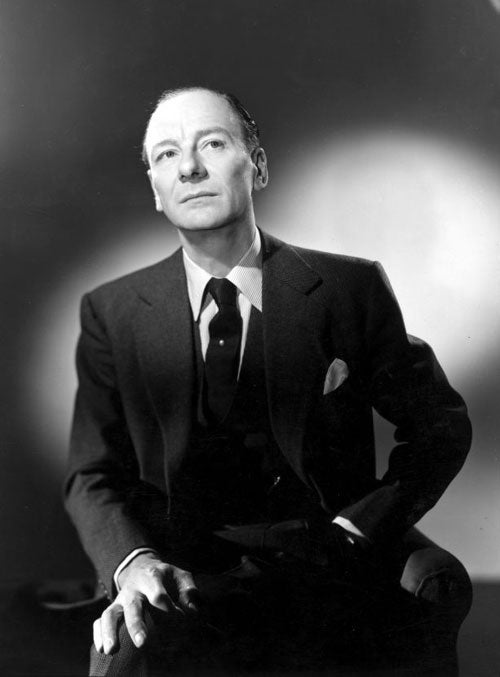
The most terrible moment in John Gielgud's life – on which he maintained a public silence for 50 years – is about to be put on public view. Nicholas de Jongh, theatre critic of the Evening Standard, has written a play in which we will witness Gielgud, played by Jasper Britton, give the glad eye in a public lavatory to a man who then turns out to be an undercover policeman.
But Plague Over England is concerned with much more than Gielgud's arrest in 1953 on the charge of "importuning for immoral purposes". The play shows the milieu Gielgud inhabited and the forces arrayed against him. Its characters include the producer who nearly ended his career, the virulently anti-homosexual Lord Chief Justice Rayner Goddard (a man, says de Jongh, "by buggery obsessed"), an American fleeing his own country's anti-Communist paranoia, and a doctor who claims to "cure" same-sex attraction with Clockwork Orange-style electric shock therapy.
Homosexuals had long been feared and hated in England as men who, it was believed, preyed on the innocent young, and were thus unfit to lead normal, happy lives. Until 1967, they risked prosecution for what the law called "acts of gross indecency between male persons", even in private, and could be arrested for merely showing – in a police spy's opinion – an intent to commit them.
Police throughout England were alert for any hints of homosexual behaviour. The officer who arrested Gielgud was part of a Metropolitan Police squad established in 1930 that regularly lurked in central London toilets.
The year in which Gielgud came to grief in a Chelsea convenience was a particularly dangerous one for homosexuals, as the increased frankness of the period allowed politicians, the police, and the press to profit by inflaming public hysteria, warning that a "plague" or "epidemic" of sodomy was sweeping the land. The Conservative government's crackdown on men who in previous decades would have been protected by their position began in earnest. The Labour MP William Field merely had to resign and pay a fine, but the popular travel author Rupert Croft-Cooke and Lord Montagu of Beaulieu, along with two of his house guests, would be tried and sentenced to between nine and 18 months in prison. The climate of fear was chilling to gay men who paid even the slightest attention to the news.
Gielgud, however, was, in his own words a "silly gubbins" who took in nothing apart from his work. On 21 October, following the rehearsal for NC Hunter's genteel A Day By the Sea, this supremely unworldly man, then 49, had a few drinks at a party and then visited a lavatory popular with cottagers.
Nicked, and aware that he should give a false identity, he said he was a clerk called Arthur (his real name) Gielgud. The next day he appeared before a magistrate who did not know who he was, fined him £10, and ordered him, with the disdain and sexual ignorance of the period, to "see your doctor the moment you leave this court."
Unfortunately, a better-informed Evening Standard reporter was there, too. When that afternoon's paper hit the streets, he was on the front page.
One can imagine the shame and the terror with which Gielgud turned up at rehearsal (he had considered suicide) for the role of a bachelor diplomat whose mother worries that he is lonely and unloved.
But the company, led by his co-star, Dame Sybil Thorndike, in fact welcomed him with open arms. "Oh, John," she said, in one of the most magnificent double entendres of all time, "you have been a silly bugger!"
The producer of A Day By the Sea, however, the immensely powerful Binkie Beaumont, saw the newspaper leaders and the hate mail, and worried that the public would stay away. Yet his thoughts of sacking the star were checked by Gielgud's brother, Val, who applied a little judicious blackmail about Binkie's very own private life.
Although everyone was nervous that Gielgud might be greeted with silence, or even boos, on his first appearance at the Liverpool opening, in the event he was cheered to the rafters, as he was again in London. Five months into the run, however, he began suffering from double vision, had a breakdown, and had to leave the play. He never spoke of the incident publicly, or referred to it in his several volumes of memoirs, and until his death in 2000, other writers respected his wish that it be forgotten.
De Jongh recalls one exception – on Gielgud's 80th birthday, the rather odd and very religious critic Harold Hobson wrote that the "sickening" episode would not have happened if he had only got married.
De Jongh based his depiction of the incident on the report of an actor friend who had the temerity, near the end of Gielgud's life, to ask him what really happened. In Gielgud's version, he had not gone looking for sex, but his account was punctuated by his longtime companion, Martin Hensler, growling, "No, no, John, you always lie!"
Gielgud was known, de Jongh says, as having a penchant for anonymous lavatory sex – "It's one of the reasons his knighthood [just a few months before the arrest] was postponed for years." It was even known he had a "cruising cap" for such forays, an attempt to disguise himself as someone lower down the social scale. But, de Jongh says, "There was no one at the time close enough to him to say, 'John, you mustn't.'"
The arrest had important consequences, and not only for Gielgud, who was told by the British embassy in Washington to forget about a planned American production of The Tempest, as he might prove "an embarrassment". Afterwards, says de Jongh, "the floodgates opened", as the public was confronted by the disturbing fact that an extremely distinguished and beloved artist was one of the people they, in theory, despised. The fuss contributed to the Wolfenden Commission, set up the following year to study prostitution, taking on homosexuality as well. Its recommendations eventually led to decriminalisation.
De Jongh believes that, while the affair broke Gielgud emotionally, he put himself back together in a way that made him better suited to a theatre in a world of greater change and upheaval. He recalls one of Gielgud's greatest performances, which he feels was informed by that consciousness of loss and guilt, in David Storey's Home (1970). "He sat, saying almost nothing, but the tears rolled down his cheeks. He was the picture of shattered, silent despair. Not one of the present generation of so-called great actors could do that now."
'Plague Over England', Finborough Theatre, London SW10 (0844 847 1652), to 22 March; NC Hunter's 'A Day by the Sea' will also run at the theatre during this period
Join our commenting forum
Join thought-provoking conversations, follow other Independent readers and see their replies
Comments
Bookmark popover
Removed from bookmarks