The Black Album: A work in progress
Hanif Kureishi's stage version of his novel The Black Album explores Muslim fundamentalism, youth culture and alienation. Kenan Malik sits in on rehearsals
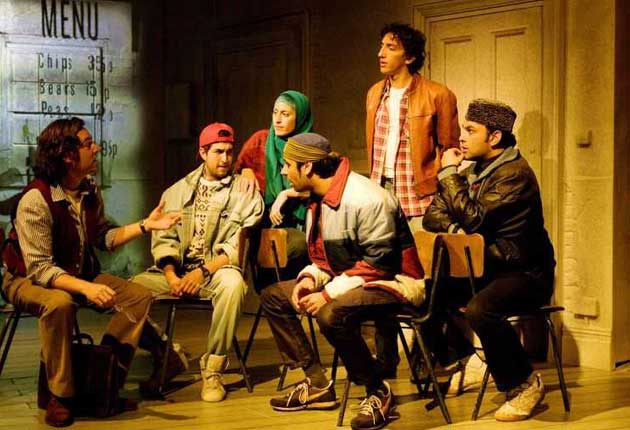
I am sitting in Rehearsal Room 2, in the maze that is the working space beneath the National Theatre, watching rehearsals of Hanif Kureishi's The Black Album. The director, Jatinder Verma, is fine-tuning the performances. Kureishi himself is sitting pensively, notebook open on his lap.
We are watching a scene in which Asian wideboy Chilli catches Riaz, leader of a radical Islamist group, wearing his favourite Paul Smith shirt. Unbeknownst to Chilli, it has been lent to him by Chilli's younger brother Shahid, a student who has been drawn to Islamism. Chilli makes Riaz strip at the point of knife. "Pants too," he demands. And then he looks down. "My fucking socks as well."
Jatinder Verma is not quite satisfied with the way the scene is playing out. "Remember," he tells his actors, "this is the final defrocking of the priest. It's not just his humiliation, it's his defrocking that's important."
It's a privilege watching a rehearsal. For it is here, in a work in progress, in which the actors and director are still struggling to let the drama emerge from the space between page and stage, rather than in the final polished performance, that you begin to understand the real soul of a piece. I am reminded, however, as I watch the rehearsals, that The Black Album is a work in progress in more ways than one. It's not just the actors trying to make sense of the narrative. It is also a story that Britain has been grappling with over the past 20 years.
The play is drawn from Kureishi's novel of the same name, published in 1993. Unlike his first novel, the laugh-out-loud, semi-autobiographical The Buddha of Suburbia, which Kureishi says he had been "trying to tell in various versions since I first decided to become a writer", The Black Album was a "contemporary, 'state of Britain' narrative". It tells the story of Shahid, a lonely, vulnerable student, newly-arrived at college, and finding himself torn between liberalism and fundamentalism – between Deedee, his lecturer and eventual lover, who introduces him to Lacan, sex, and Prince (the title of the novel is borrowed from a Prince album), and Riaz, for whom all pop music is decadent and who teaches Shahid how to pray, fast and submit.
The novel grew out of the trauma of the Rushdie affair of 1989. The campaign against The Satanic Verses, the book burnings that accompanied the protests, and Ayatollah Khomeini's fatwa that forced Salman Rushdie into hiding for a decade, all helped transform the political and cultural landscape of this country. Rushdie himself is never mentioned in either novel or play (though there are many references to "that man"), but The Satanic Verses makes an appearance, as does a dramatic book burning.
"Nineteen eighty-nine was a key moment," says Jatinder Verma. "One wall came crumbling down: there was not a month in which it seemed that another East European country did not emerge from behind the Iron Curtain. But another wall went up: that of faith and censorship." The new wall "cut off conversation". After the Rushdie affair, Verma recalls, "dialogue was out. You couldn't debate different values."
For Kureishi, the fatwa was distressing and not just because he was, and remains, a close friend of Rushdie. "It changed the direction of my writing," he says. "Unlike Salman I had never taken a real interest in Islam. I come from a Muslim family. But they were middle-class – intellectuals, journalists, writers – and very anti-clerical. I was an atheist, like Salman, like many Asians of our generation were. I was interested in race, in identity, in mixture, but never in Islam. The fatwa changed all that. I started researching fundamentalism. I started visiting mosques, talking to Islamists."
Kureishi, like Rushdie, is a writer who came of literary age in the 1980s, exploring the fraught relationship between race, culture, identity and politics in Thatcher's Britain. He became a talisman to a new generation of Asians who were kicking out not just against racism but also against the conventional image of what an Asian should be.
Kureishi's work, the cultural critic Sukhdev Sandhu recalls, transformed the way that both he and his white friends saw what it meant to be Asian. Asians, "had previously been mocked for our deference and timidity. We were too scared to look people in the eye when they spoke to us. We weren't gobby or dissing." Not so Kureishi's Asians. They were as cocksure and streetwise as Kureishi himself. For Sandhu "Kureishi's language was a revelation. It was neither meek nor subservient. It was playful and casually knowing."
Not everyone, however, welcomed either Kureishi's Asians or his language. In 1985 Kureishi wrote the screenplay for My Beautiful Launderette, the story of a gay love affair between bored Asian teenager Omar and working-class white lad Johnny, set against the backdrop of racism and recession. It was shocking, sexy and funny – and for many Islamists unacceptable. Kureishi remembers: "About a hundred people, all men, all middle-aged, would turn up every Friday to demonstrate outside cinemas shouting 'No homosexuals in Pakistan'."
Despite this brush with Islamism, Kureishi never saw The Satanic Verses controversy coming. "I first read The Satanic Verses in proof copy. I didn't notice anything about it that might rouse the fundamentalists. I saw it as a book about psychosis, about newness and change. The Eighties was an age of fusion – in music, in food, in literature. The Satanic Verses was part of that postmodern fusion."
But it was just this postmodern fusion that many found so troubling. What Kureishi calls "the mash-up of culture" others felt as the unravelling of their identity, the erosion of their sense of belonging. Rushdie celebrated his existence "in between" cultures. In The Black Album, Shahid is terrified that his ignorance of Islam "would place him in no-man's-land". As Kureishi puts it in the novel, at a time when "everyone was insisting on their identity, coming out as a man, woman, gay, black, Jew – brandishing whichever features they could claim, as if without a tag they wouldn't be human", so "Shahid, too, wanted to belong to his people. But first he had to know them, their past, and what they hoped for."
The conflict in Kureishi's stories is less a clash of civilisations between the West and Islam than a war of generations within Muslim communities. The first generation desire material prosperity, the second seek to fill a spiritual void. And it is this void that drew many to a fantasy world of Islam.
"The fundamentalists I met," says Kureishi, "were educated, integrated, as English as David Beckham. But they thought that England was a cesspit. They had an apocalyptic view of the future. They lived in a parallel universe. They had no idea what life would be like in an Islamic country but they yearned for everything sharia. And they had a kind of Islam that would have disgusted their parents."
What gives fundamentalists a badge of identity, Kureishi thinks, is their sense of grievance. "Riaz understands that hatred of the Other is an effective way of keeping his group together and moving forward. To do this, he has to create an effective paranoia. He must ensure that the idea of the Other is sufficiently horrible and dangerous to make it worth being afraid of. Just as the West has generated fantasies of the East for its own purposes, the East – this time stationed in the West – will do the same, ensuring a complete disjunction."
Kureishi had thought, back in the Nineties, of turning his novel into a film. It never happened. But a decade and a half on, in the wake of 9/11, 7/7 and the "war on terror", the relevance of the story is even greater. Was it easy, I asked Verma, transforming the tale from page to stage? "The novel had a kaleidoscopic view of London," he says, "moving quickly from episode to episode. The play maintains that episodic sense. Hanif has retained a lot of the language of the original. The novel is full of deft wit. The play is too. It moves between the real and the absurd. Hanif calls it 'hyper-real'."
The Rushdie affair was an iconic moment in our political and cultural life. Yet few artists have reflected upon it. The Black Album, Verma suggests, "is almost unique. Partly that's because it's an issue that people find very sensitive. When we started this project we wondered, 'Can we even read it out publicly?'"
Does he worry that there might be a hostile response to the play? "The Black Album could be said to be a provocative act. But neither Hanif nor I set out to make it an offensive act. We think of it mostly as a reflective act, a work that allows us to reflect upon the past."
The project began with, according to Verma, "lots of conversation with the cast". Some had memories of the Rushdie affair. Others were barely born at the time. They discussed not just the past but the present too. "We started asking ourselves: how did Mohammed Sidique Khan [the leader of the 7/7 bombers] happen? How was he so British and yet so anti-British? How did he get wanting to blow himself up and blow us up?"
Does Verma think that art can help answer the questions with which politicians grapple? "I think it is too much to ask any artist to tackle social and political issues. The only role of the artist is to cause mischief. Mischief is a way of looking at the world. A way of effecting conversation. What the Rushdie affair showed us, what The Black Album shows us, is why making mischief is so important."
'The Black Album', National Theatre, London SE1 (020-7452 3000; www.national theatre.org.uk) tonight to 7 October
Join our commenting forum
Join thought-provoking conversations, follow other Independent readers and see their replies
Comments
Bookmark popover
Removed from bookmarks