Why don't more British theatres put on Václav Havel's plays?
The late Czech dramatist was a hero, but his work is neglected
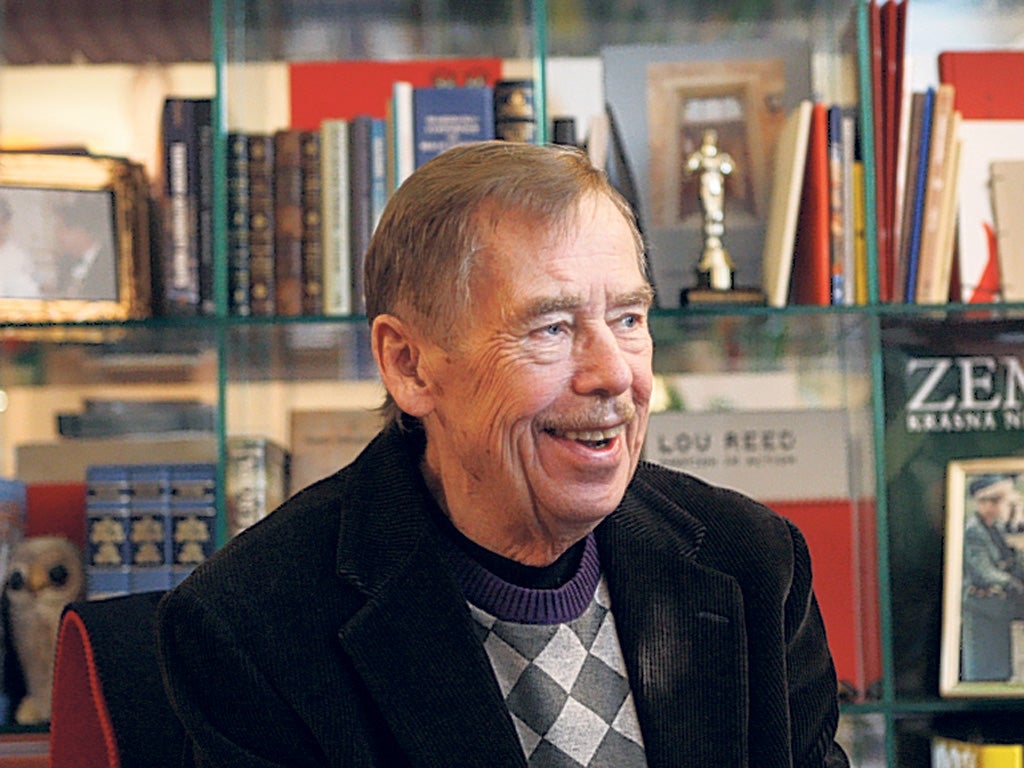
The death of Václav Havel is a loss to the world of a man of great moral integrity. His activities as a dissident, his essays, his bravery and ultimately his political career, have overshadowed his enormous talents as a playwright.
His first three major plays, The Garden Party, The Memorandum and The Increased Difficulty of Concentration, were produced in the years of the Prague Spring, but from the Russian invasion of 1968 onwards he was a banned writer, unperformed in his own country and excluded from any rehearsal process. It is amazing that during the 1970 and 80s, while labouring under restrictions on his freedom, he continued to produce first-class work.
His work in the 1970s culminated in the three one-act "Vanek" plays, with a dissident protagonist at their centre.
But then, on 1 January 1977, Charter 77 burst into the world with Havel as its leading spokesman and, of course, more restrictions followed. In 1979 he was given a four-year prison sentence. In prison he wrote letters to his wife, later published as Letters to Olga; the plays Largo Desolato and Temptation followed his release. His final major play before he found himself thrust into the leadership of his country was Redevelopment in 1987.
In the years before 1989, when the fall of the Berlin Wall and the upheaval in Eastern Europe led to the Czech Velvet Revolution and Havel's elevation to the presidency of his country, he had begun work on a new play. It took some of its themes from King Lear and Chekhov's The Cherry Orchard and its subject matter – a leader leaving office – became more pertinent when he returned to the work after ceasing to be President. Leaving received its premiere in Prague in the spring of 2008 and its first production outside the Czech Republic was at the Orange Tree Theatre, Richmond in September 2008.
In Britain we are still guilty of a certain isolationism towards plays from abroad. This, of course, is partly because we are fortunate in producing a great number of talented homegrown writers. The Orange Tree Theatre, which has had a relationship with Havel and his work over four decades and produced eleven of Havel's plays, initially began that relationship by chance. It was the publication of Audience, the first of the "Vanek" plays, in the magazine Index on Censorship that first caught my attention. The discovery that there was a companion piece, Private View, led to our scheduling a double bill at the beginning of 1977. When Charter 77 then appeared, we found we were presenting plays by the man who had suddenly become the best-known living playwright in the world. We decided to follow the double bill with The Memorandum; we created a documentary called A Faraway Country and, having collected the signatures of our audience on a petition, and with Tom Stoppard at our head, we marched on the Czech Embassy to protest at the treatment of our beleaguered playwright and his colleagues.
The Orange Tree's involvement with Havel, his work and the politics of Czechoslovakia has been the highlight of the theatre's 40-year existence.
But why are we virtually alone in championing his work? Are Havel's plays primarily of interest because of his political life? Politicians talking about him at this time of his death are unlikely to know his plays. Will those who do not know them assume them to be heavy, political and Eastern European, whatever that may mean?
The answer is that regardless of his political stature, he is a major playwright. Although in the late 1960s The Memorandum, his masterpiece, was produced on BBC television, he is now unjustly neglected in this country.
His plays are funny, pertinent, wise and enormously theatrical.
Sam Walters is director of the Orange Tree Theatre, Richmond
Join our commenting forum
Join thought-provoking conversations, follow other Independent readers and see their replies
Comments
Bookmark popover
Removed from bookmarks