Wayne McGregor: Giant leaps in the studio – and in the lab
Could a dance show help treat depression? Wayne McGregor's new production may do just that, says Clemency Burton-Hill
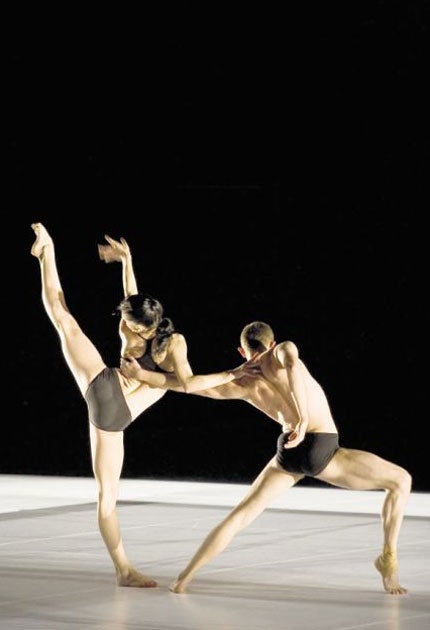
I'm watching ten members of Wayne McGregor/Random Dance in rehearsal, with notebooks in their hands, scribbling furiously. The grey-haired men who are entering data into a laptop and adjusting the many HD cameras recording every angle are two of the world's top cognitive scientists, Dr Philip Barnard of Cambridge University, and Dr David Kirsch of the University of California; and the long, lean streak of kinetic energy and charisma in the corner is Wayne McGregor himself.
Were it not for the fact that those 10 people just happen to be doing the splits as if it were the easiest thing in the world, or contorting a leg impossibly around their body as they write, I could be in a classroom, or even a science laboratory.
McGregor's company's latest dance work, Far, which opens at Sadler's Wells tonight, is an unlikely assemblage of souls.
With Far, the Stockport-born choreographer has taken his insatiable curiosity about the "technology of the dancing body" one step further, overseeing a sophisticated interdisciplinary collaboration that could have significant implications not only for his choreography, but for certain aspects of cognitive science itself.
"We've always done ourselves a big disservice in dance by saying that it isn't an intellectual art form, but one of instinct," he tells me. "Of course, instinct plays into the way we generate and perform choreography, but I've always been fascinated by what's going on with the physical thinking; not only when performing, but in actually creating movement. What are the models by which imagination is constrained? What is this relationship between the brain and the body? And what would happen if you corrupted the messages from the brain to the body, to try and make somebody dis-coordinated, un-coordinated; the antithesis of what you usually do with choreography, which is all body-perfect, body-beautiful?"
What drives McGregor is pushing boundaries, extending the palette of what the body is capable of, or, put simply, "how you say something differently" – which is where the cognitive science comes into play. "The scientists have made a huge difference in changing the dancers' physical signatures," he explains. "What we realised is it's not just about what the dancers do, it's how they think about what they do, because the first point of departure when you're moving is actually imagining. So if you're always imagining in the same way, most likely you're always moving in the same way. If you can redirect the imagining you should be able redirect the physicality. It's pretty logical, really."
For the scientists' part, the collaboration seems to be proving equally fruitful. Barnard, whose speciality is clinical depression, suggests that the tools being developed to help dancers free themselves from mental traps may influence how depressive patients are treated in future.
"In my laboratory work I'm interested in how different aspects of human cognition and emotion fit together," he explains. "And in dance, multi-modal experience – how sounds, music, movement all work together – is really important. So this was an opportunity to look at a problem which is relevant in all sorts of clinical domains, but to look at it from the point of view of elite dancers who are very sophisticated in embodied cognition. We're reaching a point where we've produced something that is potentially very useful."
Was it McGregor's intention that a work of dance should have utility beyond its existence in and of itself? "One of our aspirations," he says, "is to be able to share this information, not just with other professional dancers but with young people, to build and cultivate their imaginations. The things we're learning about can be transferred to all aspects of living and decision-making, and these capabilities are actually very useful life skills. They can help you to think in a less linear way. More dendritically," he adds, helpfully.
'Far' by Wayne McGregor/Random Dance, Sadler's Wells, London EC1 ( www.sadlerswells.com; 0844 412 4300) tonight to 20 November
Join our commenting forum
Join thought-provoking conversations, follow other Independent readers and see their replies
Comments