A tale of two Als: Why Al Gore sold out to Al Jazeera
One's a former Vice-President turned environmental activist, the other's a fast-growing media brand owned by one of the world's biggest oil exporters. So why has Al Gore sold his TV channel to Al Jazeera?
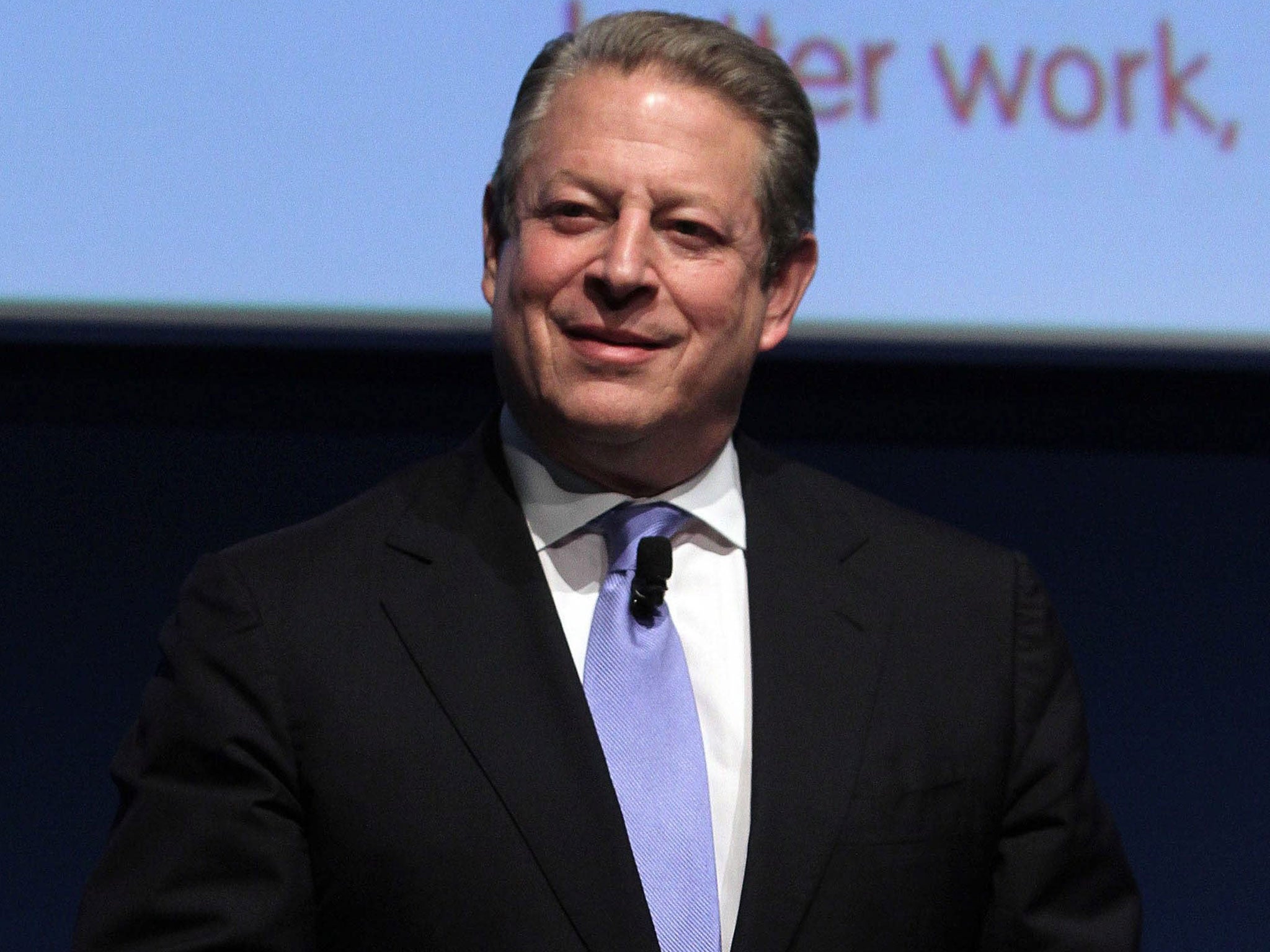
In 2008, Al Gore, US Vice-President under Bill Clinton and climate change crusader, posed a question during a speech at an energy conference in Washington. Referring to renewable energy sources such as solar power, he asked: "What if we could use fuels that are not expensive, don't cause pollution and are abundantly available right here at home?"
One answer, in light of Mr Gore's decision to sell his Current TV channel to Qatar-financed Al Jazeera, is that it would cause sleepless nights for his new friends in Doha, who make their money by selling fossil fuels to the world. Their success had made them very, very rich – and also given Qatar the largest per capita carbon footprint in the world.
This inconvenient truth was omitted from the email announcing the deal, sent to Current TV staff on Wednesday by Mr Gore's partner in the broadcasting project, Joel Hyatt.
"As you may know, Al Jazeera is funded by the government of Qatar, which is the United States' closest ally in the Gulf Region, and is where the United States bases its Middle East Air Force operations," he explained, according to a copy of the email obtained by The Wall Street Journal; what he forgot to mention was the oil and gas business, which accounted for more than half of Qatar's 2010 GDP, according to estimates by Qatar National Bank.
Mr Gore has long campaigned about the environmental damage done by fossil fuels (in the process earning a Nobel prize). Now he has first-hand experience of its economic benefits, after the Qataris reportedly paid around half a billion dollars for Current TV. Based on his reported stake of around 20 per cent, the former VP is expected to net around $100m (£60m) from the sale, a healthy gain on the $60m that Mr Gore and his partners are reported to have paid for the channel in 2004.
While it makes Mr Gore richer, the deal gives Al Jazeera a way to expand its reach in the US. Despite its record of awards and commendations for its international coverage, particularly during the Arab Spring, it has faced an uphill battle in convincing Americans that it is a legitimate news organisation, not a propaganda tool for oil-rich Gulf states or Islamist militants.
With access to Qatar's pockets, Al Jazeera has built an enviable network of bureaus around the world. Founded in the 1990s as an Arab language channel, the network came to global attention during the US wars in Afghanistan and Iraq, facing criticism from American politicians for broadcasting messages put out by Al-Qa'ida. In 2004, Donald Rumsfeld, then the US Defence Secretary, called the network's coverage of civilian deaths in Iraq "vicious, inaccurate and inexcusable". (He later changed his mind when, around the time he was promoting his book, he said the network could be "an important means of communication in the world").
The English version came about in 2006, when the 24-hour Al Jazeera English channel was launched, beaming out to the world from its base in Doha.
But all the money in the world has not been enough – so far – in the biggest TV arena of all, the US, where the network has struggled to branch out beyond a handful of big cities. Currently broadcasting to a mere 4.7 million households, it has remained, despite its global reach and no less than five US bureaus, stuck at the doorstep of a large and lucrative television market.

Watch Apple TV+ free for 7 day
New subscribers only. £9.99/mo. after free trial. Plan auto-renews until cancelled.
ADVERTISEMENT. If you sign up to this service we will earn commission. This revenue helps to fund journalism across The Independent.
Watch Apple TV+ free for 7 day
New subscribers only. £9.99/mo. after free trial. Plan auto-renews until cancelled.
ADVERTISEMENT. If you sign up to this service we will earn commission. This revenue helps to fund journalism across The Independent.
Current TV, which is distributed more widely, could finally give it an entry pass, allowing it to take on the likes of CNN, Fox and MSNBC. The channel came about when Mr Gore and Mr Hyatt bought and rebranded a little cable broadcaster called Newsworld International from France's Vivendi. The new broadcaster went largely unnoticed until a couple of years ago, when it was recast as a scrappy, liberal challenger to MSNBC, the mainstream liberal mainstay in US television news.
Keith Olbermann, the anchor of MSNBC's Countdown, was at the heart of the project to bolster Current TV. But the plans faltered when he was fired less than year into what was reported to be a five-year, $50m contract. To replace him, Mr Gore and Mr Hyatt turned to Eliot Spitzer, the former New York governor who was considered a future Democratic runner for the White House until scandalous revelations surfaced regarding his links to a pricey escort service. In 2009, the channel itself became the focus of the news after two of its journalists were arrested in North Korea for illegally entering the country. They were subsequently pardoned after a visit to Pyongyang by Mr Gore's former boss, Bill Clinton.
Although high-profile hosts and media attention did lift Current TV's ratings, the numbers have remained relatively low, with the daily average limited to fewer than 50,000 viewers, according to analyst estimates. It did, however, have more success in securing distributors. Until recently, it was beamed to around 60 million of the 100 million homes in the US that subscribe to cable and satellite services. Al Jazeera now plans to harness this base by rebranding the network – the new outfit, to be launched in 2013, will have its headquarters in New York City and will be called Al Jazeera America – and doubling its US staff to more than 300.
But challenges remain. Al Jazeera America is expected to be beamed into around 40 million homes after one of Current TV's distributors decided to pull out in the wake of the sale. Time Warner Cable said on Wednesday that it would no longer be carrying the service, which it was removing "as quickly as possible". Earlier, Time Warner was reported to be considering dropping Current TV because of low ratings.
And still looming is the battle to convince Americans to watch the new channel. "There's a fair amount of paranoia when it comes to Al Jazeera," Robert Thompson, professor of TV and popular culture at Syracuse University, told Reuters, referring to Al Jazeera's image problem in the US.
The deal, then, has already paid for Mr Gore and his partners. But whether it proves profitable for Al Jazeera remains to be seen.
Daily Dish to strike out on its own
The political blog The Daily Dish is to part ways with The Daily Beast website and strike out on its own, relying on reader subscriptions instead of advertising for its revenue.
The British writer and former editor of The New Republic, Andrew Sullivan, who lives in America, has cultivated the Dish's online following for the past 12 years. The blog attracts one million unique visitors a month.
Mr Sullivan and his team will use an innovative revenue model, eschewing advertising in favour of what he has dubbed "freemium-based metering". The move is seen as a bold one, as few websites have been successful in their attempts to charge readers for online content.
"Our particular version will be a meter that will be counted every time you hit a 'Read on' button to expand or contract a lengthy post," Mr Sullivan wrote on his blog. "You'll have a limited number of free read-ons a month, before we hit you up for $19.99. Everything else on the Dish will remain free."
Current TV
Founded Current TV launched in 2005.
Headquarters San Francisco
Backers Al Gore and businessman Joel Hyatt launched the network, but it is financed by private investors and individuals.
Size As Current TV mainly airs viewer-submitted content, it has a small staff of a few hundred. Its daily audience is estimated at less than 50,000.
Stars Current TV poached MSNBC's Keith Olbermann in 2011. He was fired a year later, but other celebrity hosts include Eliot Spitzer, a former New York governor forced to resign after admitting to visiting prostitutes.
Success story? Riding the wave of user-driven websites like Facebook and YouTube, it aimed to apply the same logic to television programming. Despite picking up an Emmy in 2007, it struggled to secure an audience. Financial problems forced it to cut about 25 per cent of staff in 2009, while a rebranding exercise in 2011 also failed to bring in viewers.
Al Jazeera
Founded Al Jazeera Arabic launched in 1996, and an English-language version followed in 2006.
Headquarters Doha, Qatar
Backers The network is heavily funded by the Qatari royal family.
Size Al Jazeera has 65 bureaus and 3,000 staff, and claims to broadcast to 220 million households in 100 countries.
Stars For British audiences, its most recognisable stars are the veteran broadcaster David Frost, and Rageh Omaar, know for his reporting of the second Gulf War.
Success story During the US invasion of Afghanistan, the network had to fight allegations from the Bush administration that is was a propaganda tool for Islamists. At the same time, Arab leaders bristled at Al Jazeera's honest, aggressive coverage of the region. Despite initial reservations, it has blossomed into a network respected worldwide for its in-depth coverage of stories and regions often overlooked by other global news outlets.
Join our commenting forum
Join thought-provoking conversations, follow other Independent readers and see their replies
Comments