Last Night's Viewing: Hunted, BBC1 Red Dwarf, Dave
Characters exchange tense remarks, their dialogue as dull as machined aluminium
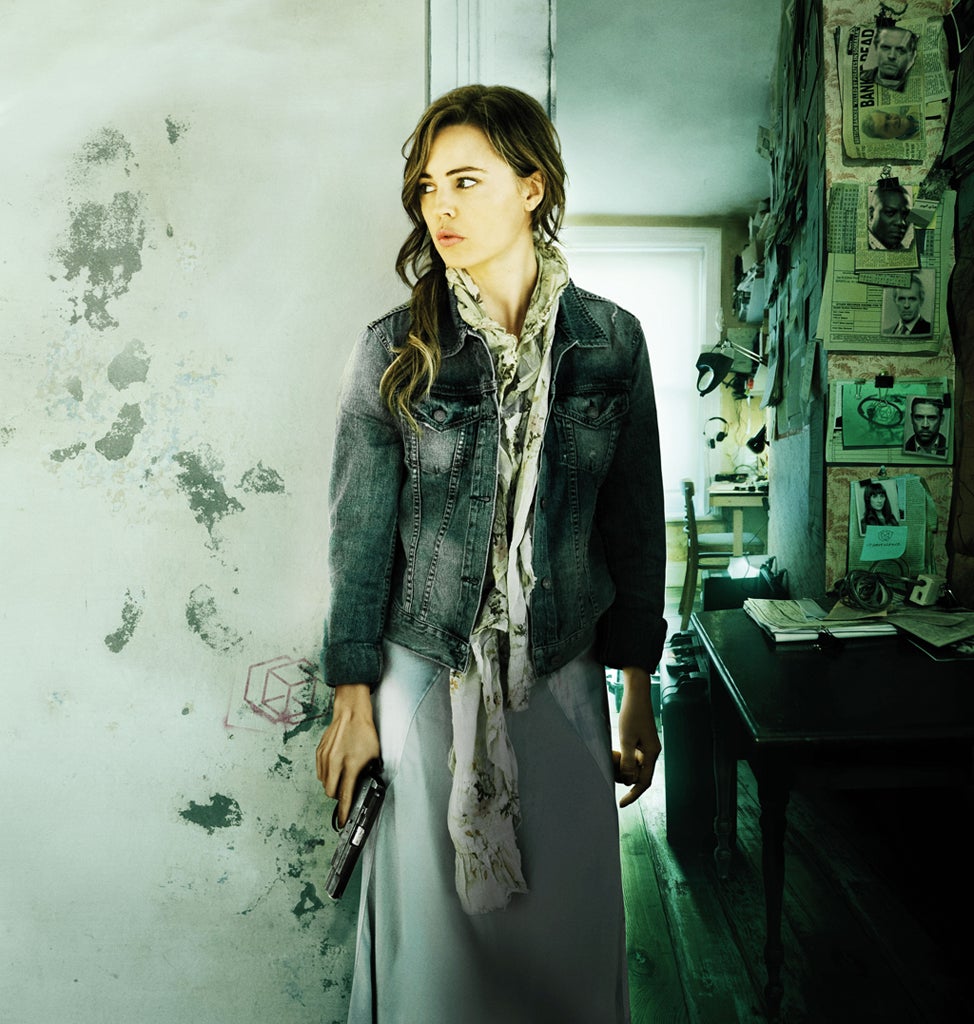
When you're launching a thriller, there are helpful questions and unhelpful ones. The helpful ones – Will she survive? Who betrayed her? Will they complete their mission? – all point down the line, towards the vanishing point of the narrative perspective.
You sit forward in your seat, urging the vehicle onwards so that you can get the answers. The unhelpful questions – Why on earth did she do that? Why have they split up when it would be much safer to stay together? Would that action make sense on any planet? – all point backwards. And they don't accelerate the story, they haul on the brake and impede it. The good thing about Hunted is that its first 23 minutes found all kinds of ways to make you forget about the unhelpful questions. The bad thing is that after that there are so many that they simply become unignorable.
It's a big help that nobody says anything for the first 23 minutes. The characters talk, of course, and exchange the odd cryptic line, but if you were to splice together everything that's said in the long opening section, I doubt it would amount to much more than a minute of speech in total. Instead, they tell the story with images, all arthouse filters and artful focus. The action begins immediately, with Melissa George's pouting agent pulling off a complicated rescue operation in Tangiers. Then she's betrayed as she waits for a colleague in a beach-side restaurant. And then she recovers in a remote bothy in Scotland. It's all style and not much substance, but the absence of substance is knowing and seductive. It plays hard to get, and it does it stylishly.
Then, just as it's reached cruising speed, the drama (created and written by Frank Spotnitz, an X-Files laureate) slams head-first into a wall of cliché. You find yourself in one of those high city offices so beloved of off-the-radar intelligence operations, with one of those unsmiling men for whom introductory small talk is a sign of weakness. Suddenly, it's all "I put my neck on the block for you" and "I'm your best operative", that enervating cocktail of steely taciturnity and baroque over-articulation that was also a feature of Spooks (made by the same company). Characters exchange terse, tense remarks with as little expression as possible, their dialogue as flat and dull as machined aluminium. There are touch screens the size of billiard tables, windowless briefing rooms, bantering colleagues. And the unhelpful questions start to swarm.
Investigating a businessman who plans to buy a Pakistani hydro-electric scheme, the team concoct a plan that has just one unlikely way to go right and about a hundred likely ways to go wrong. It depends on the untested sexual chemistry between George's character, Sam, and a recently widowed father, and on the fact that a notoriously paranoid man (one who has had his study fitted with electronic scrambling devices) won't be worried about concealed CCTV, or even have fitted his own. A professional killer appears, one who favours the unprofessionally complicated method of wrestling people to the ground and jabbing them in the eye with a hypodermic syringe. And, as you ask yourself how believable any of this is, momentum slows to the point that you may well think about getting off and walking somewhere else instead.
After nearly 13 years in television's equivalent of cryogenic suspension (barring a brief defrost in 2009), the Red Dwarf team have been resuscitated for a full-scale series, with a studio audience. A very fond studio audience, judging from the laughter that greeted even relatively straightforward lines in the opening episode. But then the ability of Red Dwarf to mesh the banal with the futuristic is deserving of fondness, as is the polished ensemble comedy of its four principals. Its best jokes aren't transcribable because they sit in the air between the characters, but I laughed. No sign of freezer burn.
Join our commenting forum
Join thought-provoking conversations, follow other Independent readers and see their replies
Comments
Bookmark popover
Removed from bookmarks