Antarctic ice loss vaster, faster than thought: study
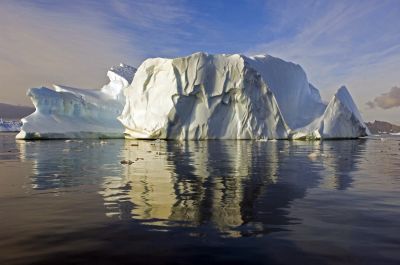
The East Antarctic icesheet, once seen as largely unaffected by global warming, has lost billions of tonnes of ice since 2006 and could boost sea levels in the future, according to a new study.
Published Sunday in Nature Geoscience, the same study shows that the smaller but less stable West Antarctic icesheet is also shedding significant mass.
Scientists worry that rising global temperatures could trigger a rapid disintegration of West Antarctica, which holds enough frozen water to push up the global ocean watermark by about five metres (16 feet).
In 2007 the UN Intergovernmental Panel for Climate Change (IPCC) predicted sea levels would rise 18 to 59 centimetres (7.2 to 23.2 inches) by 2100, but this estimate did not factor in the potential impact of crumbling icesheets in Greenland and Antarctica.
Today many of the same scientist say that even if heat-trapping CO2 emissions are curtailed, the ocean watermark is more likely to go up by nearly a metre, enough to render several small island nations unlivable and damage fertile deltas home to hundreds of millions.
More than 190 nations gather in Copenhagen next month to hammer out a global climate deal to curb greenhouse gases and help poor countries cope with its consequences.
University of Texas professor Jianli Chen and colleagues analysed nearly seven years of data on ocean-icesheet interaction in Antarctica.
Covering the period up January 2009, the data was collected by the twin GRACE satellites, which detect mass flows in the ocean and polar regions by measuring changes in Earth's gravity field.
Consistent with earlier findings based on different methods, they found that West Antarctica dumped, on average, about 132 billion tonnes of ice into the sea each year, give or take 26 billion tonnes.
They also found for the first time that East Antarctica - on the Eastern Hemisphere side of the continent - is likewise losing mass, mostly in coastal regions, at a rate of about 57 billion tonnes annually.
The margin or error, they cautioned, is almost as large as the estimate, meaning ice loss could be a little as a few billion tonnes or more than 100.
Up to now, scientists had thought that East Antarctica was in "balance," meaning that it accumulated as much mass and it gave off, perhaps a bit more.
"Acceleration of ice loss in recent years over the entire continent is thus indicated," the authors conclude. "Antarctica may soon be contributing significantly more to global sea level rise."
Another study published last week in the journal Nature reported an upwardly-revised figure for Antarctic temperatures during prior "interglacials", warm periods such as our own that have occurred roughly every 100,000 years.
During the last interglacial which peaked some 128,000 years ago, called the Eemian Period, temperatures in the region were probably six degree Celsius (10.8 degrees Fahrenheit) higher than today, which is about 3 C (5.4 C) above previous estimates, the study said.
The findings suggest that the region may be more sensitive than scientists thought to greenhouse gas concentrations in the atmosphere that were roughly equivalent to present day levels.
During the Eemian, sea levels were five-to-seven metres higher than today.
Join our commenting forum
Join thought-provoking conversations, follow other Independent readers and see their replies
Comments
Bookmark popover
Removed from bookmarks