11th-hour agreement in Durban sees Big Three legally bound to reduce carbon emissions
Climate change accord reins in China, US and India
The world's biggest greenhouse gas emitters, China, the US and India, will be legally bound for the first time to cut their emissions in a new international climate change treaty to be signed by 2015 and to come into force by 2020.
The "Big Three" polluters finally agreed to a legal regime of emissions cutting at the close of the UN Climate Conference in Durban, South Africa, at 5am yesterday morning, after most observers had thought deadlock was certain. The conference outcome is a substantial achievement for the European Union, which had proposed the new treaty and wanted, and obtained, a "road map" towards it.
Chris Huhne, the Liberal Democrat Energy and Climate Change Secretary, who led the British team at the talks, said pointedly last night: "This is a very good example of how the European Union can act crucially in the British national interest, in a way we could not possibly achieve on our own."
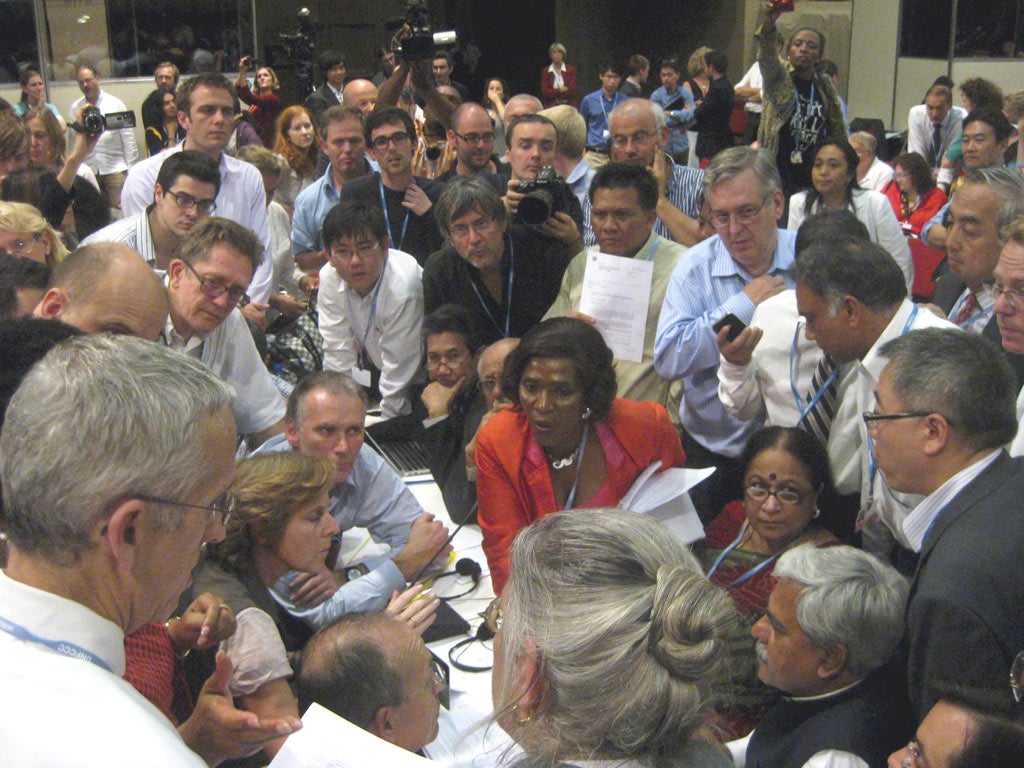
The deal was finally clinched in a face-to-face talk between two women negotiators – the EU's Connie Hedegaard, and India's Jayanthi Natarajan.
The fact that their soaring emissions – China's and India's growing by more than 9 per cent annually, America's by 4 per cent – will now be brought into a binding reduction framework, gives some hope that the world may hold the expected rise in global temperatures under the danger threshold of 2C above pre-industrial levels.
Without their participation, the chances of this were zero. Yet only a fortnight ago, at the start of the conference, all were resolutely opposed to any moves forcing them to cut back their CO2, fearing it would harm their economies.
The fact that they were persuaded to change their minds was a victory for the European Union, which came to Durban with the explicit aim of negotiating a "road map" to a new climate pact binding every country of the world – the three biggest polluters included. The current climate treaty, the Kyoto Protocol, does not cover them, and deals with only 15 per cent of global CO2.
The EU succeeded in its three aims – a new legal treaty, with a signing by 2015, and an entry into force by 2020 – because it managed to put together a coalition with developing countries, many of which greatly fear global warming's impending effects.
This "high-ambition coalition" eventually included more than 120 nations, and put what turned out to be irresistible pressure on the three top polluters, although it was a close-run thing. The US agreed first, then China – but the Indians, desperate to keep their surging economic growth which is bringing the country out of poverty, held out until the bitter end over the language which will now commit them to cutting their CO2 back.
The conference teetered on the brink of collapse and was finally saved by a face-to-face deal between two women – the EU Commissioner for Climate Action, Connie Hedegaard from Denmark, and the Indian Minister of Environment Affairs, Jayanthi Natarajan, who agreed on a final formula.
Formally entitled the "Durban Platform", this agreement commits the world community to "develop a protocol, another legal instrument or an agreed outcome with legal force... applicable to all parties" – which means a wholly new legally binding climate treaty for everyone. Work on it will begin "with urgency" in the first half of next year and it will be signed no later than 2015, and will come into effect and be implemented no later than 2020.
A major fear of environmentalists was that a new treaty coming into force by 2020 would mean "locking in a decade of inaction", but the agreement deals with this in two ways. Firstly, it explicitly recognises for the first time the so-called "emissions gap" – the fact that when all the pledges that all the countries in the world have made about reducing CO2 are combined, that is still far from enough to halt global warming. Secondly, it established a group to work on raising the carbon-cutting ambitions of all countries, in the years before the new treaty comes into force.
In return for the agreement on the new treaty, the EU agreed to a new version of the Kyoto Protocol, which has in the past been important to the developing countries as a talisman of rich countries' good faith, but is increasingly seen as less important than an overarching new treaty.
The concerns of countries such as India and China about climate action harming their development have been recognised by the setting up at Durban of the Green Climate Fund, which will channel much of the $100 billion per year of climate finance which wealthy nations have promised by the end of the decade.
Mr Huhne, who led negotiations for Britain at Durban and played a central role in securing the agreement, said yesterday: "This deal is a very significant step forward and makes it credible again that we can hold global warming to below two degrees above the pre-industrial level, as long as we use this framework to determine ambitious levels of curbs on greenhouse gases which respect the science. It is a very optimistic result at Durban and I think it will be seen as an absolutely key turning point."
But not all environmentalists were as convinced that the road map would work. "Governments have salvaged a path forward for negotiations, but we must be under no illusion – the outcome of Durban still leaves us with the prospect of being legally bound to a world of 4C warming," said Keith Allott of WWF-UK. "This would be catastrophic for people and the natural world."
* Durban deal clinched by two strong women, a united EU and a compromise
* Julian Hunt: How good was this deal really?
What the deal really promises: how to decode the official-speak
It may have been framed in impenetrable legal jargon, but the contents of the agreement boiled down to three key measures, explained below:
What it said: Also decides to launch a process to develop a protocol, another legal instrument or an agreed outcome with legal force under the United Nations Framework Convention on Climate Change applicable to all Parties
What it means: Starts work on a new legally-binding climate treaty
What is said: Noting with grave concern the significant gap between the aggregate effect of Parties' mitigation pledges in terms of global annual emissions of greenhouse gases by 2020 and aggregate emission pathways consistent with having a likely chance of holding the increase in global average temperature below 2C or 1.5C above pre-industrial levels
What it means: Recognised the "emissions gap", i.e. what's promised now won't save the world
What it said: Further decides that the process shall raise the level of ambition and shall be informed, inter alia, by the Fifth Assessment Report of the Intergovernmental Panel on Climate Change, the outcomes of the 2013-2015 review and the work of the subsidiary bodies
What it means: Promised to start something about that right away and not wait for the new treaty
* Durban deal clinched by two strong women, a united EU and a compromise
Join our commenting forum
Join thought-provoking conversations, follow other Independent readers and see their replies
Comments
Bookmark popover
Removed from bookmarks