Ancient glaciers are disappearing faster than ever
Satellite laser measurements show change in environment for the first time
REUTERS
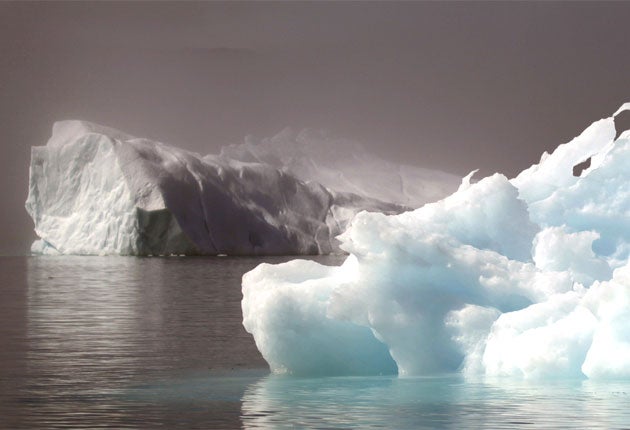
Ice loss from many glaciers in both Antarctica and Greenland is greater than the rate of snowfall further inland
Melting ice is pouring off Greenland and Antarctica into the sea far faster than was previously realised because of global warming, new scientific research reveals today.
The accelerating loss from the world's two great land-based ice sheets means a rise in sea levels is likely to happen even more quickly than UN scientists suggested only two years ago, the findings by British scientists suggest.
Although floating ice, such as that in the Arctic Ocean, does not add to sea-level rise when it melts as it is already displacing its own mass in the water, melting ice from the land raises the global sea level directly. At present it is thought that land-based ice melt accounts for about 1.8mm of the current annual sea level rise of 3.2mm – the rest is coming from the fact that water expands in volume as it warms. But the new findings, published online today in the journal Nature, imply that this rate is likely to increase.
High-resolution satellite laser measurements have shown that along both the Greenland and Antarctic coastlines, the glaciers and ice streams which for thousands of years have slowly carried ice into the sea are now rapidly thinning, meaning they are speeding up in their flow. In both cases, the increased flow rate is extending back far into the ice sheets' interior.
This is happening all the way around Greenland, even at the high northern latitudes, and around much of Antarctica, especially in West Antarctica and around the Antarctic Peninsula.
Areas around the Greenland coast are hotspots of glacier thinning – in some cases the glacier surface level is dropping at a rate of half a metre per year, while in others it is a remarkable rate of a metre and a half.
It is the first time that a comprehensive view of the rate of thinning – and thus ice loss – all the way around the coast has been made possible. It has been put together by Hamish Pritchard and his colleagues from the British Antarctic Survey and the University of Bristol, by analysing millions of measurements from Nasa's high-resolution ICESat (Ice, Cloud and Land Elevation Satellite).
Launched in January 2003, ICESat examines changes in the world's ice and land masses. The satellite's lasers have measured the surface elevation of the Earth's ice sheets with unprecedented accuracy – and thus picked up how they are changing.
"The fact that the changes are so large is alarming, and you wonder how far they will go," Dr Pritchard said. "The thinning effect must be relatively recent, as it is so strong that it could not have been sustained previously without the glaciers melting away."
The scientists compared the rates of change in elevation of both fast-flowing and slow-flowing ice. In Greenland, they studied 111 fast-moving glaciers and found 81 thinning at rates twice that of slow-flowing ice at the same altitude. They found that ice loss from many glaciers in both Antarctica and Greenland is greater than the rate of snowfall further inland.
In Antarctica, some of the fastest thinning glaciers are in the west, where the Pine Island, Smith and Thwaites Glaciers are thinning by up to nine metres per year.
"We were surprised to see such a strong pattern of thinning glaciers across such large areas of coastline – it's widespread and in some cases thinning extends hundreds of kilometres inland," Dr Pritchard said. "This kind of ice loss is so poorly understood that it remains the most unpredictable part of future sea level rise."
* Humanity must stay within the defined boundaries of several of the Earth's natural processes or face catastrophe, a group of leading environmental scientists warns today. The scientists, who include James Hansen of Nasa, the world's leading climatologist, suggest in the journal Nature that nine Earth-system processes are among the planetary boundaries: climate change, ocean acidification, interference with the global cycles of nitrogen and phosphorus, freshwater use, changes in land use, atmospheric aerosol loading, chemical pollution and rate of biodiversity loss.
For three of these – the nitrogen cycle, the rate at which species are being lost and anthropogenic climate change – they argue that the acceptable boundary level has already been passed. In addition, they say that humanity is fast approaching the boundaries for freshwater use, for converting forests and other natural ecosystems to cropland, for acidification of the oceans and for the phosphorous cycle.
View all comments that have been posted about this article.
Offensive or abusive comments will be removed and your IP logged and may be used to prevent further submission. In submitting a comment to the site, you agree to be bound by the Independent Minds Terms of Service.
- Print Article
- Email Article
-
Click here for copyright permissions
Copyright 2009 Independent News and Media Limited


Reduce your global impact.
Comments
But we don't need high resolution laser imaging to show that glaciers in the Alps are melting fast - ompare their present extent with a postcard from 80 years earlier. Glaciers are melting fast, and that is causing sea-level rise. That will threaten a lot of low-lying inhabited areas with flooding - including London.
I think it would be wise to take precautions in the face of this evidence.
Glaciers changes can be more attributed to direct LOCAL human activity. It is not a coincidence that glaciers that are studied by Scientists seem to disappear.
In fact, the only coastal ice that significantly disappears, before ice further out, is in front of the Antarctic biggest base. Nature creates dirt which decomposes. Man makes dirt that floats on surface of melt pools, for example hydrocarbon soot from oil burning. Each year the black non-reflective debris floats back to the surface and stops the reflection of the suns energy. The world weather systems restrict the distribution of soot from mid latitudes getting to the poles. Humans defeat this barrier.
The only way the Arctic copes with this is to completely melt. Once fresh ice is in place it can increase again in thickness.
So if you want to blame anyone, look at the flare stacks of the oil fields close to the Arctic and the "tourist" plane journeys to inspect the area. It is a LOCAL problem of over use to fuel the rest of the worlds greed.
It tempts one to recount the phrase "Eat, drink, be merry, for tommorow you may die!".
This sort of report is used to promote an agenda and when subject to in depth analysis is quite meaningless in the overall histroy of the planet.
Your evidence shows a lack of scientific understanding. The warmer the ice gets the more brittal it will become (ice at 100C is stronger than when it is at 40C). So while the ice won't have completely melted until it reachers 0C it will become much weaker way before then.
Now to the issue of river deltas, coastal land and atolls. All these are lands created by the sea/flood events. Their heights are determined by the local rivers or local weather conditions in storm surge situations. Left to nature the coastal lands would change height as the sea level changes. Changes in ocean currents will forever alter coasts, you can not fight nature. For example, the increase in the flow of the English channel over the last 2000 years has changed how the coast of Britain is eroded.
However LOCAL humans have put up levees, dammed rivers and over farmed the fertile planes. They have destroyed the balance and flood events that deposit the silt. The wet lands used to be huge reservoirs of water that drained during low tide keeping the rivers clear.
In the case of Atolls they have concreted over the coral debris that forms the atoll land. The trees are cut down and plantation cleared for runways and housing. Atolls are sinking Volcanoes. They should have long gone if it was not due to the coral debris entrapment during storms.
Now the storms deposit the new coral debris, that used to interlock into the old, and raise the island level. Now it just gets brushed off the tarmac and concrete and the island erodes and sinks. Atoll destruction is a LOCAL problem. I have visited (by boat) both deserted atolls and over inhabited holiday destinations and the differences are huge.
(Poisoning the New coral with sewage, over fishing, and western debris does not help either)
Then there is the issue of water extraction from beneath major cities. The land starts to fall into the sea. Bye Bye London.
But none of the destruction is down to any global CO2 or warming effects. It is LOCAL destruction to satisfy the greed of this world.
Would the Independent like to do a real story about the climate industry's manipulation of raw data - http://wattsupwiththat.com/2009/09/23/t
Thought not.
Six years is nothing in climatic terms. Nothing. Temperatures rose for 20 years from 1977 to 1998, now they are no longer rising. Twenty years, not six. We are all still here and no catastrophe has occurred.
Now six years of 'accelerated melting' will bring doomsday.
1. What evidence is there that this melting will continue unabated for another 50 years? None, I think you will find.
2. What evidence is there that it will accelerate?
3. What do we actually understand about Greenland ice melts over millennia and how does this data fit into it?
The data is no doubt carefully gathered. The question here is whether the Independent article was written after reading the paper or the Press Release. Press Releases are spun for a purpose, which in research is attracting more funding. You see such stories every year about 'a new cure for cancer'. Usually the work done is a small incremental step that MIGHT, in twenty years, lead to a new treatment. But it is trumpeted as 'a new cure'. Until you read the small print. Ditto this on climate science. What you see is a particular pattern of thinning, not the first time and it won't be the last, and it's extrapolated to doomsday.
We'll see.
1) The melting is caused by a rise in the average global temperature, if the temperature keeps rising the ice will keep melting because it is getting warmer and warmer. This can easily be demonstrated by putting an icecube in a box and steadily heating the box up. The hotter the box gets the faster the ice cube melts. So your claim that there is no scientific evidence is totally wrong.
2) If the average global temperature rises faster the ice will melt faster, for reasons explained in 1).
3) If the ice melts it will go into the sea and cause sea levels to rise.
1. It stopped at the point of the 1998 el Nino - FACT.
2. The peak of all-time record temperatures in individual locations was in the 1910s and 1920s, not now.
3. Much of the 'rise' in average 'temperatures' is ascribable to UHI effects, something which is becoming increasingly clear.
Do you have data on what was happening in Greenland in the medieval warm period? Did they in those days predict what you are predicting now? And did they predict the Little Ice Age too?
You warmers need to look at climate in terms of centuries and millennia. In terms of a self-regulating system which oscillates, not a kettle which is heated up.
I studied science for many years. And it took me a long time to read between the lines of the bullshit.
You need to look at the data. Not at the interpretations.
Sadly.
There IS going to be a crisis. But the cause is that we have little perception of time scale, civilization arose in a stable period and near water and that there are too many of us for the natural shifts in the amount of landmass to sustain the population of the world.
"At present it is thought that land-based ice melt accounts for about 1.8mm of the current annual sea level rise of 3.2mm – the rest is coming from the fact that water expands in volume as it warms. But the new findings, published online today in the journal Nature, imply that this rate is likely to increase."
Firstly the 3.2 =/- 0.04 mm/year was since 1992 until 2006 when it began to decrease and almost flatten. This is completely inconsistent with the news that glaciers are melting at an alarming rate. Furthermore, even the AGW pundits are now admitting that there has been no global warming since 1999. So to claim that this alarming melt, even if it was true, is due to global warming is just rubbish.
Others have referred to Greenland and the time when it was virtually ice free and colonised by the Vikings. But remember there are still some of the AGW faithful who still believe in the discredited hockey stick curve. Furthermore we are all aware of the fact that the Western Antarctica and the Antarctic Peninsula suffer melting. But this is a minute fraction of Antarctica and could well be due to such phenomena as underwater volcanic activity or complex ocean current behaviour. Certainly the air temperature in the region is not warming.
Unfortunately we are going to get more of this as we approach December. Mind you I reckon the whole conference could well be a disaster now Jonah Brown is attending.
Only yesterday the greenies were shouting that the Australian dust storm was clearly due to manmade global warming. Unfortunately these greenies forgot that climate change was supposed to begin just sixty years ago.
Temps have been effectively stable since 1997. This may be a short term blip but it may well be the beginning of a multi decadal change to a slight cooling trend.
http://nsidc.org/data/seaice_index/imag
Is the Antarctic ice growing or declining? Is the ice getting thicker or thinning?
I'm afraid it is as clear as mud.
http://www.sciencemag.org/cgi/content/f
but surely the Arctic has been warming?
http://ocean.dmi.dk/arctic/meant80n.u
50 years of data says "NO!"
but what has caused glaciers to speed up and slow down and will that lead to catastrope?
http://icecap.us/images/uploads/OllierP
apparently NOT!
What does that say about the reporting on the Polar ice caps?
http://pielkeclimatesci.wordpress.com/2
It says it is poor!
People around the world are finally starting to realize that they've been had. Even if global warming does occur, its overall effects will be overwhelmingly more positive than negative.
Don't be fooled by the global warming lies. 'Global warming' is a marketing concept that's proven to be a massive windfall for thousands of companies trying to sell you on a 'green' lifestyle.
receded.
People alive today have to consider whether they want to use the resources of the world without regard to the future.
Using renewable sources of energy is hardly going to break the bank or lead to the downfall of civilisation.
Changes would have to be made, but if the money can be found for the banking crisis, it should surely be there for
safeguarding energy independence and safe guarding our remaining oil reserves for the other importrant uses they have apart from fuel.
When one's opposition to the facts is based on "political belief" (like climate change skeptics) then all reasoning goes out the window. They'll search the entire world for "scientists" who support their political agenda - - - - - this is NOT hard. Why? Anyone can find quite a few "scientists" who are still prepared to say that tobacco smoking is harmless, that the earth was created in 6 days, that we didn't "really" land on the moon, that the Earth is only a few thousand years old etc etc etc etc etc. Getting a TINY minority of the world's scientists to say "global warming isn't happening" is NOT HARD TO DO - - - - - - - and it's MEANINGLESS. Why? Because the view is based on people's hatred of the left.
Global warming skepticism is based on the "political beliefs" of the religious right and the "political beliefs" of the rigidly conservative right wing side of politics.
Debate will continue probably forever about the "degree" of mankind's contribution to climate change. But that debate will be between people who know the facts and understand that it's IMPOSSIBLE for mankind to have zero environmental impact - - - - - - - - - - - - - all the other debating will be done amongst the vowed skeptics (amongst each other) about how all those commies, lefties, unbelievers, socialists, drug addicts, single mothers, atheists and unemployed parasites could not possibly be correct . Yep, the religious and conservative right NEVER stereotype people and NEVER use politics - - - - - oh no, never, never never.
With the religious and conservative right's resistance to climate change facts we have **THE** classic example of POLITICIZATION of mother nature.
It is more than a few Scientists who disagree in whole or part with AGW or with the accuracy of he prediction of the Models. Those who say that temps will NOT go up as far or as fast as the Models were predicting until the recent past do seem to have some facts on their side as even Met Office Scientists and some Climate Scientists are now agreeing that temps will probably decline slightly for some decades. This surely means that those, like myself, who were dubious of the Models were correct to some degree, at least.
Politics does not really come into it, if you look at the Science dispassionately.
Do you realize the insignificance of 9 meters of glacial coastline receeding...we don't build houses on glacial coasts. If you don't drive realize the insignificance, please drive across the U.S. from L.A. to N.Y., take a raft down the Amazon, or hike across Siberia, then come back to me and tell me the significance of 9 meters of ice melting from an area as large as all 3 of these places!
If you warm water, it increases it's evaporablity, thus decreasing it's volume, if you freeze water, the ice crystals do not conform to "surface tension/adhesion" proporties and thus would increase in volume