Climate Change

Partly Sunny with Showers 13° London Hi 16°C / Lo 8°C

Baffin Island reveals dramatic scale of Arctic climate change

Study delves back into 200,000 years of history to demonstrate the devastating impact of global warming
By Steve Connor, Science Editor

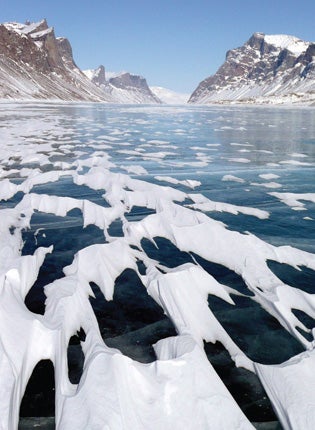
Ayr Lake on Baffin Island may hold the secrets to Arctic climate change

JASON BRINER

Ayr Lake on Baffin Island may hold the secrets to Arctic climate change

A frozen lake on a remote island off Canada's northern coast has yielded remarkable insights into how the Arctic climate has changed dramatically over 50 years.

Muddy sediment from the bottom of the lake, some of it 200,000 years old, shows that Baffin Island, one of the most inhospitable places on Earth, has undergone an unprecedented warming over the past half-century. Scientists believe the temperature rise is probably due to human-induced warming. It has more than offset a natural cooling trend which began 8,000 years ago.

Instead of cooling at a rate of minus 0.2C every 1,000 years – a trend that was expected to continue for another 4,000 years because of well-known changes to the Earth's solar orbit – Baffin Island, like the rest of the Arctic, has begun to get warmer, especially since 1950. The Arctic is now about 1.2C warmer than it was in 1900, confirming that the region is warming faster than most other parts of the world.

Baffin Island, the largest island in the Arctic Canadian Archipelago, is subjected to prevailing northerly winds that keep average temperatures at about minus 8.5C, well below similar Arctic locations at a comparable latitude. Polar bears, arctic fox and arctic hares walk the island's territory while narwhal, walrus and beluga whale patrol its coastline.

The island is dotted with lakes, the bottoms of which have been periodically scoured by glaciers with each passing ice age. However, scientists have found that the sediments at the bottom of some of the lakes, which build up each year rather like tree rings, have survived this scouring process intact.

This has enabled the scientists to take core samples going back tens of thousands of years. One such lake on Baffin Island, known as CF8, has been found to have layers of sediment dating back 200,000 years, which makes it the oldest lake sediment bored from any glaciated parts of Canada or Greenland, according to the study published in the journal Proceedings of the National Academy of Sciences.

It is the CF8 lake that has provided scientists with the sediment core showing the unprecedented warming of Baffin Island over the past few decades, compared with a time span going back 200,000 years, a period which included two ice ages and three interglacial periods – and roughly the time that Homo sapiens has been on earth.

"The past few decades have been unique in the past 200,000 years in terms of the changes we see in the biology and chemistry recorded in the cores," said Yarrow Axford of the University of Colorado at Boulder. "We see clear evidence for warming in one of the most remote places on earth at a time when the Arctic should be cooling because of natural processes." The scientists found that certain cold-adapted organisms in the layers of sediment have decreased in frequency since about 1950. Larvae from species of Arctic midge, which only live in cold conditions, have abruptly declined and two species in particular have disappeared altogether.

Meanwhile, a species of lake alga or diatom that is better suited to warmer conditions has increased significantly over the same period, indicating longer periods when the lake's surface was free of ice, the scientists said. Other sediment measurements support a dramatic reversal of the natural cooling trend, they said.

As part of a 21,000-year cycle, the Arctic has been receiving progressively less summertime energy from the Sun for the past 8,000 years because of a well-established "wobble" in the Earth's solar rotation – the Earth is now 0.6 million miles further from the Sun during an Arctic summer solstice than it was in 1BC. This decline will not reverse for another 4,000 years, but changes to the climate of Baffin Island show that the cooling it should have caused has gone into reverse in the past few decades.

A separate team of scientists analysing Arctic lakes in Alaska found a similar warming trend in recent years compared to sediment records going back a few thousand years. They, too, concluded that the warming was unprecedented and could be explained by human activities, namely the build of man-made carbon dioxide in the atmosphere.

"The amount of energy we're getting from the Sun in the 20th century continued to go down, but the temperature went up higher than anything we've seen in the last 2,000 years," said Nicholas McKay of the University of Arizona in Tucson .

"The 20th century is the first century for which how much energy we're getting from the Sun is no longer the most important thing governing the temperature of the Arctic," said Dr McKay, when the study was published last month in the journal Science.

Baffin Island: An ancient trading post

*Baffin Island lies between Greenland and the northern coast of Canada and, for all its remoteness and inhospitable climate, it may have played an important role as a staging post on the first-ever transatlantic trade route.

Archaeologists have found wooden items and a length of yarn at Nunguvik in the south which they believe indicate that visiting Vikings were interacting with the local natives, known as the Dorset people, who lived on Baffin Island between 500BC and AD1500.

The scientists believe that the Dorset, who dressed in animal skins, did not know how to spin yarn, unlike the Vikings. The three-metre strand, found frozen in the tundra, was spun from arctic hare fur mixed with goat hair, similar to yarn found at Viking settlements on Greenland. There are no goats on Baffin Island.

Further evidence comes from one of the wooden carvings which shows two faces chin to chin. One has the features of indigenous North Americans, whose ancestors had an Asian origin, while the other shows a long, narrow face and nose with a heavy beard – a portrait perhaps of a visiting Viking.

Post a Comment

View all comments that have been posted about this article.

Offensive or abusive comments will be removed and your IP logged and may be used to prevent further submission. In submitting a comment to the site, you agree to be bound by the Independent Minds Terms of Service.

Comments

(no subject) - [info]dyj67896fj - Tuesday, 20 October 2009 at 12:03 am (UTC) Expand
minus 0.C ?????
[info]someofusknow wrote:
Tuesday, 20 October 2009 at 12:24 am (UTC)
'Instead of cooling at a rate of minus 0.C every 1,000 years '

?????

What a pity someone didn't check before posting this important article.
Re: minus 0.C ?????
[info]freedommonger wrote:
Tuesday, 20 October 2009 at 08:46 am (UTC)
check? I would be pleased if they employed journalists who had an understanding of the subject they were reporting and the discipline to research what they write before writing it.

Still, better proof reading would make it pretty on the surface, sort of like a gilded t*rd.

This is complex science presented in Tomorrows World pop science style. Its typical of our shallow media whose beginning and end is to indentify someone to blame and hate as it is this that sells and boring difficulty unclear factual reality that makes papers remain in the shelf. Sort of like selling heroin is easy but selling fitness programmes is difficult. One requires work, the other delivers emotional payoff instantly so long as you ignore the damage this selfish choice causes to yourself and others.
Re: minus 0.C ????? - [info]contrastcolour - Tuesday, 20 October 2009 at 09:12 am (UTC) Expand
Re: minus 0.C ????? - [info]someofusknow - Tuesday, 20 October 2009 at 10:19 am (UTC) Expand
Re: minus 0.C ????? - [info]freedommonger - Tuesday, 20 October 2009 at 10:30 am (UTC) Expand
Re: minus 0.C ????? - [info]someofusknow - Tuesday, 20 October 2009 at 07:06 pm (UTC) Expand
Re: minus 0.C ?????
[info]rain1950 wrote:
Wednesday, 21 October 2009 at 01:13 am (UTC)
Instead of cooling at a rate of minus 0.2C every 1,000 years
Re: minus 0.C ????? - [info]someofusknow - Wednesday, 21 October 2009 at 03:55 am (UTC) Expand
Typical distortions by climate terrorists
[info]thomasgoodey wrote:
Tuesday, 20 October 2009 at 12:51 am (UTC)
"Baffin Island, one of the most inhospitable places on Earth, has undergone an unprecedented warming over the past half-century." Well, that'll make it a bit more hospitable, then. Good show.

We note the ridiculous remark in this article "Instead of cooling at a rate of minus 0.C every 1,000 years..." Not very fast, is that? Typical of gullible warming promoters - meaningless pseudo-scientific remarks and no concern whatever for accuracy.

One notices no mention in the article of the well-established fact of the Medieval Warming Period, when world temperatures went much higher than they are now. But the MWP pokes up its ugly head anyway! Note the statement "Archaeologists have found wooden items and a length of yarn at Nunguvik in the south which they believe indicate that visiting Vikings were interacting with the local natives, known as the Dorset people, who lived on Baffin Island between 500BC and AD1500." Yes, why were Vikings going to Baffin Island and people living there during this general period? (Actually the MWP started a bit later.) Because it was warmer, that's why. The Vikings came from Greenland, parts of which were, during the MWP, warm enough for agriculture. No doubt Baffin Island was also warmer and more hospitable for human life. Soon it may perhaps become so again. Good. Basically warm times are better times on this Earth for life, and colder times are bad times.


Re: Typical distortions by climate terrorists
[info]frwilliams wrote:
Tuesday, 20 October 2009 at 08:55 am (UTC)
The 0.C was a typo - obviously! Duh!
It is definitely not a well-established fact that the Medieval Warming Period was either warmer or cooler than today - the evidence in this article seems to prove that it was cooler. No one disputes that there was a warmer period at about the time that the Vikings settled in the extreme south west (warmest) tip of Greenland, which is incidentally on about the same latitude as where they came from, but the fact that they settled there provides no evidence that it was warmer then than now. We know it cooled, forcing them to leave, but the fact that the ice has recently melted, revealing their settlements, could be taken to show that today's temperatures are at least as high as then - and the evidence reported in this article strongly suggests that temperatures are now higher.

You say "Basically warm times are better times on this Earth for life, and colder times are bad times". AGW deniers are keen to point out that the climate has changed dramatically over geological timescales. The period during which life as we know it has been in existence is relatively short in geological terms, and during most of the rest of the time the composition of the atmosphere and global temperatures were far too high for today's life forms - including us, of course, to exist.
Re: Typical distortions by climate terrorists
[info]icf01 wrote:
Tuesday, 20 October 2009 at 08:59 am (UTC)
Yes, I'd be interested to know if the warm medieval period was detected in the lake-bottom sludge. If not, it calls into question the validity of the scientists conclusions.

Incidentally, the usual response to why Greenland has its hospitible-sounding name is that the Vikings were involved in a clever marketing exercise. Does anyone, anywhere actually believe this?
Re: Typical distortions by climate terrorists - [info]abushams - Thursday, 22 October 2009 at 07:24 pm (UTC) Expand
Re: Typical distortions by climate terrorists
[info]nightside242 wrote:
Tuesday, 20 October 2009 at 02:19 pm (UTC)
How would the Vikings have known that Baffin Island was warm before they even got there?
Re: Typical distortions by climate terrorists - [info]thomasgoodey - Tuesday, 20 October 2009 at 02:27 pm (UTC) Expand
Re: Typical distortions by climate terrorists - [info]ptstroud - Tuesday, 20 October 2009 at 03:36 pm (UTC) Expand
Re: Typical distortions by climate terrorists - [info]rain1950 - Wednesday, 21 October 2009 at 01:16 am (UTC) Expand
Re: Typical distortions by climate terrorists - [info]thomasgoodey - Wednesday, 21 October 2009 at 02:03 am (UTC) Expand
Re: Typical distortions by climate terrorists - [info]ptstroud - Wednesday, 21 October 2009 at 07:51 am (UTC) Expand
Natural cycles vs human interference
[info]corporeal_v001 wrote:
Tuesday, 20 October 2009 at 03:39 am (UTC)

There seem to be two camps. Isnt it more likely to be a combination of the two.The forces of natural are collosal and it is beyond man to control these forces, but on the other hand is our impact on the planet is insignificant?

I suspects it something like, majority nature plus a helping hand for us. If humans have no impact than why have we stopped using CFC refigerants to stop the ozone layer from changing?

There is also the butterfly effect. If mankind is using a sledge hammer approach on the earth, are we not impacting it - the satellite pic of the earth over the last 100 years would show significant change between the past and current images - cities, towns, deforestation, large scale surface mining, mass argiculture. A very big butterfly.

Humans are consumers, wasters, abusers and now all over the planet in volume...
Re: Natural cycles vs human interference
[info]frwilliams wrote:
Tuesday, 20 October 2009 at 09:11 am (UTC)
There are two camps, but no climatologist is saying that natural cycles have no effect - quite the contrary. They know, for example, that cycles in the oceans have a very significant effect and it is now thought that a cooler cycle between from the 1940s until the 1970s explained the leveling off in the rise of temperatures that occurred over this period - previously put down to sulphate aerosols resulting from a spike in coal burning until measures were taken to remove sulphates from power station emissions.

If you plot global land-sea temperature records (available from NASA) for the period 1901-2008 you will see a general rising trend until the 1940s, then a leveling off until the 1970s, then a continued rise at a steeper rate until now. They now think that we may be at the start of another a leveling off period for two or three decades, but that if greenhouse gases continue to accumulate, the subsequent rise will be even steeper than occurred over the last thirty years.
Re: Natural cycles vs human interference - [info]cooldave12 - Friday, 23 October 2009 at 06:54 pm (UTC) Expand
Re: Natural cycles vs human interference - [info]frwilliams - Monday, 26 October 2009 at 12:01 pm (UTC) Expand
Re: Natural cycles vs human interference - [info]morvan2 - Tuesday, 20 October 2009 at 09:16 am (UTC) Expand
Re: Natural cycles vs human interference - [info]vhawk1951 - Tuesday, 20 October 2009 at 03:24 pm (UTC) Expand
Re: Natural cycles vs human interference - [info]rexxxxxxxx - Wednesday, 21 October 2009 at 08:56 pm (UTC) Expand
Re: Natural cycles vs human interference - [info]vhawk1951 - Wednesday, 21 October 2009 at 09:23 pm (UTC) Expand
Re: Natural cycles vs human interference - [info]rexxxxxxxx - Thursday, 22 October 2009 at 10:50 pm (UTC) Expand
Re: Natural cycles vs human interference - [info]vhawk1951 - Thursday, 22 October 2009 at 10:55 pm (UTC) Expand
Re: Natural cycles vs human interference - [info]frwilliams - Monday, 26 October 2009 at 12:16 pm (UTC) Expand
Re: Natural cycles vs human interference - [info]vhawk1951 - Monday, 26 October 2009 at 03:53 pm (UTC) Expand
Re: Natural cycles vs human interference - [info]frwilliams - Monday, 26 October 2009 at 04:54 pm (UTC) Expand
Re: Natural cycles vs human interference - [info]vhawk1951 - Monday, 26 October 2009 at 06:39 pm (UTC) Expand
Re: Natural cycles vs human interference - [info]cooldave12 - Friday, 23 October 2009 at 06:47 pm (UTC) Expand
Re: Natural cycles vs human interference - [info]corporeal_v001 - Friday, 23 October 2009 at 09:17 pm (UTC) Expand
Must be doing something to human brains too
[info]find_empire wrote:
Tuesday, 20 October 2009 at 05:40 am (UTC)
Judging from the ravings of flat-earthers about "climate change terrorists," "GW conspiracy," "pseudoscience," etc., the increased temperatures and freak weather must be softening their brain tissue as well. Unless of course it's all that drinking the Brits are doing to forget the impending submergence of a good deal of their bankrupt island while the rest freezes solid when the Gulfstream switches off.
Re: Must be doing something to human brains too
[info]justwent wrote:
Tuesday, 20 October 2009 at 07:15 am (UTC)
The gulf stream comes from the gulf! Which is one of the areas that THEY claim to be getting hotter and that CAN be proven by the wildly optimistic hurricane predictions of the last few years.

The reality is that this year there were only 2 hurricanes. Both were away from land (and the gulf), and in 1800 probably would have got past without anyone noticing.

Also this year the gulf stream did fail. We had a huge area of 1-2 degree lower temperature water that stopped the jet stream progressing up past the country and so our summer was late.

So IF the scientist knew what they were doing, even within the prediction span of 1 year, they would not make hurricane and barbecue summer predictions that evidently were massively out of step with reality. That is why we can not trust them to predict 2015 or 2050.

We ARE destroying this world but not as the scientist want us to believe. All good lies are based on truth but manipulated for gain.
Destruction - [info]justwent - Tuesday, 20 October 2009 at 08:09 am (UTC) Expand
Re: Must be doing something to human brains too - [info]vhawk1951 - Wednesday, 21 October 2009 at 09:28 pm (UTC) Expand
[info]blether2 wrote:
Tuesday, 20 October 2009 at 05:41 am (UTC)
""The 20th century is the first century for which how much energy we're getting from the Sun is no longer the most important thing governing the temperature of the Arctic," said Dr McKay"

... who perhaps didn't stop to consider such times as those of the Cretaceous-Tertiary extinction ?

Yes, man-made warming is raising global temperatures. Yes, other factors affect global temperatures, which have gone up and down significantly in the past.

Yes, mankind has always had a propensity to foresee the 'end of the world'. This last century we have come to understand that the solar system can expect a lifespan of about 8 billion years, and that we're close to halfway through that. Whether our race will still be extant/dominant then remains open to question, but on past evidence it's very unlikely. It's a certainty that no-one reading this on the day it's written will be alive even for another 200 years.

The major crisis our civilisation faces next is that of the end of the oil age. Relatively soon after that, fossil fuels as a whole will run out and manmade global warming will (a) pale into insignificance in light of the practical effects of this on everyday life and (b) naturally slow down as they do so.

Read up on varying UK & US standards of living even during living memory, and varying standards of living around the world today, and be prepared for your own material prosperity to collapse.
[info]blether2 wrote:
Tuesday, 20 October 2009 at 05:49 am (UTC)
Oh yes, and:

" ...the Dorset people, who lived on Baffin Island between 500BC and AD1500.

The scientists believe that the Dorset, who dressed in animal skins, did not know how to spin yarn, unlike the Vikings. The three-metre strand, found frozen in the tundra, was spun from arctic hare fur mixed with goat hair, similar to yarn found at Viking settlements on Greenland. There are no goats on Baffin Island."

Hmm. Well, if there are no goats there now, it's obvious that there were never any, right ? So that's pretty conclusive on the goat hair being brought by Vikings. Got it. Wow, nice detective work.
Unprecedented
[info]jamie129 wrote:
Tuesday, 20 October 2009 at 08:53 am (UTC)
Interesting article. However, that warming like this hasn't happened over the last 200,000 years is poor support for the word "unprecedented", since the Earth is 4,500,000,000 years old. Just a little too loose for my taste.

I've not had a cup of coffee in the last 30 seconds, that won't make my next one "unprecedented".

Re: Unprecedented
[info]frwilliams wrote:
Tuesday, 20 October 2009 at 09:34 am (UTC)
That's a bit pedantic! The fact that the article was quoting evidence provided by material that's only been in existence for up to 200,000 years makes it obvious that the "unprecedented" meant unprecedented over that time period - which incidentally coincides roughly with the time during which Homo sapiens has existed as a distinct species, I believe. And to criticise scientific results on the basis of the way a newspaper report is phrased (if that's what you were implying) is also rather unfair!
Re: Unprecedented - [info]jamie129 - Tuesday, 20 October 2009 at 09:54 am (UTC) Expand
Re: Unprecedented - [info]vhawk1951 - Thursday, 22 October 2009 at 11:17 pm (UTC) Expand
Re: Unprecedented - [info]jamie129 - Thursday, 22 October 2009 at 11:39 pm (UTC) Expand
Re: Unprecedented - [info]vhawk1951 - Thursday, 22 October 2009 at 11:50 pm (UTC) Expand
Re: Unprecedented - [info]vhawk1951 - Friday, 23 October 2009 at 12:14 am (UTC) Expand
Re: Unprecedented - [info]jamie129 - Friday, 23 October 2009 at 12:32 pm (UTC) Expand
Re: Unprecedented - [info]vhawk1951 - Friday, 23 October 2009 at 12:59 pm (UTC) Expand
Re: Unprecedented - [info]jamie129 - Friday, 23 October 2009 at 02:51 pm (UTC) Expand
Re: Unprecedented - [info]vhawk1951 - Friday, 23 October 2009 at 03:25 pm (UTC) Expand
Re: Unprecedented - [info]jamie129 - Friday, 23 October 2009 at 09:46 pm (UTC) Expand
Re: Unprecedented - [info]vhawk1951 - Friday, 23 October 2009 at 10:10 pm (UTC) Expand
Re: Unprecedented - [info]jamie129 - Friday, 23 October 2009 at 10:32 pm (UTC) Expand
Re: Unprecedented - [info]vhawk1951 - Friday, 23 October 2009 at 10:46 pm (UTC) Expand
Re: Unprecedented - [info]vhawk1951 - Friday, 23 October 2009 at 10:50 pm (UTC) Expand
Re: Unprecedented - [info]jamie129 - Saturday, 24 October 2009 at 10:38 am (UTC) Expand
Re: Unprecedented - [info]vhawk1951 - Saturday, 24 October 2009 at 01:11 pm (UTC) Expand
[info]john_levett wrote:
Tuesday, 20 October 2009 at 09:59 am (UTC)
More enviroballs from the Independent in the lead-up to Copenhagen.

For the truth about this story, read the details in Anthony Watts' Watts Up With That blog where the source study is considered. In all probability, the changes in core samples are due to the effects of DDT on organisms in and around the lake and have little or nothing to do with climate change, man-made or not.

It really should be behoven upon persons calling themselves 'Science Editor' to produce properly researched articles rather than merely repeating the spin fed to a credulous MSM.

[info]vhawk1951 wrote:
Friday, 23 October 2009 at 10:52 pm (UTC)
Another Hockey Stick curve - Cherry Picking the data.
[info]muckle10 wrote:
Tuesday, 20 October 2009 at 10:27 am (UTC)
Attempts to manufacture a Hockey Stick out of temperature proxies, be it sediments or tree rings, have been shown to be highly problematical and in serious error.

It is well know that only a few sediment proxies correlate with global temperature records, namely; Blue Lake (Alaska) varves, Iceberg Lake (Alaska) varves and Big Round Lake (Baffin Island) varves. The majority of sediment studies do not show any correlation at all.

To reject the majority of studies in favour a few is simply Cherry Picking. It introduces a bias and hence undermines the science. Something that Steve Connor, Science Editor at the Independent, should be aware if he is good at his job.
read the print edition
[info]markover2 wrote:
Tuesday, 20 October 2009 at 10:47 am (UTC)
the error over the temperature was clearly a technological glitch and nothing to do with the author of this ineresting report.
200,000 years
[info]dunque123 wrote:
Tuesday, 20 October 2009 at 11:08 am (UTC)
So the silt has built up over 200,000 years. I assume that the fact that scientists can be so certain of the implcations of their analysis of the last 50 years must mean that the 200,000 belt of silt can be analysed by 4,000 similar 50 year samples ? I bet not therefore there is a possible flaw in their findings.

But never mind, no-one ever got sacked for reinforcing the latest religion.

By the way did not see anything in the Indy about NASA's miscalculations on the ice melt in the Western Antarctic - funny that.

http://www.theregister.co.uk/2009/10/20/antarctic_ice_loss_overestimated/
The Medieval Warm Period Makes a Come Back
[info]muckle10 wrote:
Tuesday, 20 October 2009 at 12:24 pm (UTC)
If you were to include all the sediment studies on proxy temperature measurements in the Arctic it paints a completely different picture to the one being presented in this study. If you believe that lake sediments are a true temperature record then the more complete studies show that The Medieval Warm Period is by far the warmist period in the last 1000 years.

Attempts to skew the science in the way that Steve Connor tries to do just makes more people skeptical Global Warming.
Re: The Medieval Warm Period Makes a Come Back
[info]muckle10 wrote:
Tuesday, 20 October 2009 at 12:39 pm (UTC)
UPDATE: Here is a peer reviewed study that completely contradicts the Axford study.

Evidence for a warmer period during the 12th and 13th centuries AD from
chironomid assemblages in Southampton Island, Nunavut, Canada

http://www.cen.ulaval.ca/paleo/Publications/Articles/Rolland.2009b.pdf
Re: The Medieval Warm Period Makes a Come Back - [info]vhawk1951 - Friday, 23 October 2009 at 12:23 am (UTC) Expand
Typical distortions by climate terrorists
[info]thomasgoodey wrote:
Tuesday, 20 October 2009 at 01:58 pm (UTC)
frwilliams said "The 0.C was a typo - obviously! Duh!"

Yes, obviously, but my point was that the journalist who wrote the article (who appears to be the Science Editor, Gawd'elpus!) couldn't even be bothered to get the basic numbers right. That's the attitude of a whore. Numbers are everything in science.

And he said "It is definitely not a well-established fact that the Medieval Warming Period was either warmer or cooler than today..." Well, I think it is. Nobody had properly calibrated thermometers in those days, of course, but the overwhelming mass of anecdotal evidence about what plants grew where and what products were produced, proves it conclusively. So does a lot of physical evidence.

To continue picking at frwilliams's post: he said "... the extreme south west (warmest) tip of Greenland, which is incidentally on about the same latitude as where they came from..." The latitude is basically irrelevant - what matters is the length of the growing season. He said "the fact that they settled there provides no evidence that it was warmer then than now." Well, yes it does, because agriculture is not possible there now - it's too cold. He said "the fact that the ice has recently melted, revealing their settlements, could be taken to show that today's temperatures are at least as high as then..." No, it couldn't; it merely means that the settlements are currently exposed to the atmosphere. It's a long way from that, to being able to live by primitive agricultural methods. And he said "... the evidence reported in this article strongly suggests that temperatures are now higher." No it doesn't - the article conveniently skips over all details of recent temperature fluctuations, presumably because that would be contrary to the pseudo-facts the investigators are trying to prove to justify their budget.

And, comically, frwilliams said "... relatively short in geological terms, and during most of the rest of the time the composition of the atmosphere and global temperatures were far too high for today's life forms - including us, of course, to exist." What utter balderdash. Does he seriously believe that human beings and today's animal and plant life, cannot live and thrive at temperatures a few degrees hotter than now overall? Has he ever been to the tropics? Did it kill him? What did animals of those long-ago days have in their veins? molten copper?

And icf01 perfectly sensibly said "I'd be interested to know if the warm medieval period was detected in the lake-bottom sludge. If not, it calls into question the validity of the scientists conclusions." I think we already know the answer - they didn't mention the MWP, so yes, they did find it in the sediments; if they had not, they would have trumpeted out the fact! He also asks "Incidentally, the usual response to why Greenland has its hospitible-sounding name is that the Vikings were involved in a clever marketing exercise. Does anyone, anywhere actually believe this?" I have also heard this, and yes, I believe it, because they also called Iceland "Iceland", although it is actually green and fertile (except for four modest icecaps). "Iceland" is a complete misnomer. However, I cannot cite a respectable chapter and verse.


[info]thomasgoodey wrote:
Tuesday, 20 October 2009 at 02:06 pm (UTC)
And john_levett comments "It really should be behoven upon persons calling themselves 'Science Editor' to produce properly researched articles rather than merely repeating the spin fed to a credulous MSM". Quite. With careless mistakes added. That man is not a science editor in any meaningful sense. He is merely a climate terrorist campaigner.
Origins and climate change
[info]pamfromthenorth wrote:
Tuesday, 20 October 2009 at 02:08 pm (UTC)
"One has the features of indigenous North Americans, whose ancestors had an Asian origin..."

This bunk continues to be a "theory" perpetuated by people who also support the land bridge theory. Although the author of this article may not have meant to be so casual, simply throwing out a statement like that as if it were a known fact is irresponsible. Have you ever talked to an Indian or "indigenous" person?

As someone who has had their genetic coding done for a particular disease, I can assure you my genetic coding is completely different from that commonly found in "Asia". It's like looking at a "caucasian" or "white" person "features" from Russia and saying someone from the UK has shared ancestry because they both have caucasian "features" so therefore they must be connected.

As for the Vikings, well it's pretty obvious they were poking around up North. Where do people think dog sleds came from?

Global warming? Climate change? It's simply the cyclical nature of weather. So it's warming in sections of Canada's North and COOLING in other sections. The media rarely will report on the cooling aspects.
Temperature Proxies - You say tomato, I say tomato
[info]muckle10 wrote:
Tuesday, 20 October 2009 at 02:57 pm (UTC)
The only way that you can replicate recorded global temperatures using tree rings and sediments is when you Cherry Pick the data. In each study that has done so you end up with a hockey stick curve - cue alarmist headlines.

Now here is a funny thing, when you incorporate all the tree ring and sediment data sets the hockey stick curve magically disappears and you end up with a pronounced Medieval Warm Period, a result that fits historical claims and archaelogical studies of that period.

Here is the hard part for those carrying out tree ring and sediment studies - scientifically it could be complete bollox. There is so much statistical noise in the data that it can render these studies as being next to useless.

The jury is very much out on temperature proxies, trees and mud may not be good thermometers.
[info]goingbacktobed wrote:
Wednesday, 21 October 2009 at 01:15 pm (UTC)
I think global warming can be prevented by something as simple as biomass fuels. I use a biomass boiler from http://www.eco-link.co.uk/ They do many more enviromentally friendly products such as wood pellet boilers
flawed science
[info]rexxxxxxxx wrote:
Wednesday, 21 October 2009 at 08:37 pm (UTC)


ddt could well be responsible for deminishing fauna found in the lake sediments on baffin island since 1950
research indicates that temperature falls in this underwater environment are not significant.

research quoted in this article has not been subject to peer review and should never have reached the public en mass

wether it proves right or wrong it was not ready for publication

ignore it


,

Re: flawed science + bad journalism
[info]muckle10 wrote:
Thursday, 22 October 2009 at 09:32 am (UTC)
This is bit of a professional disaster for Steve Connor. He forgot the old journalistic adage "if your mothers says she loves you, you go and check it out."

This study contends that the lake has experienced unprecedented warming in recent times. A simple check with the actual temperature record for the locality would have shown that there is no upward trend in summer temperatures for the period discussed. So the original claim by Steve Connor that this study "proved" there has been dramatic climate change in the Arctic was completely without foundation.

This article reveals that Steve Connor is neither a journalist (he didn't check the facts) nor a scientist (he would have known that the use of temperature proxies are controversial) but that he is an advocate of climate alarmism (an environmental activist).

If the science editor of The Independent doesn't question the science and present the subject in a balanced way then it does a great disservice to all scientists.
Re: flawed science + bad journalism - [info]rexxxxxxxx - Thursday, 22 October 2009 at 10:46 pm (UTC) Expand
[info]cooldave12 wrote:
Friday, 23 October 2009 at 06:40 pm (UTC)
Nice try Warmistas! Didn't you get the follow up memo? It turns out rather than sily and midges, we actually had something called thermometers that were employes and measured the TEMPERATURE over the last 50 years - no unusual warming... Of course the warming headline was news, the facts behind the misrepresentation are merely typical and do not need to be shouted.

How about those tree's cherry picked because they showed warming by Briffa, but were unfortunately right next to funcrtional temperature stations that shows what the rest of the trees not selected showed - cooling. Again, that won't sell you new taxes or get people to make windmills, so the correction is buried on page 35 somewhere.

Article Archive

Day In a Page

Sun | Mon | Tue | Wed | Thu | Fri | Sat

Select date