Battle for Europe's last ancient forest
Climate change, border disputes and the opposition of residents to expansion threaten eastern Poland's unique woodlands. Gabriela Baczynska reports
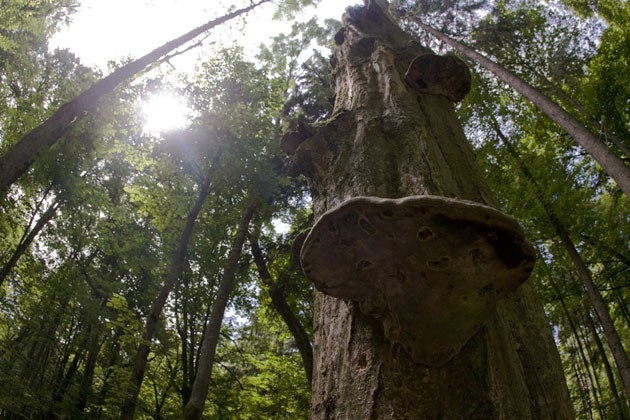
Acontest between competing needs of conservation and economic growth is threatening the future of large parts of Europe's last ancient forest. The 380,000-acre Bialowieza Primeval Forest, which straddles the border between Poland and Belarus, is one of the largest unpopulated woodlands remaining in Europe. It has been a Unesco World Heritage Site since 1979, is home to the continent's largest herd of bison, and resembles – in appearance and the self-contained food chain it supports – the fabled wildwood that covered much of Europe's plain, and, indeed, England before man intervened.
On the Polish side of the border, residents are opposing plans to extend the protected zone of this unique habitat, which is under threat from rising temperatures and declining rainfall. Encouraged by international conservation agencies, Warsaw wants to enlarge the area's national park, which occupies less than a fifth of the Polish part of the forest. It has offered up to 100 million zlotys (£20m) to be shared among the nine communities that would be affected by broader regulations protecting wildlife.
However, the region is among the poorest in Poland, and the 2,400 residents of Bialowieza district are sceptical, fearing it would discourage investment, cause job losses and reduce the community's tax revenues. "You may think we are fools not willing to take the money," Mayor Albert Litwinowicz told Reuters. "But it will only go for green investments, while we need roads."
Forests occupy more than 80 per cent of the Bialowieza administrative district and provide a significant part of its income, thanks to government cash. Revenues come mostly from woodland and other subsidies from the central government, plus grants and other state aid, Mr Litwinowicz said. Income would be halved if the whole area were incorporated into the national park, and most of about 50 forestry workers, responsible for maintaining the woodland as well as for cutting the timber, could be laid off, he added.
Bialowieza district would be fully incorporated into the national park under the current proposal. "Building anything in the middle of a national park with strict conservation rules would be almost impossible and we want to develop better transport and other infrastructure," Mr Litwinowicz said.
There are no major industrial centres nearby. Every year, 150,000 people visit Bialowieza, but tourism accounts for only a tenth of the district's revenue. However, unemployment in Bialowieza is almost non-existent, partly because a quarter of the population has left since 1990.
Signs of climate change that could threaten the forest have become more evident. "The average annual temperature has risen by 0.8C over past 50 years. This is a lot for a primeval forest," Elzbieta Malzahn of the Forest Research Institute told Reuters. "That's enough time to call it a change to climate. There is less rain in the summer; winters are milder and end sooner, prompting vegetation to start earlier."
National park officials say the level of ground water has fallen by 20 inches in the past three decades. "Spruce roots are very shallow and they just run out of water. We are observing falling number of spruce," said park employee Mateusz Szymura.
Bialowieza was kept pristine from the 14th to the early 20th century because it was a royal hunting preserve. It is home to more than 3,000 species of fungi, 178 kinds of breeding birds, and 58 species of mammal. These include wolves, lynx and 800 wild European bison, the continent's heaviest land animals weighing up to one ton each and standing more than six feet high. So far, the changes have not endangered the bison because they adapt easily to a shifting environment. Bialowieza had undergone many changes over the centuries and the forest had adjusted to new conditions. "The problem is if the changes we are now causing are too fast and too unpredictable and leave nature little chance to catch up," Ms Malzahn said.
Political arguments between Belarus and Poland have stifled joint efforts to safeguard the forest. Since Poland joined the European Union in 2004, the EU's eastern border runs through the forest, marked by a fence built by Belarus years ago. The barrier prevents bison on each side from intermingling. However, they remain genetically similar since the species was regenerated using just a few animals that survived in a zoo after they had vanished from the wild in the 1920s.
To extend the protected area on the Polish side, the government needs the approval of local authorities and says the scheme would cost between 1.5 million and three million zlotys. "For years local people have opposed plans to enlarge the park and we are now presenting a programme that shows they can go on operating with an enlarged park," said Janusz Zaleski, the deputy environment minister.
Mayor Litwinowicz did not seem convinced. He said he was considering holding a referendum among residents. "If where we live is so unique for the whole of Europe, why shouldn't the residents benefit rather than suffer?" he said. "Personally, I am against it, but the people will decide."
Join our commenting forum
Join thought-provoking conversations, follow other Independent readers and see their replies
Comments
Bookmark popover
Removed from bookmarks