Case against climate change discredited by study
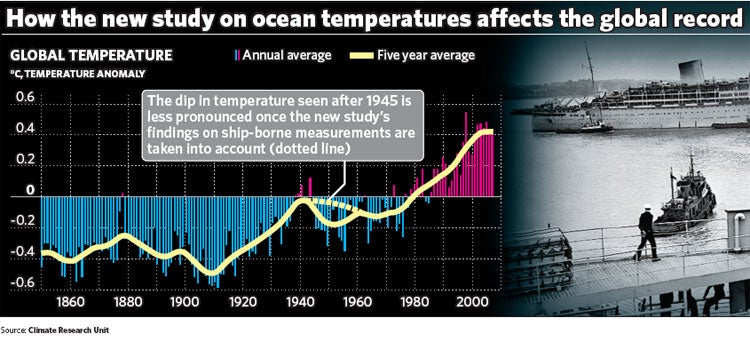
A difference in the way British and American ships measured the temperature of the ocean during the 1940s may explain why the world appeared to undergo a period of sudden cooling immediately after the Second World War.
Scientists believe they can now explain an anomaly in the global temperature record for the twentieth century, which has been used by climate change sceptics to undermine the link between rising temperatures and increases in atmospheric carbon dioxide.
The record for sea-surface temperatures shows a sudden fall after 1945, which appeared to go against the general trend for rising global average temperatures during the past century.
Sceptics have argued it supports the idea that rising temperatures have more to do with increased solar activity – sunspots – than increasing levels of man-made carbon dioxide exacerbating the greenhouse effect.
However, an international team of scientists has investigated the raw data from the period. They found a sudden increase from 1945 onwards in the proportion of global measurements taken by British ships relative to American ships.
The scientists point out that the British measurements were taken by throwing canvas buckets over the side and hauling water up to the deck for temperatures to be measured by immersing a thermometer for several minutes, which would result in a slightly cooler record because of evaporation from the bucket.
The preferred American method was to take the temperature of the water sucked in by intake pipes to cool the ships' engines. Those records would be slightly warmer than the actual temperature of the sea because of the heat from the ship, the scientists said.
Taking into account the difference in the way of measuring sea-surface temperatures, and the sudden increase in the proportion of British ships taking the measurements after the war, the result was an artificial lowering of the global average temperature by about 0.2C, said Professor Phil Jones of the University of East Anglia in Norwich.
"It occurred in the period of the 1940s when the number of observations of sea-surface temperature were markedly fewer than either before or after that period and most of the measurements were made by British and American ships. This made the apparent anomaly more pronounced," Professor Jones said.
The study, published in the journal Nature, found that the global average temperatures in the late 1940s stayed roughly the same rather than falling. David Thompson of Colorado State University, the team's leader, said a drop was, in effect, an artefact rather than a real observation.
"I was surprised to see the drop so clearly in the filtered data, and working in partnership with others, realised it couldn't be natural," Dr Thompson said.
Although the initial drop was significant, it did not last. By the 1960s, many other nations began taking ship-borne measurements of ocean temperature, mini-mising the discrepancy.
Professor Jones said that the study lends support to the idea that a period of global cooling occurred later during the mid-twentieth century as a result of sulphate aerosols being released during the 1950s with the rise of industrial output. These sulphates tended to cut sunlight, counteracting global warming caused by rising carbon dioxide.
"This finding supports the sulphates argument, because it was bit hard to explain how they could cause the period of cooling from 1945, when industrial production was still relatively low," Professor Jones said.
A similar problem could be occurring now with the move from ship-borne measurements to those from unmanned buoys, which tend to produce slightly lower records. This could explain why global average temperatures in recent years have levelled off.
Join our commenting forum
Join thought-provoking conversations, follow other Independent readers and see their replies
Comments
Bookmark popover
Removed from bookmarks