Climate change at the poles IS man-made
Scientists refute sceptics by proving that human activity has left its mark on the Arctic and Antarctic
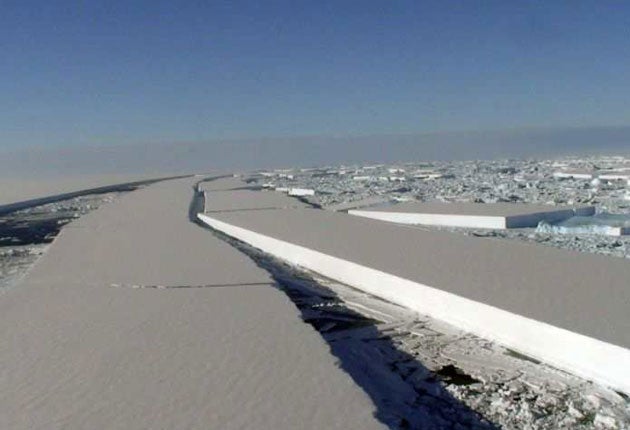
Changes to the climate due to human activity can now be detected on every continent, following a study showing that temperature rises in the Antarctic as well as the Arctic are the result of man-made emissions of greenhouse gases.
It is the first time scientists have been able to prove the link between the temperature changes in both polar regions are down to human activity and it also undermines climate sceptics who believe the warming trend seen in the Arctic in recent decades is part of the climate's natural variability.
The findings contradict the 2007 report of the Intergovernmental Panel on Climate Change, which said that Antarctica was the only continent where the human impact on the climate had not been observed.
The new study shows that Antarctica has been caught up in the changes to the global climate over the past 60 years and that this warming cannot be attributed to natural variations.
Using four computer models and data from dozens of weather stations sited around both the North and South Poles, the study conclusively shows that humans are responsible for the significant increases in temperatures observed in the Arctic and the Antarctic over the past half century.
"We're able for the first time to directly attribute warming in both the Arctic and the Antarctic to human influences on the climate," said Nathan Gillett of the Climate Research Unit at the University of East Anglia, who led the study, published in the journal Nature Geoscience.
The analysis has also shown there is a significant change to the Antarctic climate caused by human activity.
Peter Stott of the Met Office Hadley Centre, who took part in the modelling analysis, said: "In both polar regions the observed warming can only be reproduced in our models by including human influences – natural forcings [increases] alone are not enough.
"For a long time, climate scientists have known that Arctic areas would be expected to warm most strongly because of feedback mechanisms, but the results from this work demonstrate the part man has already played in the significant warming that we've observed in both polar regions.
"There was a clear detection in both the Arctic and Antarctic regions of a human influence on the climate. We had shown we had detected the human fingerprint in both regions."
In the Arctic, the most visible effect of warmer temperatures has been the disappearance of the sea ice which floats on the Arctic Ocean. In 2007, the sea ice reached an all-time summer minimum, which was nearly reached again this year.
In the Antarctic, global warming has had the greatest impact on coastal areas and the Antarctic Peninsula, which has seen the greatest increases in average temperatures in the region, leading to the disintegration of ice shelves and the speeding up of the flow of glaciers to the sea.
The picture in the Antarctic has also been obscured by the effect of ozone depletion, which has tended to lower temperatures and so counteract the effect of global warming within the region. However, with the recovery of the ozone layer, scientists are expecting to see even greater increases in Antarctic temperatures in future.
Andrew Monaghan of the US National Centre for Atmospheric Research in Boulder, Colorado, said the study clarifies human impact on two regions that are notoriously variable in terms of climate. "The polar regions exhibit the largest climatic variability on Earth, so detecting and attributing climate changes has been more difficult than elsewhere," Dr Monaghan explained. "The study is important because it formally demonstrates the human contribution for the first time."
Join our commenting forum
Join thought-provoking conversations, follow other Independent readers and see their replies
Comments
Bookmark popover
Removed from bookmarks