Climate change: do you want the good news or the bad?
Britain faces more flooding and water shortages – but farmers may come out on top, according to a new global forecast
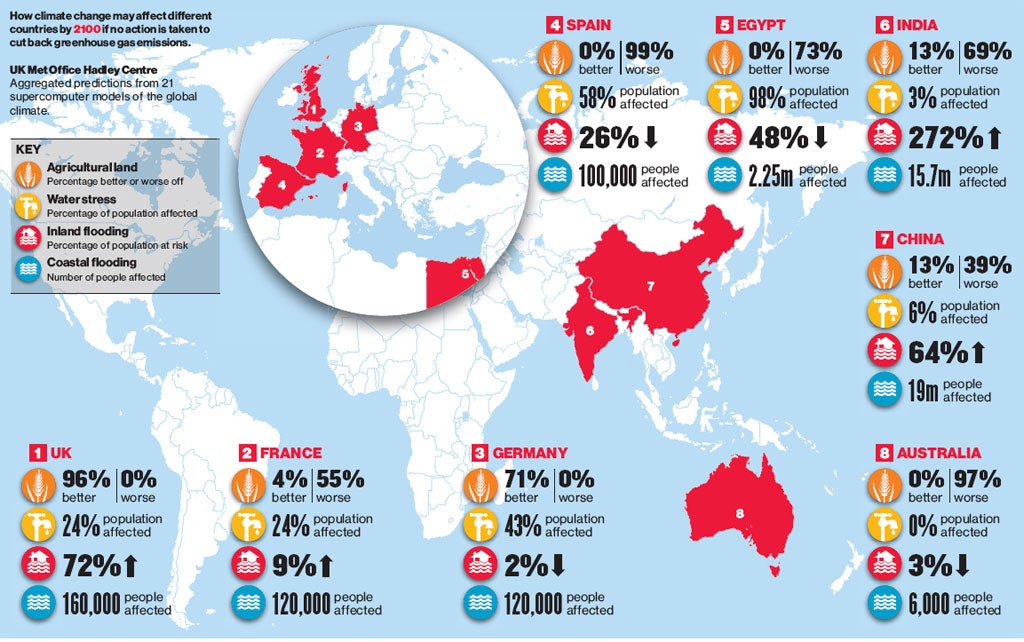
Spain will be arid, with all of its agricultural land degraded. India will face a near-tripling of its flood risk. Virtually the whole population of Egypt will be hit with water shortages. But British farmers will find their crops much easier to grow – while their French counterparts will find it harder.
Such will be the varying fortunes of different countries by the end of the century if climate change is not brought under control, according to a new study by the Met Office, launched at the UN Climate Conference in Durban yesterday.
The study is the first ever detailed, large-scale comparison, using the same methodology, of how different nations will fare with global warming.
The new study, from the Met Office's Hadley Centre for Climate Prediction and Research, compares how 24 nations will be affected by the year 2100 if greenhouse-gas emissions continue to pour into the atmosphere unchecked.
The researchers used the amalgamated results of 21 different computer models of the global climate, in institutes around the world, so wide margins of error are possible. But the "central estimate" averaged out for each country allows for fascinating comparisons to be made.
In a finding which will surprise many, 96 per cent of Britain's cropland is likely to be more suitable for agriculture in a much hotter world at the end of the century, while no part of it will be less suitable. Vineyards in Lincolnshire? Who knows. The Romans had them.
In France, however, only 4 per cent of agricultural land will be more suitable, while 55 per cent is likely to be worse. But not all of Britain's side of the comparison is favourable. Looking at the number of people likely to be affected by increased "water stress" – effectively water shortages – France will find 14 per cent of its population affected, while the UK will find 24 per cent.
With flooding from rivers, France faces a 9 per cent increase in risk, while the UK faces a 72 per cent increase. With the additional numbers of people at risk from coastal flooding, caused by storm surges and sea-level rise, up to 120,000 people are expected to be more vulnerable in France and up to 160,000 more in Britain.
The study estimates that average temperatures will be 3C higher in southern Britain by the end of the century if nothing is done, and 2.5C higher in the north. In terms of what is already happening, the study estimates that Britain is now experiencing 35 more "unseasonably warm" days per year than 50 years ago.
Some countries are likely to fare much worse than others. Spain, already forecast to become much more arid, stands out in terms of how much of its cropland will become less suitable for agriculture, with an average figure from all the computer predictions of 99 per cent.
Australia and Turkey are close behind, with 97 per cent of their cropland facing degradation, followed by South Africa with 92 per cent. Britain is likely to benefit most; its 96 per cent increase in suitability is only approached only by Germany at 71 per cent, then Canada at 61 per cent, Peru at 60 per cent and Russia at 40 per cent. In terms of future water stress, no country approaches Egypt's 98 per cent of the population being affected. Spain comes next with 58 per cent, then Turkey with 45.
For inland flooding, some countries face a gigantic percentage increase in risk, with Kenya leading the way with a 356 per cent increase, followed by India with a 272 per cent increase. For coastal flooding, India is facing the highest increased risk, with 15.7 million more people likely to be affected by the turn of the century.
"This report highlights some of the very real dangers we face if we don't limit emissions to combat the rise in global temperature," said the UK's Energy and Climate Change Secretary Chris Huhne, who arrived in Durban yesterday.
New deal: China may lead the way
China, the world's biggest polluter, would sign up to a new legally binding climate treaty if a number of conditions were met, the Chinese Climate Change Minister, Xie Zhenhua, told the UN Climate Conference in Durban yesterday.
Mr Xie's comments, though qualified, offered the first glimpse of a possible global deal involving all nations to cut greenhouse gas emissions.
A "road map" to such a deal, to replace the current Kyoto protocol, which only commits the western industrialised countries to act to cut emissions, is the main aim of Britain and the European Union at the Durban meeting, which began its ministerial session yesterday.
The EU has offered to renew Kyoto – seen as a talisman of rich nation good faith by developing countries, but which expires next year – as long as the eventual prospect of a new all-embracing deal can also be agreed.
Hitherto the two developing country "giants", China and India (now the world's third biggest carbon emitter) have set their face against such an agreement. At the weekend the Indians said they still would not countenance it, but Mr Xie's comments have changed things.
MICHAEL MCCARTHY
China, the world's biggest polluter, would sign up to a new legally binding climate treaty if a number of conditions were met, its Climate Change Minister, Xie Zhenhua, told the UN Climate Conference in Durban yesterday.
Mr Xie's comments, though qualified, offered the first glimpse of a possible global deal involving all nations to cut greenhouse gas emissions.
A "road map" to such a deal, to replace the current Kyoto protocol, which only commits the Western industrialised countries to act to cut emissions, is the main aim of Britain and the EU at the Durban meeting, which began its ministerial session yesterday.
The EU has offered to renew Kyoto – seen as a talisman of rich nation good faith by developing countries, but which expires next year – as long as the eventual prospect of a new all-embracing deal can also be agreed.
Hitherto the two developing "giants", China and India (now the world's third biggest carbon emitter) have set their face against such an agreement. At the weekend the Indians said they still would not countenance it, but Mr Xie's comments have changed things.
MICHAEL MCCARTHY
Join our commenting forum
Join thought-provoking conversations, follow other Independent readers and see their replies
Comments
Bookmark popover
Removed from bookmarks