Climate change special: Twelve days to save the world
We face a threat as terrible as the rise of fascism, says Johann Hari. Now we must rise to the challenge
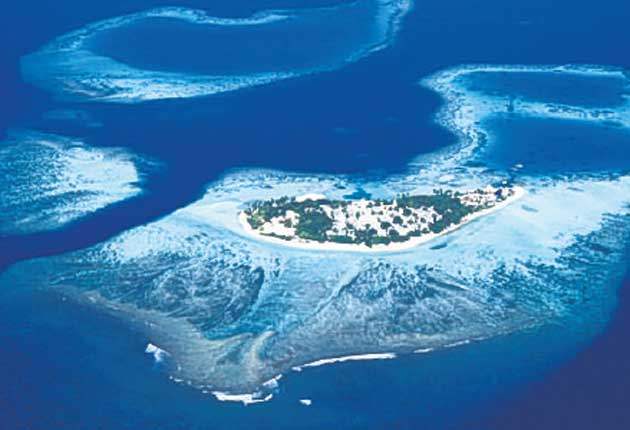
Mohammed Nasheed knows what global warming means, because he sees it every day. He survived years of imprisonment and torture to lead his country – the Maldives – to democracy. But now, as its President, he is being forced to watch as his homeland is wiped from the map. With each year that passes, the rising sea claims more land, and at the current rate it will claim everything.
He knows why. We know why. It is because we have released massive amounts of greenhouse gases into the atmosphere, and we aren't stopping. Unless we turn around – fast – the Maldives will be gone.
Today, he has a final plea. President Nasheed says: "Copenhagen can be one of two things. It can be an historic event where the world unites against carbon pollution in a collective spirit of co-operation and collaboration, or Copenhagen can be a suicide pact. The choice is that stark."
If we fail, the story of the Maldives will become our story. A ream of scientific studies now suggest we could be on course for 6°C of global warming this century. It doesn't sound like much at first. But the last time the world warmed by six degrees so fast was at the end of the Permian period, 251 million years ago. The result? Almost everything on earth died.
The only survivors were a few shelled creatures in the oceans, and a pig-like creature that had the land to itself for millions of years. The earth was racked by "hypercanes" – hurricanes so strong they even left their mark on the ocean floor. Oxygen levels in the atmosphere plunged to 15 per cent; low enough to leave any fast-moving animal gasping for breath. These six degrees of separation stand between us and a planet we do not recognise and cannot live on.
The fever of denialism is natural. This is so far outside our experience that is seems intuitively untrue, wrong, or even mad. I desperately wish the deniers were right: I would jump on the next flight to Tahiti for a month-long party. But the scientific consensus is overwhelming – as strong as the consensus that smoking causes lung cancer, or HIV causes Aids. The deniers are a discredited fringe with virtually no scientists currently working in the field. If you release greenhouse gases into the atmosphere on an industrial scale year after year, the world will get much warmer, and many of us will die.
I have seen it happen. In the past few years, I have reported from three places where global warming is having a catastrophic effect – the Arctic, Bangladesh, and the borders of Darfur. I spoke to Inuit who are watching in disbelief as their historic hunting-lands disappear and the ice-sheets crumble into the sea. I stood on the drowning coast of Bangladesh as villagers pointed to a spot in the middle of the sea and said: "That is where my house was."
"When did you leave?" I asked.
"Last year," they said, shaking their heads.
But it was in Darfur that I got the plainest glimpse into a much warmer world. The settled farmers and the nomadic pastoralists had developed a peaceful way to share the water supplies of the area – but then, in the Nineties, the water started to vanish. As one refugee put it to me: "The water dried up, and so we started to kill each other for what was left." (The UN Secretary General, Ban Ki-moon, has said this is due to global warming, summarising the reports of his leading scientists.) When the things we require to survive vanish – water, food and land – we don't wait to die. We kill for them.
Whenever the scientific consensus is accurately described, the deniers cry that we are being "alarmist". There is a difference between being alarmist, and being alarmed by the facts. To know what we know and carry on pumping out warming gases wouldn't just be foolish. It would be a crime. Yet even politicians who understand the science don't believe there will be progress at Copenhagen, because we must adhere to "political reality". People aren't ready to make changes; there's still a sense this is a vague problem for future generations; the US Senate won't pass a bill; and on, and on. But in a conflict between political and physical reality, physical reality will win. You can't stand at the edge of a super-charged hurricane and shout: "The focus groups say I can't deal with you yet."
Others complain that we who want to prevent the catastrophe mustn't be negative or scare people; we should "stress the positive". Yes, there are positive opportunities to grab: it's a chance for us all to come together in a common cause and to be a great generation, remembered as heroes by history. But it would be patronising and bizarre to start there. In 1936, Winston Churchill and George Orwell warned about the rise of Nazism. They didn't sugar-coat it. They didn't wrap it in feel-good homilies. They treated people like adults. A terrible threat was rising, and it had to be stopped. This is our position today. This is our choice. We can make history – or we can commit suicide.
Join our commenting forum
Join thought-provoking conversations, follow other Independent readers and see their replies
Comments
Bookmark popover
Removed from bookmarks