Climate change will melt snows of Kilimanjaro 'within 20 years'
Ice on Africa's highest peak is vanishing at fastest rate for 100 years
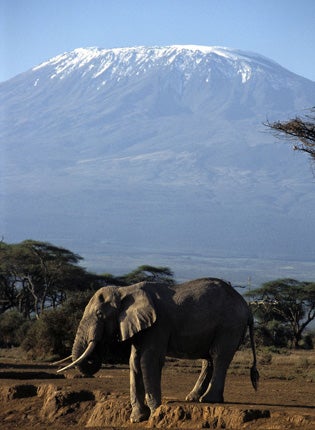
ALAMY
Researchers have confirmed that 85 per cent of the ice that covered the mountain in 1912 has now been lost
The snows of Mount Kilimanjaro – the highest mountain in Africa – may soon be falling on bare ground following a study showing that its ice cap is destined to disappear entirely within 20 years, due largely to climate change.
The vast ice fields of Kilimanjaro in Tanzania are melting at a faster pace than at any time over the past 100 years and at this rate they will be gone completely within two decades or even earlier according to one of the world's leading glaciologists.
A team led by Professor Lonnie Thompson of Ohio State University said that the latest assessment of Kilimanjaro's famous ice cap has confirmed that 85 per cent of the ice that covered the mountain in 1912 has been lost, and 26 per cent of the ice that was there in 2000 is now gone.
A series of cores drilled through the ice fields at different points on Kilimanjaro has revealed that the melting observed over the past few decades is unprecedented in nearly 12,000 years. The research also shows that that the current thinning of the ice cap is faster than when a devastating 300-year drought occurred 4,200 years ago, a period when very little snow fell on the mountain.
"The dramatic loss of Kilimanjaro's ice cover has attracted global attention. The three remaining ice fields on the plateau and the slopes are both shrinking laterally and rapidly thinning," the scientists write in a study published in the journal Proceedings of the National Academy of Sciences.
"We present additional evidence that the combination of processes driving the current shrinking and thinning of Kilimanjaro's ice fields is unique within an 11,700-year perspective. If current climatological conditions are sustained, the ice fields atop Kilimanjaro and on its flanks will likely disappear within several decades," they say.
If conditions persist, and warmer temperatures continue to melt more ice than falls in the form of snow, then there is a "strong likelihood that the ice field will disappear within a decade or two", the authors conclude.
In 2000, Professor Thompson and his colleagues measured a radioactive signal in the ice cap that was left over from the American atomic tests in 1951 and 1952. That signal was at a depth of 1.6 metres (5.25ft) below the surface of the ice. It has now disappeared because the top 2.5 metres of ice have melted away.
Professor Thompson said that the scientists have also detected elongated bubbles in the surface of the ice field, which occur when the ice melts and refreezes. There is no evidence this melting and refreezing has occurred at any other period going back 11,700 years.
"This is the first time researchers have calculated the volume of ice lost from the mountain's ice fields. If you look at the percentage of volumes lost since 2000 versus the percentage of area lost as the ice fields shrink, the numbers are very close," he said.
Data from the ice cores shows that the summits of both the northern and the southern ice fields have thinned by 1.9 metres and 5.1 metres respectively. The smaller Furtwängler Glacier, which was melting and was water-saturated when it was drilled by Professor Thompson in 2000, has thinned by 50 per cent in the past nine years.
Kilimanjaro is just one of many low-latitude mountains around the world that are losing their glaciers. They include the ice fields on Mount Kenya and the Rwenzori Mountains in Africa, as well as glaciers as far apart as the Alps in Europe, the Andes in South America and the Himalayas in Asia.
"The fact that so many glaciers throughout the tropics and subtropics are showing similar responses suggests an underlying common cause," Professor Thompson said.
"The increase of Earth's surface temperatures, couple with even greater increases in the mid- to upper-tropical troposphere as documented in recent decades, would at least partially explain the observed widespread similarity in glacier behaviour," he said.
Changes in the local vegetation around Kilimanjaro, which has lost much of it forests, may have affected the cloudiness and amount of snow that falls on the mountain. However, the scientists believe that warmer global temperatures have had a bigger impact on the rate at which its glaciers are melting.
Large numbers of people rely on mountain glaciers for a regular supply of water or hydroelectric power throughout the year. In Peru, for instance, the Quelccaya Ice Cap has shrunk by nearly a quarter in the past 50 years and, if it disappears completely, many people will be badly affected by the lack of hydroelectric power, crop irrigation and drinking water.
"What we're doing is cashing in on a bank account that was built over thousands of years but isn't being replenished. Once it's gone, it will be difficult to re-form," Professor Thompson said in 2001 in his earlier glaciers study.
View all comments that have been posted about this article.
Offensive or abusive comments will be removed and your IP logged and may be used to prevent further submission. In submitting a comment to the site, you agree to be bound by the Independent Minds Terms of Service.
- Print Article
- Email Article
-
Click here for copyright permissions
Copyright 2009 Independent News and Media Limited


Reduce your global impact.
Comments
There should be posting by now telling us that the Earth is actually cooling and will soon enter anoither ice age...... and, of course, there is absolutely no link between human activity and the meltdown of the planet [that isn't happening].
There is no doubt the earth is now cooling, and even a prominent member of the IPCC has made a speech acknowledging that, but he thinks warming will kick in again within 10 years. However some scientists believe the disappearance of sun spots augurs a Maunder minimum replica and will bring a new little ice age. If that happens, the snows of Kilimanjaro will no doubt make a spectacular re-appearance.
What you have missed in all this, is that climate science is largely a matter of speculation, and the science is not settled. How does that justify taking drastic action now which will cripple the world economy irreversibly? And who will suffer most from that action? The poor and underfed in the third world, of course.
http://www.youtube.com/user/pothole
1. Earth receives short wave radiation from the sun, predominantly as visible light.
2. Earth radiates long wave radiation, predominantly as infrared and microwave radiation.
3. Carbon dioxide in the atmosphere absorbs some of that longwave radiation and sends it back to the earth's surface.
4. Humans have increased, and are increasing the amount of carbon dioxide in the atmosphere.
Now, should you and your denialist colleagues depart this planet and go to the moon, exhale some carbon dioxide to warm yourselves.
'We' don't need to do anything about the rest of 'you'. Nature will attend to all of us in her own good time.
It's not an issue of "belief about humans being the cause of climate change"; that human activity has been and is contributing to such change is demonstrated. If you were distracted, and unable to notice this, I recommend William F Ruddiman's 'Plows, Plagues and Petroleum'. (US spelling) Ruddiman explains how humans have been affecting climate since the advent of agriculture.
Mind you, even without agriculture, but by use of selective burning, Indigenous Australians transformed large swathes of Australian landscape long before European arrival, from broadleaf temperate forest to dry eucalypt forest, scrub and savannah.
I hope this helps guide your journey out of the darkness of rage and confusion.
'We' don't need to do anything about the rest of 'you'. Nature will attend to all of us in her own good time.
It's not an issue of "belief about humans being the cause of climate change"; that human activity has been and is contributing to such change is demonstrated. If you were distracted, and unable to notice this, I recommend William F Ruddiman's 'Plows, Plagues and Petroleum'. (US spelling) Ruddiman explains how humans have been affecting climate since the advent of agriculture.
Mind you, even without agriculture, but by use of selective burning, Indigenous Australians transformed large swathes of Australian landscape long before European arrival, from broadleaf temperate forest to dry eucalypt forest, scrub and savannah.
I hope this helps your journey out of that pit of rage and confusion.
Not only did I pay attention in third form science, I went on to university and got a degree in mathematics and theoretical physics (on which climate science is based, of course). From what exalted heights of scientific education do you presume to condescend and lecture to me, david_fta?
And I know from my extensive scientific education that the Earth's atmosphere is not infinitely thick (if it were, then the Earth would be a black hole, for starters). However, all the climate scientists who claim that CO2 causes global warming apparently think that it is, because that is one of the hidden - or guiltily concealed - assumptions in all of their climate models. Once you correct this absurd error, and re-run the models, the contribution to global warming from CO2 completely disappears.
See the links in my previous post. Then stop lecture ME about science, and try learning some yourself!
http://www.youtube.com/user/pothole
To begin, it'd be rather pointless to demonise CO2, or any other gas. Gases are not demons, they are gases.
That said, the source of thermal radiation that atmospheric CO2 absorbs is from one direction, namely the earth's surface. If, when the CO2 re-emitted that absorbed radiation, it sent it all skywards, there'd be no worries, we'd not get too hot down here. When the CO2 re-emits that thermal radiation, it sends half of it skywards, and the other half back down to us. This is what keeps it warmer here on earth, even in Scunthorpe, than on the dark side of the moon.
However, as Kilimanjaro shows, should the thermal resistivity of the troposphere vary, then the ice melts, and the people no longer have a water storage for the dry season. Perhaps our fellow correspondent Sid Snot is a plumber who can help arrange water supplies for Tanzania.
Just as the outside of your blankets does not have to be at 37 deg C for you to be warm at night, the troposphere does not have to be at the same temperature as, say, Scunthorpe, to be a barrier to heat transfer. The point is, it provides a resistivity to heat transfer from surface to space, yet does not provide a barrier to heat transfer from sun to surface. Ergo, if that tropospheric resistivity changes, surface heat balance changes until (time-averaged) equilibrium is re-established. It does so by altering surface temperature until total of radiated energy from the surface (as per Boltzmann distribution) equals insolation (incoming solar radiation).
Please refer to William F Ruddiman's "Plows, Plagues and Petroleum" for further explanation.
When you've finished reading, have a think, and have a chat with our friend Sid Snot. We're all in this together.
Deforestation of the mountain`s foothills means that moisture-laden winds blowing across those forests have become drier and drier. Loss of humidity automatically leads to a reduction in cloud cover. Reduced precipitation means less snow. Also clouds play a crucial role in protecting snow and ice from sunrays, with fewer sunrays meaning faster freezing of water.
Repeating climate-change propaganda like this undermines the AGW arguements.
This has led to a direect loss in humidity which leads to a reduction in cloud cover. Clouds play a crucial role in protecting ice from sunrays, with fewer sunrays meaning faster freezing of water,“
It's the warmers who won't face reality, that this example is explained by other factors.
This argument has been had, and won, by those who address issues, not dogma.
However, I cannot see how moisture-laden blowing across those foothills would be drier as a result of not passing a forest; I can see how a dry wind would remain dry if it doesn't have a forest to moisten it, and that alteration to cloud cover over Kilimanjaro changes the local climate.
In the case of Kilimanjaro, as with many parts of the world, deforestation could indeed be contributing to changing climate. In general, clear skies allow it to be colder than cloudy skies. Anyway, sunlight itself doesn't melt ice, because light is not absorbed by ice. I would expect that the big effect of absence of clouds to be drought.
For a more complete account of how deforestation has contributed to climate alteration in the past, I recommend that you also refer to William F Ruddiman's "Plows, Plagues and Petroleum" for further explanation.
Perhaps it would help you understand by noting that glaciers are melting all over the world, irrespective of whether or not deforestation has occurred in the vicinity. It follows then, that local deforestation cannot account for all these observations.
That said, Freeman Dyson argues that global re-afforestation would go a long way to addressing concerns about changing climate ... by withdrawing carbon dioxide back out of the atmosphere. But then, so do a great many climate scientists, all of whom are concerned about changing atmospheric CO2 content for reasons such as those outlined in other postings.
Carbon monoxide healthy? Probably not, as it is known to be toxic. Carbon DIOXIDE healthy? Certainly! it is one of the most powerful foods/fertilizers of plants, which feed animals and, either directly or indirectly, humans. read the links in my previous post if you want to know why adding crabon dioxide to the atmostphere can actually be a good thing, and certainly isn;t a bad thing (because it does not, repeat NOT, cause global warming!).
Unfortunately the CO2 concentration in the atmosphere has gone from 3parts per 10000 in around 1700 to almost 4parts today and the graph exactly corresponds with the increased use of fossil fuels over the same period. Temperature rise is not even and has dips and peaks and is modulated by many other factors including the sun, the earth's orbit, volcanic activity, etc, etc. What matters is the trend.
Some things to note:
Rapid climate change is associated (historically) with species extinction - do we see species extinction? Answer: YES
Warming is expected to melt the ice caps and glaciers around the world. Do we see this happening today? Answer: YES
Do humans consume more energy than animals and in so doing release more CO2? Answer: YES the average Brit consumes about 125KwH per day
Is CO2 in the atmosphere likely to be the cause of temperature rise? Answer: YES look at Venus
Leaving global warming aside (if that's possible), what possible reason can there be for continuing to pollute the atmosphere with CO2 by old-fashioned, wasteful, dangerous, inefficient technologies? The only 'reason' is the vested interests of mining companies, oil and gas companies and the like.
Answer: NO - look at the EARTH!
All you have done - and it is a common mistake/tactic of warmists - is to mention CO2 and global warming in the same paragraph, as if this is suffficient to establish a causal link between CO2 and global warming. But you have not established that global warming is CAUSED by CO2, or even made worse by it. You must establish this causation, because this is the key point in the whole debate.
If you actually listened to skeptics and 'deniers', you would find that many of them are quite happy to accept that climate change, and even global warming, may be a real phenomenon. All they are saying is that whatever is responsible for it, it is NOT CO2.
Please READ THE LINKS I posted earlier before jumping in with more ill-informed, dogmatic pseudoscience.
"The fact that an opinion has been widely held is no evidence that it is not utterly absurd; indeed, in view of the silliness of the majority of mankind, a widespread belief is more likely to be foolish than sensible."
Given that CO2-AGW is, apparently, the 'consensus' - i.e. the opinion held by the majority - I think I know what Russell's opinion of its likely truth would be...
The Stephan- Boltzmann Constant is irrelevant to climatology.
From the posts of this discussion, I'm not sure that the mechanism of greenhouse warming is well understood. Following is the abstract of U Copenhagen geophysicist Peter Ditlevsen's "A climatic thermostat making Earth habitable", available at http://arxiv.org/abs/astro-ph/0505245Pe
"The mean surface temperature on Earth and other planets with atmospheres is determined by the radiative balance between the non-reflected incoming solar radiation and the outgoing long-wave black-body radiation from the atmosphere. The surface temperature is higher than the black-body temperature due to the greenhouse warming. Balancing the ice-albedo cooling and the greenhouse warming gives rise to two stable climate states. A cold climate state with a completely ice-covered planet, called Snowball Earth, and a warm state similar to our present climate where greenhouse warming prevents the total glaciation. The warm state has dominated Earth in most of its geological history despite a 30 % fainter young Sun. The warming could have been controlled by a greenhouse thermostat operating by temperature control of the weathering process depleting the atmosphere from CO2. This temperature control has permitted life to evolve as early as the end of the heavy bombardment 4 billion years ago."
The Stefan-Boltzmann Constant may not be overly relevant to climatology, however, the Boltzmann distribution for black-body radiation is relevant, particular its temperature dependence.
Global Warming plays no part in what is basically land change use. In fact the temps atop Kilmanjaro have been falling.
http://icecap.us/images/uploads/KILITEM