El Salvador in battle against tide of climate change
Rising sea levels and deforestation have destroyed the mangrove crops that villagers depend on to survive
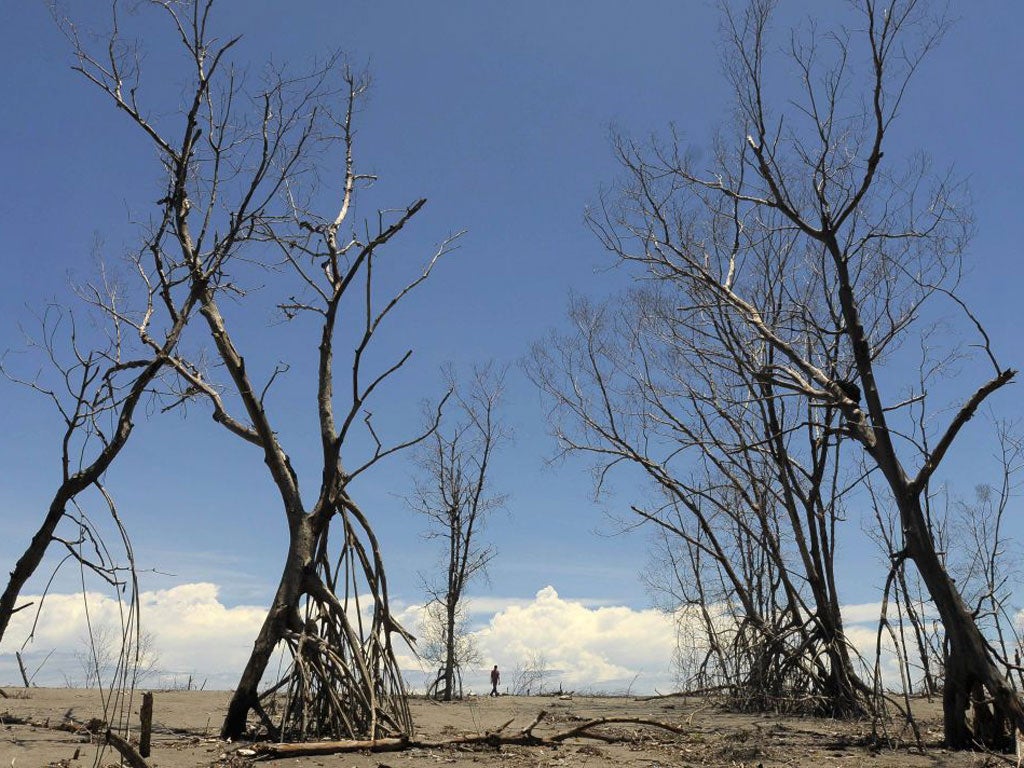
The forest of towering, dead mangrove trees stretches along the beach as far as the eye can see. As the crashing waves rise and fall, short stumps emerge and vanish beneath the Pacific Ocean. Climate change has come early to the Bajo Lempa region of western El Salvador.
A tiny rise in the sea level has, according to local people, seen about 1,000ft of the mangroves on which they depend vanish beneath the ocean since 2005. Another 1,500ft remains between the Pacific and their village, La Tirana. No one, it seems, knows how long it will take before the waves reach their homes.
But even now, the rising waters are ruining the villagers' meagre livelihood. At low tide each day, the men in this community of 22 families wade through the mud collecting punche, a local species of crab.
A full day's backbreaking work can yield two dozen crabs, which fetch around £2.50 on the local market. It is the only cash income the people of La Tirana have and they need it to buy basics such as clothing and cooking oil. For their own food, they rely on fishing and subsistence agriculture, growing corn, rice and vegetables, and rearing chickens and ducks.
"We can't take too many punche because we have to make sure that the species survives, and that there will be enough for our children," says Nahun Diaz Ramirez, the 26-year-old mayor of La Tirana. Despite the evidence before his eyes, he is finding it difficult to adjust to the fact that, on current trends, his three children aged two to five, may never get the chance to go crab-hunting.
According to El Salvador's Ministry of the Environment and Natural Resources (MARN), this country will lose somewhere between 10 per cent and 28 per cent of its coastal territories in the next century as a result of rising seas caused by climate change.
The lower figure is based on an anticipated sea level rise of 13cm and the higher figure on a rise of 110cm, the two extremes of the range predicted by some current climate modelling. Yet as both locals and the research of the United Nations' climate science task force, the IPCC, attest, the process has already started.
But the people of La Tirana, with no electricity, running water or sewerage, are far from the only vulnerable citizens of El Salvador to have their lives turned upside down. Devastating storms increasingly batter the Central American nation. Meanwhile, the ravaging of its forests has left natural drainage systems unable to cope.
After decades of indiscriminate logging, only 2 per cent of El Salvador's original forests remain. In the Western Hemisphere, only Haiti has seen a larger proportion of its forest cover destroyed. The result is that, when sudden heavy rains do occur, there are massive, sometimes catastrophic flash floods along the lower reaches El Salvador's main river, the Lempa.
"There is no doubt that the deforestation has left El Salvador even more vulnerable to climate change and the storms it is increasingly bringing," says Ricardo Navarro, director of CESTA, the national branch of Friends of the Earth.
There was only one extreme storm in each of the 1960s and 1970s, and two in the 1980s, according to data released by MARN. But in the 1990s there were four, including Hurricane Mitch in 1998, which killed thousands across Central America. In the last decade, there were eight. So far, in this decade there has already been one, a massive tropical depression in October last year, named 12E by scientists. It lasted 10 days and saw between 762mm and 1513mm of rain, depending on where in the country it was measured. The higher figure was roughly equivalent to the country's average annual rainfall in the 1970s, 80s and 90s.
"The flood destroyed my whole harvest," says Herminia Arqueta, who lives in the village of Octavio Ortiz, beside the mouth of the Lempa about a mile from La Tirana. "My house was flooded for three weeks and we had to free all the chickens and ducks, otherwise they would have died."
Worse still, that harvest of corn and rice had been financed with a $1,000 (£600) loan which she has yet to repay. Desperate, she is considering selling five of her seven dairy cows, for around £150 each. The cows provide her and her three daughters aged 11 to 18 with a vital source of nutrition. She sells what is left over, bringing in her only regular cash income, £1.60 a day.
"Of course I don't want to sell them," Ms Arqueta says as she sits outside her two-room breeze block house. "But what choice do I have if the bank insists on me repaying? Everyone else around here is in the same boat. No one can afford to pay back the loans for the 2011 harvest."
The extreme storms and devastating floods are not the only problem caused by climate change. Even moderate rains have become increasingly unpredictable, making it impossible for the country's peasant farmers to know when to sow their crops.
"We don't know when it's winter or summer," says Ms Arqueta. "We used to sow at the first rain, but now we do that and then it doesn't rain again for a long time and the whole harvest is lost. The corn dies if it does not rain for a couple of weeks."
Climate chaos is the last thing that El Salvador neeed. Among the Western Hemisphere's poorest nations and plagued by gang warfare that has seen its murder rate reach 33 times that of the UK, it has more than enough on its plate without having to worry about an internal wave of climate refugees.
Yet that is exactly what Dr Navarro and other experts fear. "In 50 years, we will be in an extremely difficult situation in El Salvador," he warns. "Our government needs to do much more to help communities adapt. The world, especially the big carbon emitters, should take note of what is happening... and slash their emissions before they find themselves in the same boat."
Travel for this story was funded with a grant from the Pulitzer Center on Crisis Reporting
Sea levels: A planet under threat
Sea levels have been rising gently around the world throughout most of the last century, according to the Intergovernmental Panel on Climate Change (IPCC), the UN's climate science task force.
Although the rise has been uneven around the globe, for various reasons including the Coriolis effect caused by the Earth's rotation, the average increase was about 1.7mm per year.
The rise is the result of two phenomena produced by global warming: thermal expansion as sea water increases in volume as its temperature rises, and flows of melt-water from the ice and snow which is vanishing across the planet from Greenland to the Himalayas. According to the IPCC, the rise comes after at least two millennia of roughly stable global sea levels. It is now expected to speed up during the 21st century as climate change accelerates.
Estimates vary but under the "A1B" scenario of future carbon emissions – based on a balanced use of different energy sources – the IPCC estimates that sea levels in the 2090s will be between 22cm and 44cm higher than 1990 levels and will continue to increase at around 4mm per year.
As the waters rise, vast low-lying coastal areas, from Bangladesh to Florida, and including El Salvador, are expected to be swept up permanently by the seas.
Join our commenting forum
Join thought-provoking conversations, follow other Independent readers and see their replies
Comments
Bookmark popover
Removed from bookmarks