Exclusive: Scientists warn that there may be no ice at North Pole this summer
Polar scientists reveal dramatic new evidence of climate change
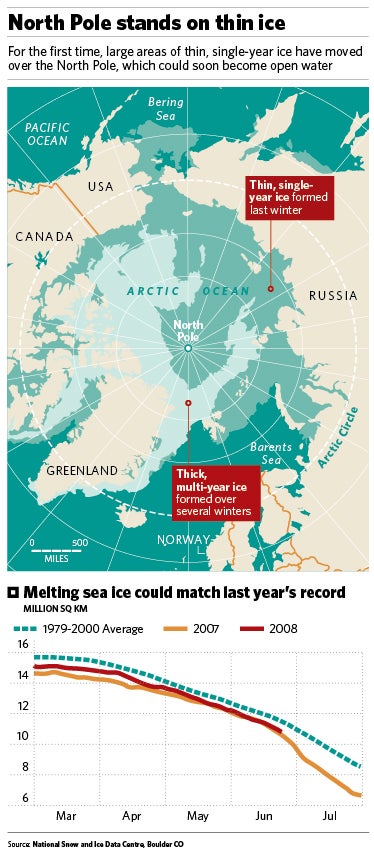
It seems unthinkable, but for the first time in human history, ice is on course to disappear entirely from the North Pole this year.
The disappearance of the Arctic sea ice, making it possible to reach the Pole sailing in a boat through open water, would be one of the most dramatic – and worrying – examples of the impact of global warming on the planet. Scientists say the ice at 90 degrees north may well have melted away by the summer.
"From the viewpoint of science, the North Pole is just another point on the globe, but symbolically it is hugely important. There is supposed to be ice at the North Pole, not open water," said Mark Serreze of the US National Snow and Ice Data Centre in Colorado.
If it happens, it raises the prospect of the Arctic nations being able to exploit the valuable oil and mineral deposits below these a bed which have until now been impossible to extract because of the thick sea ice above.
Seasoned polar scientists believe the chances of a totally ice-free North Pole this summer are greater than 50:50 because the normally thick ice formed over many years at the Pole has been blown away and replaced by huge swathes of thinner ice formed over a single year.
This one-year ice is highly vulnerable to melting during the summer months and satellite data coming in over recent weeks shows that the rate of melting is faster than last year, when there was an all-time record loss of summer sea ice at the Arctic.
"The issue is that, for the first time that I am aware of, the North Pole is covered with extensive first-year ice – ice that formed last autumn and winter. I'd say it's even-odds whether the North Pole melts out," said Dr Serreze.
Each summer the sea ice melts before reforming again during the long Arctic winter but the loss of sea ice last year was so extensive that much of the Arctic Ocean became open water, with the water-ice boundary coming just 700 miles away from the North Pole.
The diminishing polar ice
Courtesy of NOAA / NESDIS Center for Satellite Applications and Research
This meant that about 70 per cent of the sea ice present this spring was single-year ice formed over last winter. Scientists predict that at least 70 per cent of this single-year ice – and perhaps all of it – will melt completely this summer, Dr Serreze said.
"Indeed, for the Arctic as a whole, the melt season started with even more thin ice than in 2007, hence concerns that we may even beat last year's sea-ice minimum. We'll see what happens, a great deal depends on the weather patterns in July and August," he said.
Ron Lindsay, a polar scientist at the University of Washington in Seattle, agreed that much now depends on what happens to the Arctic weather in terms of wind patterns and hours of sunshine. "There's a good chance that it will all melt away at the North Pole, it's certainly feasible, but it's not guaranteed," Dr Lindsay said.
The polar regions are experiencing the most dramatic increase in average temperatures due to global warming and scientists fear that as more sea ice is lost, the darker, open ocean will absorb more heat and raise local temperatures even further. Professor Peter Wadhams of Cambridge University, who was one of the first civilian scientists to sail underneath the Arctic sea ice in a Royal Navy submarine, said that the conditions are ripe for an unprecedented melting of the ice at the North Pole.
"Last year we saw huge areas of the ocean open up, which has never been experienced before. People are expecting this to continue this year and it is likely to extend over the North Pole. It is quite likely that the North Pole will be exposed this summer – it's not happened before," Professor Wadhams said.
There are other indications that the Arctic sea ice is showing signs of breaking up. Scientists at the Nasa Goddard Space Flight Centre said that the North Water 'polynya' – an expanse of open water surrounded on all sides by ice – that normally forms near Alaska and Banks Island off the Canadian coast, is much larger than normal. Polynyas absorb heat from the sun and eat away at the edge of the sea ice.
Inuit natives living near Baffin Bay between Canada and Greenland are also reporting that the sea ice there is starting to break up much earlier than normal and that they have seen wide cracks appearing in the ice where it normally remains stable. Satellite measurements collected over nearly 30 years show a significant decline in the extent of the Arctic sea ice, which has become more rapid in recent years.
Click here to watch a video on ways to reduce carbon emissions
View all comments that have been posted about this article.
Offensive or abusive comments will be removed and your IP logged and may be used to prevent further submission. In submitting a comment to the site, you agree to be bound by the Independent Minds Terms of Service.
- Print Article
- Email Article
-
Click here for copyright permissions
Copyright 2009 Independent News and Media Limited


Reduce your global impact.
Comments
WILL BE LOTS OF HAPPY PEOPLE DROWNING AND WONDERING IF THE MONEY THEY HAVE WILL BE
ENOUGH TO SAVE THEM SELF.
REGARDS...JUAN CARLOS NUNEZ
The consuming level of all kinds of resources is only going up due to economical expansion and population increase.
However, it is 2009 and the ice is still there. In fact it is more ice.
How come we don't see a drop in ice as the carbon levels are still the same.
Who is lying to us an why?
I see this just a way to create a diversion: focus people's attention in other direction so they don't see that their lives are manipulated.
We should strive to pollute less on all levels and that is the positive aspect about this propaganda.
But from this to say that we are the main culprits is a big an erroneous leap in my opinion.
A few volcanoes make create more carbon in the atmosphere than the entire world does.
Scientists contradict themselves, information is biased and subject to interests personal and economic.
The truth is in the eye of the beholder - who do you choose to trust is not the truth.
Exclusive: Scientists get it wrong about arctic ice levels
As there is currently MORE arctic ice now than at the same times in 2007 and 2008, at the time of year when ice melt is ending, how about re-interviewing the supposed 'experts' about the current situation.
No doubt they will fall back on statements such as "the chances of a totally ice-free North Pole this summer are greater than 50:50" and "I'd say it's even-odds whether the North Pole melts out". This would almost be acceptable if their additional comments were not so catastrophe-biased.
The media is all over these 'scientists' when they make their predictions but are nowhere to be seen when the facts are at odds with their models, scenarios, predictions, guesses and beliefs.
Experts: beware of their predictions, in whatever field, esp the ones which matter. Tomorrow is proving to a highly intractable affair when it comes to laying out its offerings. Even telling us what happened yesterday is too much for most of them.
Part of the problem with a lot of people in the so called "environmental movement" is that they use platitudes and claims that have no foundation in REAL science. If Al Gore says its true, then it must be. People forget that 30 years ago he wrote a book on the impending doom of mankind due to population growth and the coming ice-age. This is POP SCIENCE BULL.
The author of the article states that "It seems unthinkable, but for the first time in human history, ice is on course to disappear entirely from the North Pole this year." This is simple a LIE, especially if he has the gall to label himself as a "science editor." He is simply stating a political agenda.
THE TRUTH is that when the Vikings colonized North America in 894 AD, Lief Ericksson and his people named GREENLAND because it was a green lush land mostly FREE OF ICE. End of story.
So, is the loss of ice from Greenland glaciers or the North Pole, the act of SUVs and the evil American economic system, or the simple natural rhythms of earths environment. Ice ages come and go and the SUN, remember that star thing in the sky, has more to do with weather that anything man can do.
Can we wreck a local ecosystem with pollution. YES and it should be prevented. But in terms of global ecosystem a single major volcanic eruption has more impact in a couple days then 100 years of SUVs.
It is time for the environmental movement to have its feet be put to the fire and to be subject to the REAL scientific method and stop using "if-then" pop science.
Oh and here is some real science for the poster "NO ICE". The displacement of water by ice is greater then the water that makes up that ice itself. Get the picture or is this too tough for you?
This is a scientific fact that is 100% undeniable. You can not simply ignore the laws of physics.
It has been tested and retested millions of times every year by middle school kids all over the US. Al Gore "IF-then" pop science will tell you that the melting ice of the north pole will cause massive floods. The truth is and it is a undeniable fact of PHYSICS, is that if the north pole melts the ocean level will go DOWN and will just as likely cause less costal flooding then we know experience.
www.ijis.iarc.uaf.edu/seaice/extent/AMSR
Of course, this does not in turn disprove a threat of a melting Arctic, but it demonstrates the foolhardiness of an over willingness to believe 'the end of the world is nigh'. (a continually recurring aspect of human nature throughout history).
But has the Independent or 'science' editor Steve Connor learned to be more cautious about simply reprinting press releases promoting global warming scaremongering? Not at all. If the headlines help to dramatise the global warming threat, than their realism needs no checking, they obviously support the 'truth'.