Extreme weather link 'can no longer be ignored'
Scientists to end 20-year reluctance with study into global warming and exceptional weather events
Scientists are to end their 20-year reluctance to link climate change with extreme weather – the heavy storms, floods and droughts which often fill news bulletins – as part of a radical departure from a previous equivocal position that many now see as increasingly untenable.
Click HERE to view graphic (74 kb)
Climate researchers from Britain, the United States and other parts of the world have formed a new international alliance that aims to investigate exceptional weather events to see whether they can be attributable to global warming caused by greenhouse gas emissions.
They believe that it is no longer plausible merely to claim that extreme weather is “consistent” with climate change. Instead, they intend to assess each unusual event in terms of the probability that it has been exacerbated or even caused by the global temperature increase seen over the past century.
The move is likely to be highly controversial because the science of “climate attribution” is still in the early stages of development and so is likely to be pounced on by climate “sceptics” who question any link between industrial emissions of carbon dioxide and rises in global average temperatures.
In the past scientists have been extremely reluctant to link a single extreme weather event with climate change, arguing that the natural variability of the weather makes it virtually impossible to establish any definitive association other than a possible general consistency with what is expected from studies based on computer models.
However, a growing number of climate scientists are now prepared to adopt a far more aggressive posture, arguing that the climate has already changed enough for it to be affecting the probability of an extreme weather event, whether it is an intense hurricane, a major flood or a devasating drought.
“We’ve certainly moved beyond the point of saying that we can’t say anything about attributing extreme weather events to climate change,” said Peter Stott, a leading climate scientist at the Met Office Hadley Centre in Exeter.
“It’s very clear we’re in a changed climate now which means there’s more moisture in the atmosphere and the potential for stronger storms and heavier rainfall is clearly there.”
Kevin Trenberth, a distinguished senior scientist at the US National Centre for Atmospheric Research (NCAR) in Boulder, Colorado, also believes the time has come to emphasise the link between extreme weather and the global climate in which it develops.
“The environment in which all storms form has changed owing to human activities, in particular it is warmer and more moist than it was 30 or 40 years ago,” Dr Trenberth said.
“We have this extra water vapour lurking around waiting for storms to develop and then there is more moisture as well as heat that is available for these storms [to form]. The models suggest it is going to get drier in the subtropics, wetter in the monsoon trough and wetter at higher latitudes. This is the pattern we're already seeing.”
The Met Office and NCAR have joined forces with other climate organisations, including the influential US National Oceanic and Atmospheric Organisation (NOAA), to carry out detailed investigations of extreme weather events, such as the vast flooding in Pakistan last year, to see whether they can detect a climate change “signal” as a likely cause.
A group of their researchers has formed a coalition called the Attribution of Climate-Related Events which is preparing a report on the subject to be published later this year at a meeting of the World Climate Research Programme in Denver. They hope in future to assess each extreme weather phenomenon in terms of its probability of being linked with global warming and then to post the result on the internet.
“There is strong evidence if you look across the world that we are seeing an increase in heatwaves and floods and droughts and extreme rainfall and extreme temperatures,” Dr Stott said.
“The evidence is clear from looking at the observational records globally that extreme temperatures and extreme rainfall are changing. But you can’t jump from that and say that a specific event is straightforwardly attributable because we know that natural variability could have played a part.
“We’ve been developing the science to be increasingly more quantitative about the links and make more definitive statements about how the risk has changed. You look sensibly about these things by talking about changing risk, or changing probability of these events.”
Dr Stott had his colleagues have already carried out studies of the 2003 heatwave in Europe, in which up to 35,000 people died of heat-related illnesses, as well as the devastating UK floods in 2000 which cost £1.3bn in insurance claims and destroyed 10,000 homes following the wettest autumn in England and Wales since records began in 1766.
In both cases, the scientists found that the contribution of man-made greenhouse gases to global warming substantially increased the risk of such extreme events occurring. The group is also investigating the exceptional warm April in Britain this year, which was the warmest since central England records were kept in 1659 and 0.5C warmer on average than the previous warmest April.
Also this year, an unprecedented number of tornadoes across the southeastern US and the flooding of major rivers such as the Mississippi and Missouri led many people to question whether they were exacerbated by global warming. In the past scientists would have been reluctant to link single weather events such as these with climate change, but Dr Trenberth believes this is wrong.
“I will not say that you cannot link one event to these things. I will say instead that the environment in which all of these storms are developing has changed,” Dr Trenberth told The Independent.
“It’s not so much the instantaneous result of the greenhouse effect, it’s the memory of the system and the main memory is in the oceans and the oceans have warmed up substantially, at depth, and we can measure that. I will assert that every event has been changed by climate change and the main time we perceive it is when we find ourselves outside the realms of the previous natural variability, and because natural variability is so large this is why we don't notice it most of the time.
“When we have things that occur usually 4 per cent of the time start to occur 10 per cent of the time, that’s when we begin to notice. The main way we perceive climate change is in changes in the extremes… this is when we break records.”
A report by the insurance company Munich Re found that 2010 was one of the worst years on record for natural disasters, nine-tenths of which were related to extreme weather, such as the floods in Pakistan and eastern Australia and heatwave in Russia, which is estimated to have killed at least 56,000 people, making it the most deadly natural disaster in the country’s history.
“This long-term trend can no longer be explained by natural climate oscillations alone. No, the probability is that climate change is contributing to some of the warming of the world’s oceans,” said Peter Höppe, author of the Munich Re report.
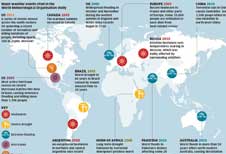
Making the connection
Tornadoes, US, 2011 More than 220 people were killed by tornadoes and violent storms that ripped through south-eastern United States in April; 131 were killed in Alabama alone. Fifteen people died in Tuscaloosa and sections of the city were destroyed.
Heatwave, UK, 2011April was the warmest since 1659, when records in England began. Sun-lovers flocked to St Ives, above, but fears of drought were raised. Rainfall in the UK that month was only 52 per cent of the long-term average.
Drought, Brazil, 2005 The Amazon region suffered the worst drought in more than a century. The floodplains dried up and people were walking or using bicycles on areas where canoes and river boats had been the only means of transport.
Floods, USA, 2005 Katrina was one of the five deadliest hurricanes in the history of the US, and it caused the destruction of New Orleans when levees were overwhelmed. Some 90 per cent of residents of south-east Louisiana were evacuated.
Join our commenting forum
Join thought-provoking conversations, follow other Independent readers and see their replies
Comments
Bookmark popover
Removed from bookmarks