Global warming makes trees grow at fastest rate for 200 years
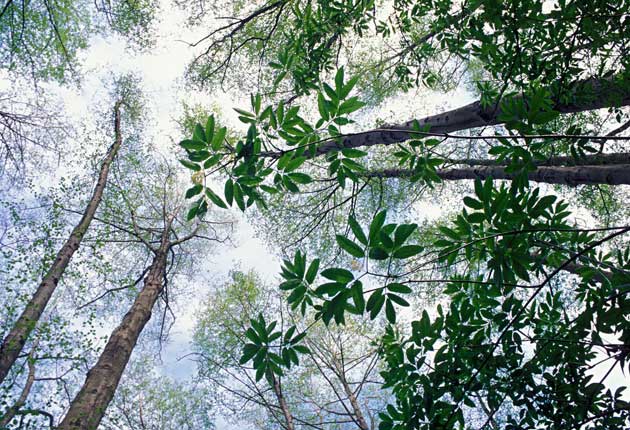
Forests in the northern hemisphere could be growing faster now than they were 200 years ago as a result of climate change, according to a study of trees in eastern America.
The trees appear to have accelerated growth rates due to longer growing seasons and higher concentrations of carbon dioxide in the atmosphere. Scientists have documented the changes to the growth of 55 plots of mixed hardwood forest over a period of 22 years, and have concluded that they are probably growing faster now than they have done at any time in the past 225 years – the age of the oldest trees in the study.
Geoffrey Parker, a forest ecologist at the Smithsonian Environmental Research Centre in Edgewater, Maryland, said that the increase in the rate of growth was unexpected and might be matched to the higher temperatures and longer growing seasons documented in the region. The growth may also be influenced by the significant increase in atmospheric carbon dioxide, he said.
"We made a list of reasons these forests could be growing faster and then ruled half of them out," Dr Parker said. The study, which is published in the journal Proceedings of the National Academy of Sciences, suggests that northern forests may become increasingly important in terms of moderating the influence of man-made carbon dioxide on the climate.
Dr Parker and his colleagues have carried out a detailed census of the trees on a regular basis since 1987, measuring every tree and sapling that has a diameter of more than 2cm (0.78in). They calculated that the forest is producing an additional two tonnes of wood per acre each year, which is equivalent to a tree with a diameter of two feet sprouting up in the space of a year.
The scientists identified a series of plots with trees at different stages of growth and found that both young and old trees were showing increased growth rates. More than 90 per cent of the tree groups had grown by between two and four times faster than the scientists had predicted from estimates of the long-term rates of growth.
The scientists said that if the trees had grown as quickly throughout their lives as they had shown in recent years they would be much larger than they are now. They based their conclusions on 250,000 measurements taken over more than 20 years.
During the same period, the scientists measured the concentration of carbon dioxide in the forest air and found that it had risen by 12 per cent. The average temperature had increased by three-tenths of a degree, and the growing season had lengthened by 7.8 days. The scientists believe that all three factors have played a role in helping the trees to grow faster.
Higher concentrations of carbon dioxide and extended growing seasons could be favourable for agriculture in some parts of the world, mainly in the northern hemisphere. The study in Maryland suggests that the extra growth in trees could help to act as a more efficient carbon "sink", which could offset the carbon dioxide being added to the atmosphere by the burning of fossil fuels.
Join our commenting forum
Join thought-provoking conversations, follow other Independent readers and see their replies
Comments
Bookmark popover
Removed from bookmarks