High hopes for Norfolk's artificial volcano in fight against climate change
The project could result in 20 balloons, each the size of Wembley Stadium, firing tonnes of dust into the air at 20km up
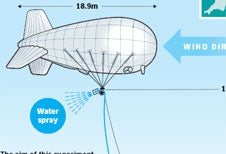
A disused airfield in Norfolk will become the focus of a controversial scientific experiment to see whether it is feasible to engineer the climate by cooling the planet with a simulated volcanic eruption.
Click HERE to view graphic (63k jpg)
Scientists and engineers plan to test the "geoengineering" idea at Sculthorpe Airfield near Fakenham next month by launching a helium-filled balloon tethered to a strengthened hosepipe which will spray tap water into the air at a height of 1km.
The project is one of the first geoengineering field trials in the world and could result in the deployment of a fleet of up to 20 giant balloons, each the size of Wembley Stadium, injecting millions of tonnes of sulphate particles at a height of 20km into the stratosphere to reflect sunlight back into space.
The researchers behind the trial say the project is designed to test the movements of the tethering system in the wind, and will not attempt to reflect sunlight or alter the climate in any way.
"It doesn't have an impact on the environment, it doesn't have an impact on the climate, it is simply a technology test. It is one of the first times that people have taken geoengineering out of the lab into the field," Matt Watson of Bristol University, who is in charge of the £1.6m study, said yesterday at the British Science Festival at Bradford University. "It's very important to us to be able to communicate what we are doing effectively and honestly to make sure everyone understands, because this is a controversial and potentially alarming subject."
Geoengineering has become a semi-respectable subject for scientists to discuss in public. However, opponents argue that it is impractical and dangerous. Even talking about it could deflect attention from the urgent need to reduce carbon dioxide emissions, the main cause of man-made global warming, they argue.
"No form of geoengineering is a replacement for reducing carbon dioxide emissions. It's very important, we are not advocating this as a good idea, we just want to know whether this is a good idea," Dr Watson said. "It's hard to imagine a situation except a dire emergency where this will be used but in order to have that conversation sensibly, we need to provide some evidence-based research."
Hugh Hunt of Cambridge University, who is leading the field test at Sculthorpe, said: "It may turn out that this whole strategy is a bad strategy, that's what we're trying to find out."
The test is part of a three-year project, Stratospheric Particle Injection for Climate Engineering (Spice), which uses knowledge gained from observations of the Mount Pinatubo eruption in the Philippines in 1991, when volcanic sulphate particles enveloped theplanet, cooling it by about 0.5C for two years.
The project, involving the universities of Bristol, Cambridge, Edinburgh and Oxford, working with engineering company Marshall Aerospace, will evaluate the type of particles in solution that could be injected into the stratosphere, how they could best be carried 20km up and what effect the spraying would have on the global climate.
Dr Hunt said that a fleet of 10 to 20 giant balloons moored over the ocean and spraying at an altitude of 20km could cool the planet by about 2C at a cost of between £5bn and £50bn. "Because this is affordable, surely we must be thinking about it," he said.
Join our commenting forum
Join thought-provoking conversations, follow other Independent readers and see their replies
Comments
Bookmark popover
Removed from bookmarks