Climate Change

Partly Sunny with Showers 8° London Hi 11°C / Lo 6°C

Hundreds of miles of ice drop from Antarctic shelf
By David Rising, Associated Press

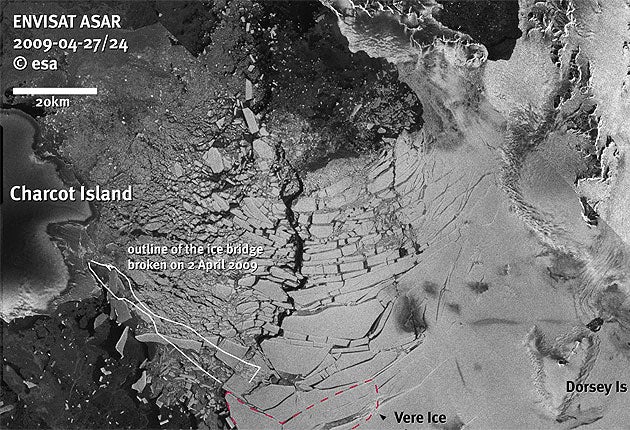
Superimposed Envisat images show margins of the collapsed ice bridge

www.esa.int

Superimposed Envisat images show margins of the collapsed ice bridge

New satellite images from the European Space Agency show massive amounts of ice are breaking away from a shelf on the western side of the Antarctic Peninsula, researchers said today.

The Wilkins Ice Shelf had been stable for most of the last century, but began retreating in the 1990s. Researchers believe it was held in place by an ice bridge linking Charcot Island to the Antarctic mainland.

But the 127-square-mile (330-square-kilometer) bridge lost two large chunks last year and then shattered completely on 5 April.

"As a consequence of the collapse, the rifts, which had already featured along the northern ice front, widened and new cracks formed as the ice adjusted," the European Space Agency said in a statement today on its Web site.

The first icebergs started to break away on Friday, and since then some 270 square miles (700 square kilometers) of ice have dropped into the sea, according to the satellite data.

"There is little doubt that these changes are the result of atmospheric warming," said David Vaughan of the British Antarctic Survey.

"The retreat of Wilkins Ice Shelf is the latest and the largest of its kind," he said, adding that "eight separate ice shelves along the Antarctic Peninsula have shown signs of retreat over the last few decades."

The Wilkins shelf, which is the size of Jamaica, lost 14 percent of its mass last year, according to scientists who are looking at whether global warming is the cause of its breakup.

Average temperatures in the Antarctic Peninsula have risen by 3.8 degrees Fahrenheit (2.5 Celsius) over the past 50 years — higher than the average global rise, according to studies.

Over the next several weeks, scientists estimate the Wilkins shelf will lose some 1,300 square miles (3,370 square kilometers) — a piece larger than the state of Rhode Island, or two-thirds the size of Luxembourg.

One researcher said, however, that it was unclear how the situation would evolve.

"We are not sure if a new stable ice front will now form between Latady Island, Petrie Ice Rises and Dorsey Island," said Angelika Humbert of Germany's Muenster University Institute of Geophysics.

But even more ice could break off "if the connection to Latady Island is lost," she said, "though we have no indication that this will happen in the near future."

In the meantime, researchers said the quality and frequency of the ESA satellite images have allowed them to analyze the Wilkins shelf breakup far more effectively than any previous event.

"For the first time, I think, we can really begin to see the processes that have brought about the demise of the ice shelf," Vaughan said.

Post a Comment

View all comments that have been posted about this article.

Offensive or abusive comments will be removed and your IP logged and may be used to prevent further submission. In submitting a comment to the site, you agree to be bound by the Independent Minds Terms of Service.

Comments

Hot air
[info]pete_from_yorks wrote:
Wednesday, 29 April 2009 at 03:57 pm (UTC)
It's a shame Christopher Booker wasn't there to see it. Maybe he could have held it back by the power of wishful thinking?
Loss of ice from Antarctic shelf
[info]jackfind wrote:
Wednesday, 29 April 2009 at 04:15 pm (UTC)
There are a number of questions which could have been adressed in this aticle such as;
Was this ice floaring or land based?
What are the consequences of loss of ice, both here, in the Arctic, and from the receding snow lines on various mountains in the Northern hemisphere?
Is James Lovelock right in his claim that the Gulf Stream is failing?
Could the present economic crisis be beneficial to the human Race through a slowdown in our ever growing demand for energy?
I'm afraid, very afraid
[info]von_mises wrote:
Wednesday, 29 April 2009 at 06:56 pm (UTC)
May I be the first to volunteer to pay whatever global taxes the elite would like me to pay to just make this problem go away; I'll gladly sign up too for one world government if this will delay in any way this global warming panic which is causing my household, if it were possible, even greater nightmares than Swine Flu.

It is of no consolation whatsoever that the area of ice lost, 330 square kilometers, is a mere 0.00002% of the total land mass of antarctica of 14 million square kilometres. Put another way, if the average human male weighs 80 kilos then the equivalent body 'loss' would be less than one tooth.
So what...
[info]bishbashbong wrote:
Wednesday, 29 April 2009 at 10:23 pm (UTC)
"There is little doubt that these changes are the result of atmospheric warming," said David Vaughan of the British Antarctic Survey.

The Ice in Antarctica has expanded 100,000 square kilometres per decade since the 1970s, according to the same British Antarctic Survey.

Do you have little doubt that this is also the result of atmospheric warming, Mr Vaughan?
Re: So what...
[info]global_changes wrote:
Friday, 1 May 2009 at 02:51 pm (UTC)
In a way it is. See Here Antarctic Ice Growing

"It seems the hole in the O-Zone layer, created by CFCs and other ozone-depleting chemicals have given the South Pole respite from global warming. But only temporarily according to the British Antarctic Survey (BAS)"

"In a new study, Turner and colleagues show how the ozone hole has changed weather patterns around Antarctica. These changes have drawn in warm air over the Antarctic Peninsula in West Antarctica and cooled the air above East Antarctica.

?Over the next 50 to 100 years, the ozone hole will heal, At the same time, greenhouse gases will rise. In next decade or so we should see sea ice plateauing and then decreasing massively if greenhouse gases continue to increase.? "

Antarctic ice shelf
[info]margaret222 wrote:
Thursday, 30 April 2009 at 06:26 am (UTC)
Impressive article. 3370 sq kms of ice shelf breaks off.

Meanwhile, taking the whole of Antarctica the ice area is more than 1 MILLION sq kms above its long term average. [ see "Cryosphere today"]

There are lies, damned lies, and statistics.
So what...
[info]ptstroud wrote:
Thursday, 30 April 2009 at 07:35 am (UTC)
The amount of ice that has been lost is a tiny, tiny percentage of the Antarctic continent and bishbashbong and margaret222 are right, the ice is expanding. This is just another doom and gloom article put out by AGW alarmists who are now fearful of their reputations as they see the predictions of their computer models falsified by just about all empirical data.
What the Independent doesn't want us to know.
[info]canadastan wrote:
Friday, 1 May 2009 at 01:48 am (UTC)
The eastern Antarctic ice is increasing.
Not surprising, it happens every year
[info]canadastan wrote:
Friday, 1 May 2009 at 02:50 am (UTC)
Somehow that's news.
'In other news t was dark last night, film at eleven...'
News stories on Wilkins shelf date back to 1993
[info]calum100 wrote:
Friday, 1 May 2009 at 09:19 am (UTC)
The imminent death of the Wilkins ice shelf back date back to 1993, a year when scientists first took an interest inn this particular ice shelf. Since 1993 scientists have confidently predicted the ice shelf's quick demise and the media have duly printed an associated alarmist headline. For the past 16 years the ice shelf reforms every winter, and every summer it breaks up again. How long has the Wilkins ice shelf being doing this? We don't know, but its annual break up always makes the news.

Mean-while over the past 30 years the Antarctic sea ice and ice shelves have grown by 1.2 million square km. That is TWICE the size of France.

Article Archive

Day In a Page

Sun | Mon | Tue | Wed | Thu | Fri | Sat

Select date