IPCC feels the heat as it is told to get its facts right about global warming
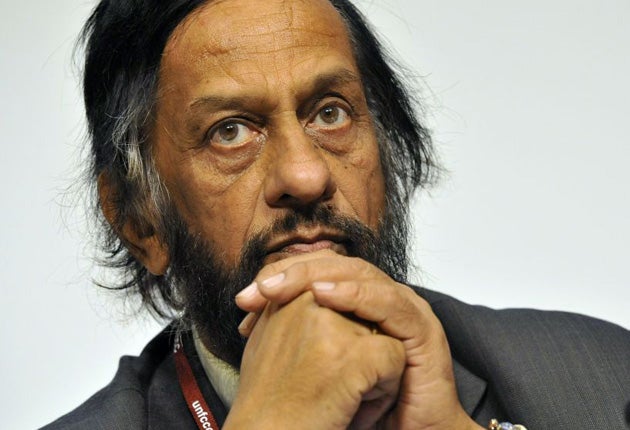
The powerful international body set up to advise governments on the effects of global warming needs a major overhaul if it is not to repeat errors that damaged its credibility and gave succour to climate change sceptics, an independent investigation has concluded.
In the latest review designed to limit the fallout from what sceptics called "climategate", the Intergovernmental Panel on Climate Change (IPCC) was told it should be much clearer in explaining that some scientific claims are more speculative than others.
And the review did nothing to lessen the pressure on the IPCC's chairman, Dr Rajendra Pachauri, who has been assailed by opponents for failing to respond properly to the revelation of errors in the panel's latest assessment report, and for also working as a consultant to energy companies. Yesterday's report did not criticise him personally, but it said that the IPCC needs a clear conflict-of-interest policy, should avoid "straying into advocacy", and should no longer allow chairmen to preside over more than one assessment report. He said he would not resign.
The IPCC was established to pull together the latest scientific work on climate change, using hundreds of volunteers drawn from the ranks of academics working in the field, and report to governments a consensus on the likely dangers facing the planet.
But a furore erupted over the IPCC's work last year when it was discovered that one of the most widely reported claims in the 2007 assessment report – that the Himalayan glaciers would be melted by global warming by 2035 – was based on a mistaken interpretation of the underlying science. The real figure should have been 2350. The report also misstated the percentage of the Netherlands which is below sea level.
Earlier reviews concluded that the errors did not come close to undermining the overall conclusions of the IPCC's work, namely that climate change is real, man-made, getting worse, and destined to have big impacts on sea levels, and therefore on human life. The assessment report cited 10,000 scientific papers and ran to 3,000 pages.
Yesterday's investigation, by an international panel of scientists called the InterAcademy Council, did not concentrate on the science but rather on the structure of the IPCC, although it had some criticism of imprecisions in the writing of the assessment report.
"Authors reported high confidence in some statements for which there is little evidence. Furthermore, by making vague statements that were difficult to refute, authors were able to attach 'high confidence' to the statements," it said. One summary for policy makers "contains many such statements that are not supported sufficiently in the literature, not put into perspective, or not expressed clearly".
Howard Shapiro, the Princeton University professor who chaired the review, said the Himalayan glacier error "did dent the credibility of the process" and "came from just not paying close enough attention to what [peer] reviewers said". The response to the discovery of the errors was "slow and inadequate", he concluded, and the IPCC should hire an executive director and communications staff to make its work more robust in future.
Dr Pachauri said he intended to continue work on the next assessment report, due to be published in 2013 and 2014. "This is a mission that I cannot shirk and cannot walk away from," he said.
Join our commenting forum
Join thought-provoking conversations, follow other Independent readers and see their replies
Comments
Bookmark popover
Removed from bookmarks