Lizards are dying out because of climate change, study says
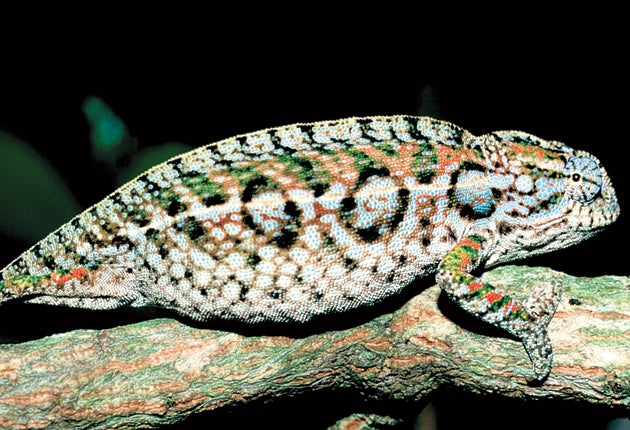
They have been around since the time of the dinosaurs and have in the past survived several global mass extinctions of species, but now lizards are at serious risk of disappearing from the face of the earth as a result of climate change, scientists said yesterday.

An international study has found that as many as 20 per cent of the 3,800 species of lizards could be extinct by 2080 if global temperatures continue to rise as predicted. In some parts of the world 12 per cent of the lizard populations that have been studied since 1995 have already disappeared – and researchers are blaming climate change.

Lizards, which include geckos, iguanas and chameleons, are often referred to as cold-blooded creatures but in fact their body temperature rises and falls with their exterior environment. They have to bask in the sun to raise their body temperature, and seek shade when it gets too warm.

Scientists fear that, in many parts of the world, temperatures have become too warm for the local lizards to be able to stay out during the hottest part of the day to catch enough food, causing the animals to weaken and die.

"The results were clear. These lizards need to bask in the sun to warm up, but it it gets too hot they have to retreat into the shade, and then they can't hunt for food," said Professor Barry Sinervo of the University of California, Santa Cruz, who led the study published in the journal Science. Other scientists have already documented an alarming loss of amphibian species – frogs, toads and newts – as a result of a complex interaction with a fungal infection and possibly climate change. But the latest study, which involved constructing a computer model to predict future extinctions, clearly points to rising temperatures alone for the decline of lizards.

"We did a lot of work on the ground to validate the model and show that the extinctions are the result of climate change. None of these are due to habitat loss. These sites are not disturbed in any way, and most of them are in national parks or other protected areas," Professor Sinervo said.

"Our research shows that the ongoing extinctions of lizards are directly due to climate warming from 1975 to the present... We thought we'd see evolution occurring in response to climate change, but instead we're seeing extinctions," he said.

"Beyond a certain point, the lizards can't adapt. We're predicting 40 per cent of local populations will go extinct and that will translate into roughly 20 per cent of species going extinct by 2080," Professor Sinervo added.

The scientists have studied some 48 species of spiny lizards at 200 sites in Mexico and found that between 1975 and 1995 some 12 per cent of the populations had gone extinct, even though their habitats had not changed noticeably. A device that could mimic the increase in body temperature of blue spiny lizards basking in the sun indicated that local temperatures had risen too high for the animals to cope.

"At the extinct sites, we found the hours they could be out foraging had collapsed. They would barely have been able to emerge to bask before having to retreat," Professor Sinervo said.

Lizard facts

Lizards are a large and diverse group of reptiles, with nearly 3,800 known species. They include geckos, chameleons and iguanas and are widely distributed around the world, but are concentrated in tropical and sub-tropical regions where high temperatures allow them to be active for long periods of time during the day all-year round.

Lizards play a critical role in the food chain, being an important food source for bigger animals such as snakes and birds, as well as controlling insect populations that might otherwise explode if left unchecked.

Most lizards are harmless to humans, with the huge Komodo dragon in Indonesia posing the greatest risk.

Independent Comment
blog comments powered by Disqus
News in pictures
World news in pictures
From the blogs

Game of Thrones ‘Second Sons’ – Season 3, episode 8

Even though there was a complete absence of our favourite odd couple Brienne and Jaime, we got anoth...

Made in Chelsea – Series 5, Episode 7

SPOILERS: Do not read this if you have not seen series 5, episode 7 of ‘Made in Chelsea’ If you had ...

Nike kit deal puts England at No 2 in the world (but which country is top?)

As England’s new football strip – made by Nike – is revealed today, new research shows the English F...

The Photography Blog: ‘Control Order House’ by Edmund Clark – Photographing our response to terrorism

Recent events in Boston have served as a painful reminder of the threat posed by terrorism. In Contr...

       
iJobs Job Widget
iJobs General

SAP SD Consultant

£475 - £476 per day + negotiable: Progressive Recruitment: SAP SD Contract Con...

Maths Teacher- Reading

Negotiable: Randstad Education Reading: Our client in Sonning Common, is looki...

Science Teacher- Reading

Negotiable: Randstad Education Reading: Our client in Sonning Common, is looki...

Special Needs Teacher in Lewisham South London

£27000 - £55000 per annum: Randstad Education London: Supply special education...

Day In a Page

'There is a battle going on inside us that is never discussed'

Masculinity in crisis?

'There is a battle going on inside us that is never discussed'
Have US shock jocks gone too far?

Have US shock jocks gone too far?

An incendiary remark from Rush Limbaugh may be the beginning of the end for outspoken right-wing US broadcasters
The ‘Beverly Hills’ of Surrey pays more income tax than big cities of the North

The ‘Beverly Hills’ of Surrey

Elmbridge pays more income tax than big cities of the North
Heavenly Bodies

Heavenly Bodies

Michael Landy's artistic marriage made in heaven... and hell
'He will always be a friend': Jackie Stewart backs Polanski

'He will always be a friend'

Jackie Stewart backs Roman Polanski
The price of pacifism: Refusing to go to war is finally being recognised as a brave act

The price of pacifism

From the Second World War refusenik to the 19-year-old Israeli, Holly Williams talks to five people who risked shame and suffering to take a stand as conscientious objector.
'It was mass hysteria': Jason Isaacs on groupies, theatre bores and snogging James Bond

Jason Isaacs: Groupies, theatre bores and James Bond

To millions, Jason Isaacs is one of Harry Potter's arch enemies – but his wife prefers him as a Scottish TV detective.
Notes from a small island: Is Sealand an independent 'micronation' or an illegal fortress?

Sealand: 'Micronation' or illegal fortress?

Thomas Hodgkinson spent a week at the tiny platform off the Suffolk coast to find out.
Not a bad bone: Mark Hix cooks with cutlets and ribs

Mark Hix cooks with cutlets and ribs

If you ignore cutlets and ribs, you'll risk missing out on some delicious and easy meals, says our chef.
The experts' guide to summer: From getting fit for the beach to recreating that Olympic buzz

The experts' guide to summer

From getting fit for the beach to recreating that Olympic buzz
Sex, drugs and fast cars: The legend of James Hunt has set Hollywood hearts racing

Legend of James Hunt has set Hollywood hearts racing

Early glimpses of Ron Howard's film Rush suggest it will portray Hunt as a high-living lothario, with an insatiable appetite for partying.
Macklemore: 'I don't have moderation when using drugs and alcohol. It was hurting my life'

Macklemore: 'I don't have moderation'

The next Vanilla Ice or the next Eminem? Macklemore doesn't have a record contract – but he does have the UK's biggest-selling single of the year.
Don't be shy: Bill Granger's Sri Lankan recipes

Don't be shy: Bill Granger's Sri Lankan recipes

Sri Lankan cuisine is light, sunny, wonderfully spiced – and so easy to cook from scratch. Just as soon as you've broken into the coconut, that is.
Sir James Dyson’s latest project: Cleaning up hospitals

Sir James Dyson’s latest project: Cleaning up hospitals

Doctors are hailing the revamp of a Bath neonatal unit, where babies sleep more and feed better, as the model for patient care
One man returns to Argentina's town that drowned

One man returns to Argentina's town that drowned

Epecuen was submerged under 10 metres of water in 1985. Now the floods have gone – and 83-year-old Pablo Novak has moved back in