Million acres of Guyanese rainforest to be saved in groundbreaking deal
A deal has been agreed that will place a financial value on rainforests – paying, for the first time, for their upkeep as "utilities" that provide vital services such as rainfall generation, carbon storage and climate regulation.
The agreement, to be announced tomorrow in New York, will secure the future of one million acres of pristine rainforest in Guyana, the first move of its kind, and will open the way for financial markets to play a key role in safeguarding the fate of the world's forests.
The initiative follows Guyana's extraordinary offer, revealed in The Independent in November, to place its entire standing forest under the protection of a British-led international body in return for development aid.
Hylton Murray-Philipson, director of the London-based financiers Canopy Capital, who sealed the deal with the Iwokrama rainforest, said: "How can it be that Google's services are worth billions but those from all the world's rainforests amount to nothing?" The past year has been a pivotal one for the fast- disappearing tropical forests that form a cooling band around the equator because the world has recognised deforestation as the second leading cause of CO2 emissions. Leaders at the UN climate summit in Bali in December agreed to include efforts to halt the destruction of forests in a new global deal to save the world from runaway climate change.
"As atmospheric levels of carbon dioxide rise, emissions will carry an ever-mounting cost and conservation will acquire real value. The investment community is beginning to wake up to this," Mr Murray-Philipson added.
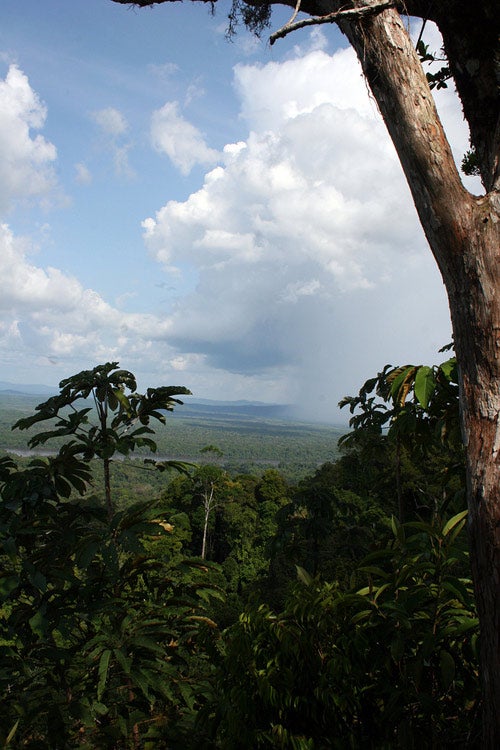
Guyana, sandwiched between the Latin American giants Venezuela and Brazil, is home to fewer than amillion people but 80 per cent of its land is covered by an intact rainforest larger than England. The Guiana Shield is one of only four intact rainforests left on the planet and at its heart lies the Iwokrama reserve, gifted to the Commonwealth in 1989 as a laboratory for pioneering conservation projects.
Iwokrama, which means "place of refuge" in the Makushi language, is home to some of the world's most endangered species including jaguar, giant river otter, anaconda and giant anteater.
Guyana's President Bharrat Jagdeo, a former economist, has appealed for state and private sector help for the country to avoid succumbing to the rampant deforestation currently blighting Brazil and Indonesia, in an effort to raise living standards in one of Latin America's poorest countries.
"Forests do much more for us than just store carbon ... This first significant step is in keeping with President Jagdeo's visionary approach to safeguarding all the forests of Guyana," said Iwokrama's chairman, Edward Glover.
The deal, drawn up by the international firm Stephenson Harwood, is the first serious attempt to pay for the ecosystem services provided by rainforests.
"We should move beyond emissions-based trading to measure and place a value on all the services they provide," said Mr Glover.
In addition to providing shelter to half the world's terrestrial species and one billion of the earth's poorest people, forests such as Iwokrama act as pumps, drawing water from the Atlantic Ocean inland to the Amazon and Guiana Shield where they help to seed clouds and deliver moisture over vast distances.
The Amazon generates the rain that falls on the vast soya estates of Sao Paulo, helping to make Brazil the second biggest agricultural exporter in the world.
Guyana's attempt to secure its entire standing forest has received the backing of the British environment minister Phil Woolas and Downing Street has told The Independent that it is "considering the offer". President Jagdeo met with Gordon Brown on the sidelines of a recent Commonwealth Summit in Uganda where they discussed the proposal. The UN road map to a deal to replace the Kyoto protocols foresees payments from wealthy climate-polluting nations to developing countries to compensate for potential income lost through avoiding deforestation. But there are fears that this formula may simply displace the demand for timber and cheap agricultural land.
Andrew Mitchell, head of the Global Canopy Programme, an alliance of rainforest scientists, said: "The decision on forests at December's conference in Bali is a major step in tackling climate change but it fails to reward countries such as Guyana that aren't cutting down their forests."
Join our commenting forum
Join thought-provoking conversations, follow other Independent readers and see their replies
Comments