Sea levels rising too fast for Thames Barrier
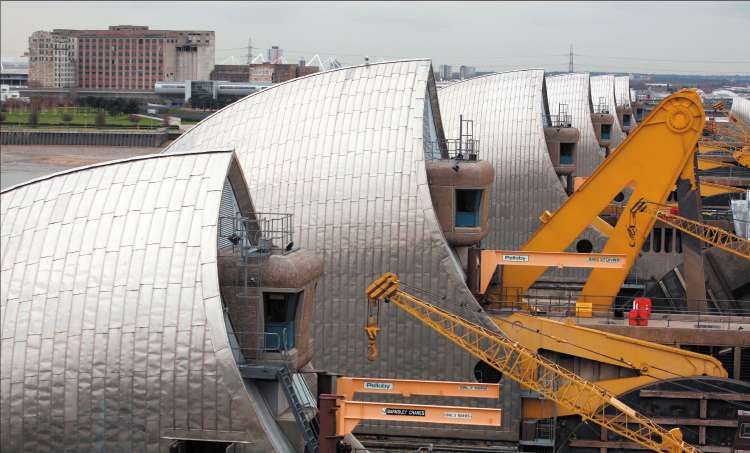
A fear that sea levels will rise far faster than predicted this century has led to a revision of the plan to protect London from a devastating flood caused by the sort of storm surge in the North Sea that resulted in the closure of the Thames Barrier yesterday.
It was the 108th time that the barrier had to be closed since it became operational in 1982 but scientists are concerned that rapidly rising sea levels could significantly shorten the expected lifespan of one of the world's biggest anti-flood structures.
When the Thames Barrier was being designed in the 1970s, global average sea levels were rising at about 1.8 millimetres a year and global warming was not seen as a threat, but in the past 15 years the rate has nearly doubled to about 3.1mm a year and many scientists expect it to accelerate still further.
Sea levels are rising even faster in south-east England because of local effects, such as land sinking, but officials for the Environment Agency said that the barrier is designed to cope with an 8mm-per-year rate of sea level increase yet still meet its design specifications – such as coping with a one-in-a-thousand-year storm surge by 2030.
"The defences we have at the moment allow for sea level rise and the tidal levels we're expecting by 2030. That is still some time away. However, it takes time to research, design and build tidal defences, so we're already planning how we can manage increasing flood risk in the estuary," said a spokesman for the Environment Agency. Experts working on the Thames Estuary 2100 project, who are writing a report on what needs to be done to protect London in the next 100 years, believe that past assessments on the sea level rise this century are too optimistic and have devised far higher worse-case scenarios.
A report on the options open to the Government if sea levels rise faster than expected is due to be completed next year. If sea levels are forecast to rise by two metres or more, a bigger and more expensive barrage will have to be built and raised permanently.
Under the Government's estimate for a rise of less than one metre, the Thames Barrier will meet its maximum preferred closure rate of 70 times a year by about 2082. Under the extreme "high plus plus" scenario of TE2100, which envisages a four-metre rise in sea level, this limit will be reached in the early 2020s.
Few experts believe that sea levels will rise this fast in the coming century, although they accept that this depends on the rate at which ice sheets in Greenland and west Antarctic melt or move in to the sea. Most climate specialists believe that the current predictions of a maximum 59cm rise by 2100 made by the Intergovernmental Panel on Climate Change are likely to be significantly underestimated.
On current, outdated forecasts the barrier is likely to be closed up to 30 times a year by 2030 – compared with an average closure rate of five times a year over the past quarter century.
The Thames Barrier protects about £80bn worth of buildings and capital infrastructure in London. Some 1.25 million people live or work in the at-risk area.
Join our commenting forum
Join thought-provoking conversations, follow other Independent readers and see their replies
Comments
Bookmark popover
Removed from bookmarks