Solution to the carbon problem could be under the ground
Hope for the fight against climate change as study finds greenhouse gas can be buried without fear of leaking
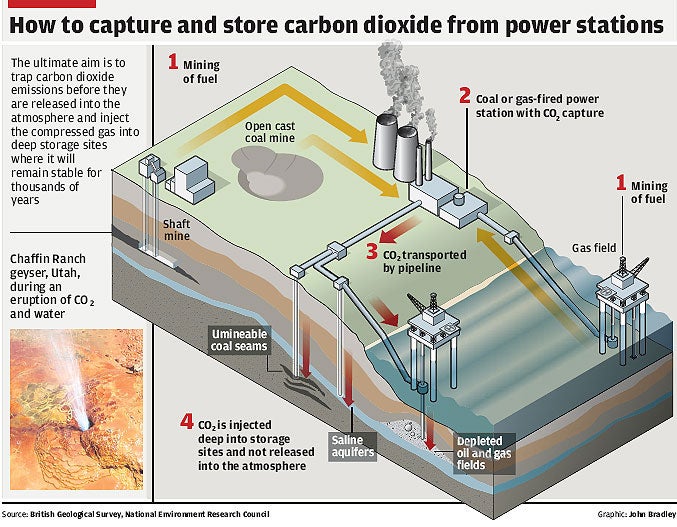
Carbon dioxide captured from the chimneys of power stations could be safely buried underground for thousands of years without the risk of the greenhouse gas seeping into the atmosphere, a study has found.
The findings will lend weight to the idea of carbon capture and sequestration (CSS) – when carbon dioxide is trapped and then buried – which is being seriously touted as a viable way of reducing man-made emissions of carbon dioxide while still continuing to burn fossil fuels such as oil and coal in power stations.
There are two substantial problems with CCS. The first is how to trap carbon dioxide efficiently in power-station emissions and the second is how to ensure that the underground store of the gas does not leak back into the atmosphere and so exacerbate the greenhouse effect and global warming.
In seeking to answer the second question, scientists looked at natural underground reservoirs of gas. They found that carbon dioxide trapped underground had been stable for possibly millions of years because it dissolves harmlessly in subterranean stores of water which do not appear to have leaked any substantial quantities of the gas back into the atmosphere.
The researchers believe the study shows that it will be possible to inject vast amounts of carbon dioxide from power stations into deep underground reservoirs where it will dissolve in water and remain undisturbed for at least as long as it will take for mankind to completely abandon fossil fuels and generate clean, carbon-neutral electricity.
Stuart Gilfillan of the University of Edinburgh said: "The study shows that naturally stored carbon dioxide has been safely stored for millions of years, which means that these sort of storage timescales should be achievable for the deliberate sequestration of the gas.
"It suggests that underground storage of carbon dioxide, in the correct place, should be a safe option to help us cope with emissions until we can develop cleaner sources of energy not based on fossil fuels," Dr Gilfillan said.
The study, published in the journal Nature, was based on an analysis of the chemical isotopes of helium and carbon dioxide in nine natural gas fields in North America, Europe and China. These gas fields have filled with carbon dioxide for many thousands or millions of years as it seeps from even deeper sources resulting from either volcanic activity or the heating of carbonate rocks.
The ratio of the two isotopes in the gas fields can tell the scientists whether any substantial quantities of carbon dioxide have seeped out of these underground sites during the period of time that they have filled up with gas.
Professor Chris Ballentine of Manchester University, who took part in the study, said that the isotopic technique will also be invaluable for further research, particularly when engineers begin carbon sequestration.
"The new approach will be essential for tracing where carbon dioxide captured from coal-fired power stations goes after we inject it underground – this is critical for future safety verification," Professor Ballentine said.
One of the reasons why the carbon dioxide remains trapped in the nine natural gas fields studied by the researchers could be down to physical changes occurring after its dissolution in water.
Dr Gilfillan said that when carbon dioxide dissolves in water the solution becomes denser than ordinary water and so sinks. This feature may have helped to keep the carbonated water underground for a long time, he said.
"We already know that oil and gas have been stored for millions of years and our study clearly shows that carbon dioxide has been stored naturally and safely in underground water in these fields," he said.
"It's good news in terms of the understanding of the system of carbon dioxide storage. It means that what actually happens in the natural storage of carbon dioxide suggests that it is possible to achieve the 10,000-year storage widely quoted as being necessary for effective carbon sequestration," he added.
There were initially fears that injecting carbon dioxide into the ground could simple result in it bubbling to the surface like a source of carbonated mineral water, releasing the gas into the atmosphere. The scientists also found that the underground carbon dioxide would not tend to form minerals and so form immovable solids. Mineral deposits block pores in rock, limiting the size of the overall carbon sink.
"It's bad news in the sense that mineralising the carbon dioxide would make it even more stable. But the good news is that mineralisation would have limited the amount of carbon dioxide that could be pumped into any one reservoir," Dr Gilfillan said.
Barbara Sherwood Lollar, a geologist at the University of Toronto, said that it was important to understand how carbon dioxide was stored in natural underground reservoirs if the problems of long-term storage of carbon dioxide were to be solved.
What we found was remarkable. At sites throughout the world, we found that the major way carbon dioxide is stored is by dissolution into the underground water, rather than by mineral trapping," Dr Sherwood Lollar said.
However, even if the sequestration part of the equation is solved, there is still the major problem of how to capture carbon dioxide emitted by power stations efficiently and cheaply.
View all comments that have been posted about this article.
Offensive or abusive comments will be removed and your IP logged and may be used to prevent further submission. In submitting a comment to the site, you agree to be bound by the Independent Minds Terms of Service.
- Print Article
- Email Article
-
Click here for copyright permissions
Copyright 2009 Independent News and Media Limited


Reduce your global impact.
Comments
CH4 + O2 => CO2 + 2H20
Obvious to who? Can you please provide us with some names of people who have published reputable, peer reviewed work concluding that "carbon dioxide has no significant influence on climate"?
Or are we just supposed to take your word for it?
Also radiosonde and satellite studies over the past 50 years have conclusively shown that there is no HOT SPOT in the atmosphere - no HOT SPOT no radiative forcing.
The AGW hypothesis has been denied a physical cause and effect.
The only way that the AGW hypothesis can stand this test of criticism is for it to become dogma.
Man-made global warming is pseudo-science that borders on the religous. It is little wonder it's adherents are zealots. No scientific test can dent their faith.
Biochar seems like the way to go. I calculated that all the "excess" CO2 in the atmosphere would be equivalent to a 2mm layer of charcoal over the Earth's surface - or to converting a sixth of our arable land into Terra Preta with 50cm of charcoal. A big project, to be sure, but it could certainly be done on the cheap. (Full calculations at www.abrazohouse.org/?p=237.)
The matter is becoming so serious that one hundred prominent scientists have signed a open letter to Obama who is absolutely sold on the man made global warming hypothesis and is supporting policies that will seriously damage US industry and its economy. This letter can be found at: http://climatesci.org/2009/03/31/open-l
"All the climate models assume that the increase in atmospheric water vapour caused by carbon dioxide heating leads to a positive feedback mechanism resulting in even higher temperatures. In fact without such a feedback mechanism there can be no serious warming and no tipping point. This assumption is now being challenged experimentally and theoretically."
What? Not only is this not right, it's not even wrong. I have to assume that ptstroud has mangled his thoughts here somehow.
Water vapour is a greenhouse gas. The amount of water vapour in the atmosphere depends upon the average temperature of the atmosphere (warmer = more vapour). Therefore if the atmosphere warms (however that warming occurs), the percentage of water vapour will increase, it's contribution to the greenhouse effect will increase also and this enlarged greenhouse effect will, in turn, cause more warming to occur. That is the textbook definition of a positive feedback and it is utterly uncontroversial that this is occurring. Indeed if it didn't work like this then the last ice age would not have ended and I would be typing this post from underneath an extremely large glacier.
"...there has been no warming trend for a decade..."
False. This has been a popular talking point for several years now, but it only works if you are willing to cherrypick your start year (1998), ignore the inconveniently hot 2005 and then refuse to do any kind of trend analysis. In fact the most recent 10-year trend in the global surface temperature record shows that temperatures are still increasing (+0.125K/decade). This is not a statistically significant result however (10 years is not long enough to resolve signal from noise in this series), so it is better to use a 30-year sample of data instead - this trend is also positive (+0.16K/decade for the period 1979-2008) and *is* statistically significant.
"even though their codes predict continuous warming"
False. No-one predicts a continuous, monotonic increase in the earth's temperature as a result of AGW and all of the computer model realisation runs feature extended periods of relative (or even absolute) cooling in the global temperature series that they project. The fact that 2008 was sufficiently below trend that it was only about as warm as 2000 was, is completely unremarkable to a climate scientist.
"that the predicted, and essential hot spot in the upper tropical troposphere just does not exist"
This became a favourite talking point last year after David Evans wrote an op-ed about it in 'The Australian'. It is wrong in two different ways.
Firstly the tropospheric hot spot is not a prediction that derives from AGW theory, it is a consequence of the behaviour of the moist adabiat and, as such, the hot spot should appear any time that there is surface warming (and irrespective of the cause of that warming). Consequently if it was confirmed that there was no tropospheric hot spot at the same time that we have verified surface warming, this would indicate that our understanding of how the moist adabiat works is wrong in some way. Such a result would be big news in atmospheric physics, but it would have no implications for the correctness of AGW theory.
Secondly however, it is incorrect to say that the hot spot does not exist - you can only say that it has not been detected (and even that assertion is debatable). Recent work (Allen & Sherwood, Nature Geoscience 1 (2008)) uses the windspeed data (which is collected at the same time as the temperature data by the radiosonde stations that are used to monitor the troposphere) in order to get a better estimate of how accurate the temperature readings are. Their results reinforce long-standing suspicions that the absence of a hot spot in the data is an artifact of the detection network (that is, an error) rather than an actual physical fact. Work is ongoing in this area to try and improve the quality of the radiosonde network in order to constrain these errors, but the smart money says that once this has been done a hot-spot will be found.
[tbc]
In addition, the storage capacity in most depleted natural gas reservoirs is very finite. Recent estimates of such gas fields in Germany, suggested that they would have only two years before they were full, and UK has far few field which would be candidates for such emplacement
As carbon dioxide, water and heat (all by products of energy generation) are important components of plant growth, perhaps using them to power greenhouses in the vicinity of energy generation stations would be an alternative. Why waste such valuable resources by burying or releasing them to the atmosphere? This is especially relevant to water vapour which is a more potent greenhouse gas than carbon dioxide.
To continue to portray carbon as some kind of monster that will destroy all mankind is insanity and this be the reason why:
Carbon is a unique element because with hydrogen, oxygen, nitrogen and other elements it can form a large and varied amounts of compounds. There are close to Ten Million known carbon compounds, many thousands of which are vital to life processes.
To believe that carbon is a demonic element and that carbon dioxide is an evil, the Devil's own brew, is a retreat into fantasy.
Over what to do about climate change, there certainly should and must be a public debate. Over climate change itself, there can't, because most people simply aren't qualified to offer an opinion. Not that that stops people like the previous poster.
Once this technology is installed the fuel is free. That is why it has not happened yet. The energy corporations can own it, control it, manipulate it, or price gouge off it.
Media Lens have a very good riposte to 'fixes' like CCS:
http://www.medialens.org/alerts/08/0809
The debate in science happens in the peer-reviewed literature. Why are the hundreds of scientists who have empirical data which falsifies the predictions of AGW theory not publishing it?
The scientist whose work overturned AGW would be cast-iron certainty for a Nobel - a Wegener for the 21st century. Surely there is one out of the hundreds you claim are out there who has the ambition to shoot for such a prize?
Regards
Luke
Doubtless this is true for many of them (although not, I fear, for the Orgone guy) - but apart from Lindzen, Douglass and Christy none of them have any record of publication in the relevant literature.
Why should I pay any heed to what (say) a professor of marketing or a nuclear engineer or a materials scientist has to say about the significance of the recent temperature record or the utility of GCMs?
Regards
Luke
You are absolutely spot on about these Warmers. They have no counter argument. All that they have in their quiver is abuse and name calling. You are either in the pocket of Big Oil or a Tobacco Scientist or know nothing at all. Pathetic.
The reason for this post is that you might be interested in the following paper titled
"Geologic Global Climate Change"
Author: Nasif Nahle
http://www.biocab.org/Carbon_Dioxide_Ge
I am sure you will find this paper very interesting.
Besides......... will we next be expected to all wear masks to capture what we, and every mammal on earth, exhale as part of being alive.??....
They assume while CO2 has been safely stored for millions of years in undergrround deposits together with oil/gas, it should be safe to inject CO2 back into those deposits. Well, have you ever heard of an oil/gas deposit that was being emptied without series of earthquakes happening in the proces? That means fractures are formed. And fractures can be the pathway for explosive releases of CO2. It will certainly be possible in some cases, but I doubt it can generally be considered safe.
Norwegian research has shown that the mineralisation would happen over hundreds if not thousands of years. Reinjection would happen fast, so the blocking by mineral deposits in the pores would be a neglectable problem anyway.
The dissolution will happen, no doubt, but to say that this happens throughout the world, seems a blatant exaggeration. That would mean that they would have done practical experiments and actually injected CO2 back in empty deposits and see what reactions would occur. Obviously, they haven't done so, so in the best case they have a nice, new theory which would need lots and lots of further testing.
Wouldn't it be faster, cheaper and more sensible to cut out all fossil fuels fast, and convert to solar, geothermal, tidal. wind and hydro power!? We need to make the conversion anyway, so why investing in prolonging its deathstruggle...????
We need to get away from narrow-focus solutions, that only address one issue. We need more solutions that address several issues at once, sustainably.
Mark E. Capron, Professional Engineer
But if you want to pay the oil companies to do what they would do anyway, fill your boots.
Isn't it more economic to inject steam or hot water into nearly empty wells, increasing the pressure dramatically while lowering the viscosity? Just a question, I am not an oil geologist, more into mineralogy and magmatic geology.
Paul Roberts,
Lake Cathie
NSW
Australia
But we don't need coal to produce electricity. Especially Australia doesn't need fossil fuels. You have plenty of desert areas where you can produce electricity by harvesting the energy of the sun.
The only reason you don't, is because of the interests of a specific kind of industry which has no concerns about the future. Easy money, fast money. That's all they care about. They are the cancer in our society. You need to get rid of them! There is no viable future for any society that hangs on to non-sutsainables...